

Euphoberia was a Late Carboniferous millipede with forked spines along its trunk. The Mazon Creek fossils of Illinois include adult material and two nodules containing groups of juveniles. The latter preserve different stages of growth within a narrow range of body size.
Quick facts
| Group | Diplopoda, Euphoberiidae |
|---|---|
| Age | Late Carboniferous |
| Type species | Euphoberia armigera |
| Genus established | Fielding Meek and Amos Worthen, 1868 |
| Key locality | Mazon Creek, Illinois, USA |
| Adult length | Approximately 8–15 cm in the diagnosis of the genus |
What can the fossils tell us?
They occur with shorter projections in a characteristic pattern. The shape alone leaves the animal's defensive behaviour uncertain.
Ring counts indicate different growth stages even among similar-sized specimens.
The fossils support aggregation as one interpretation. They do not reveal what brought the animals together.
The type material and its spines
Fielding Meek and Amos Worthen described E. armigera in 1868 from the coal-bearing strata of Grundy County, Illinois. One syntype from Mazon Creek is FMNH UC 19703. A later diagnosis put adult members at about 8–15 cm. The larger material historically named E. major was subsequently placed in Acantherpestes.
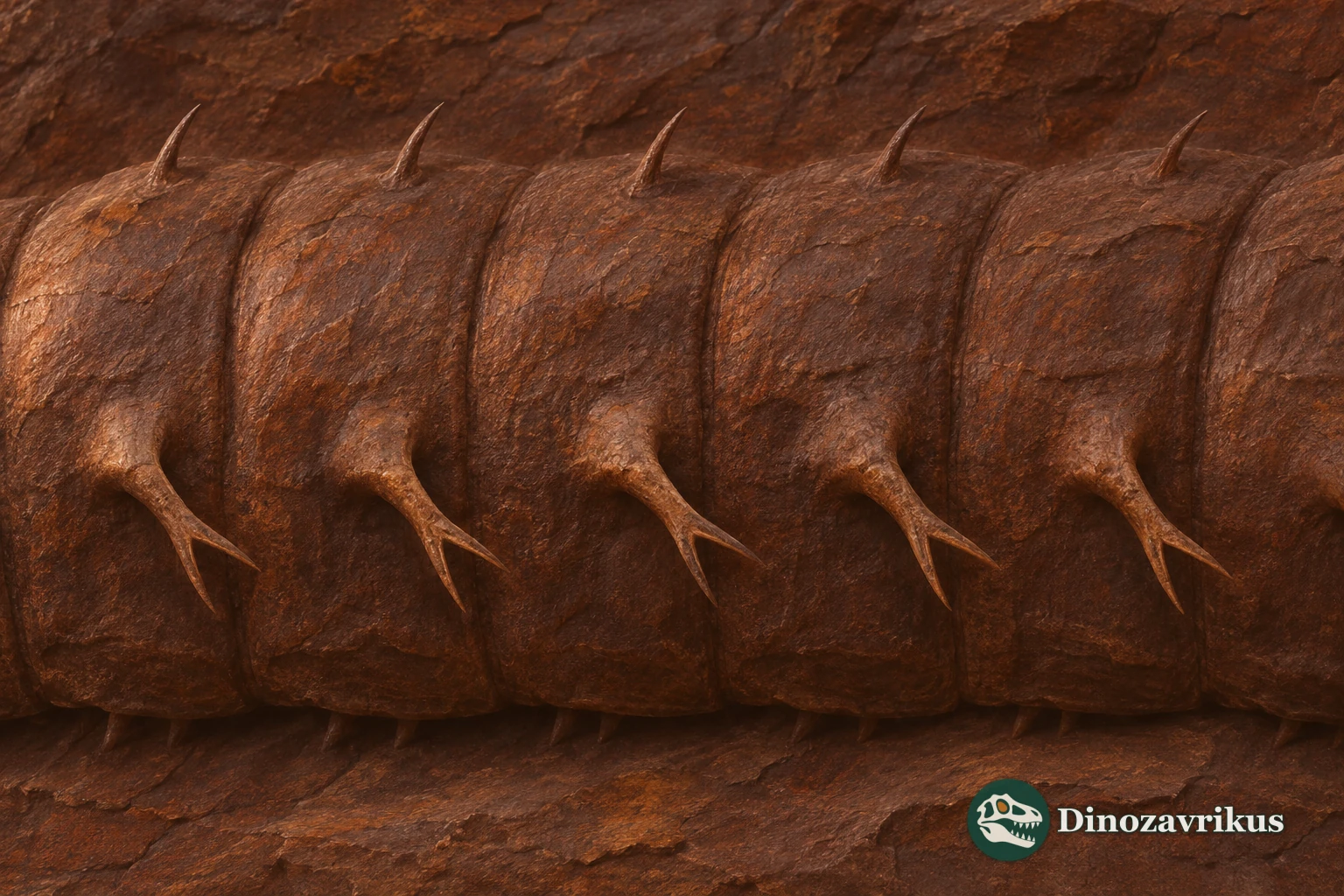
A typical trunk ring carried spines along the back and paired forked projections at the sides. In suitable fossils small jointed legs are visible underneath. The cylindrical body and its spines were quite different from the broad body of the much larger Carboniferous arthropod Arthropleura.
Juveniles in ironstone
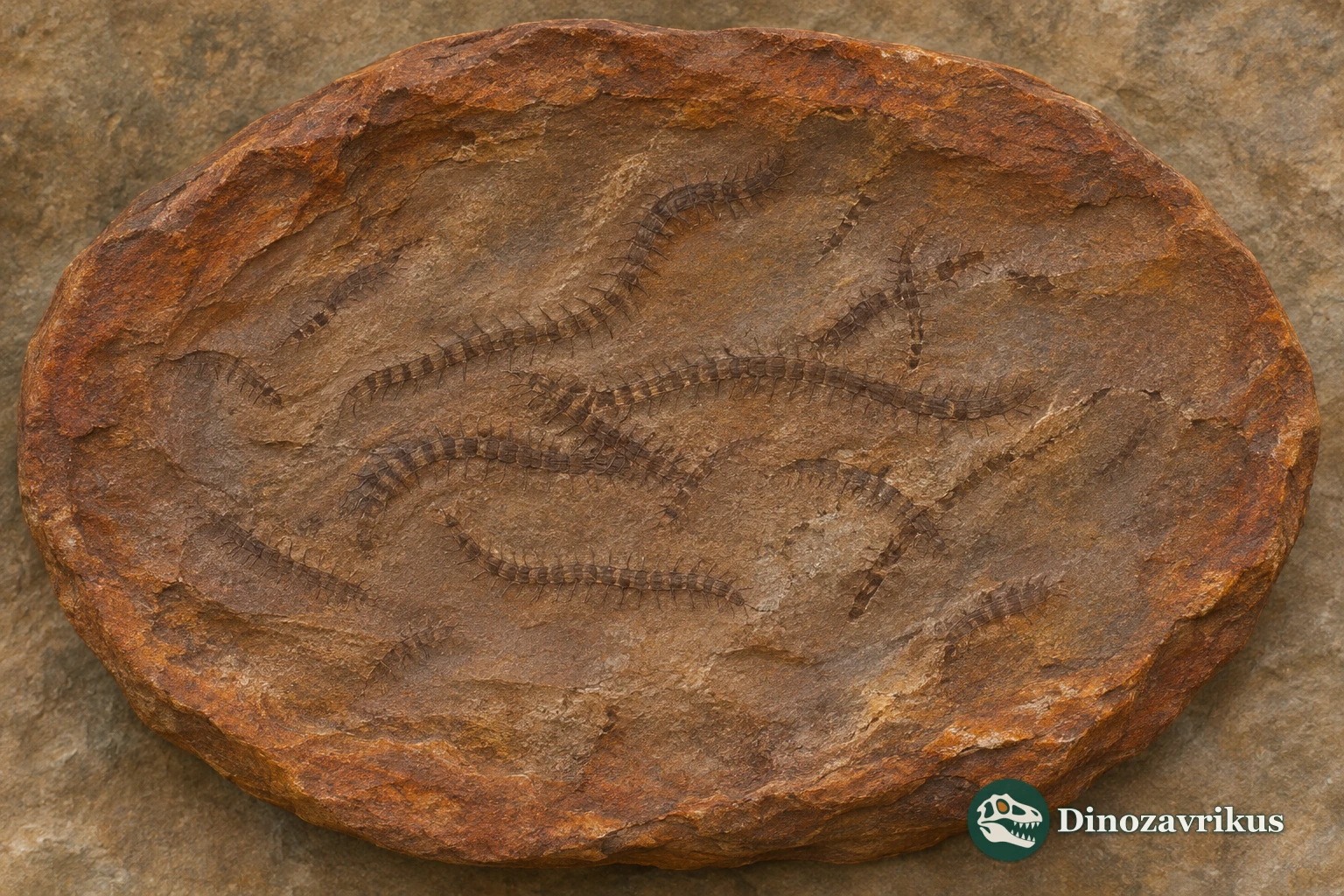
Heather Wilson described two ironstone nodules from the Braidwood fauna at Mazon Creek, each containing numerous juvenile Euphoberia. Their lengths are similar, but their numbers of rings show that the group included individuals at different developmental stages.
Compared with adults, the juveniles had proportionally shorter spines and fewer simple eyes. A series of reduced hind rings carried no legs. Some characters used to separate adult species change during this early growth, so the juveniles were identified only to the genus.
An aggregation before burial?
Some juvenile fossils lie nearly parallel, while other impressions cross their neighbours. Wilson proposed that the fossils came from a group that had formed before being washed into the delta. Their preservation provides a record of juveniles together, with interpretation needed to infer what happened before burial.
Wilson suggested that grouping might help defend juveniles while their spines were still small. Related fossil millipedes preserve openings comparable to defensive pores in modern forms. The nodules cannot establish what secretions Euphoberia produced or how the juveniles used them.
Frequently asked questions
What species is Euphoberia based on?
Euphoberia armigera, described from Illinois.
What shape were the lateral spines?
They were forked and curved forwards. Their relative length was shorter in the juveniles.
Why did similarly sized individuals have different numbers of rings?
The juveniles represent several developmental stages. Their overall length alone did not resolve the difference.
Do the nodules prove the juveniles defended themselves together?
They preserve groups of juveniles. Collective defence is a proposed explanation for aggregation.