

Europejara olcadesorum is known from a partial skull found at Las Hoyas in Spain. Its clearest feature is a deep bony crest beneath the lower jaw, with a rear edge that curves backwards. The jaws are toothless, but no body or wings were found. Wingspan and diet therefore rely on comparisons rather than direct evidence.
Quick facts
| Scientific name | Europejara olcadesorum, Vullo and colleagues, 2012 |
|---|---|
| Holotype | MCCM-LH 9413, jaws and parts of the skull |
| Locality | Las Hoyas, Cuenca Province, Spain |
| Rock and age | La Huérguina Formation, late Barremian |
| Lower jaw | 230 mm preserved; total length estimated at 255 mm |
| Bony crest | Deep lower-jaw crest with a recurved rear margin |
| Wings and food | Wingspan about 2 m by analogy; diet unconfirmed |
What can the fossils tell us?
The jaws of MCCM-LH 9413 have no teeth. This is a direct anatomical observation, but it does not identify a particular food.
A deep bony crest under the lower jaw has a backward-curving rear edge. The full upper crest and soft tissues are unknown.
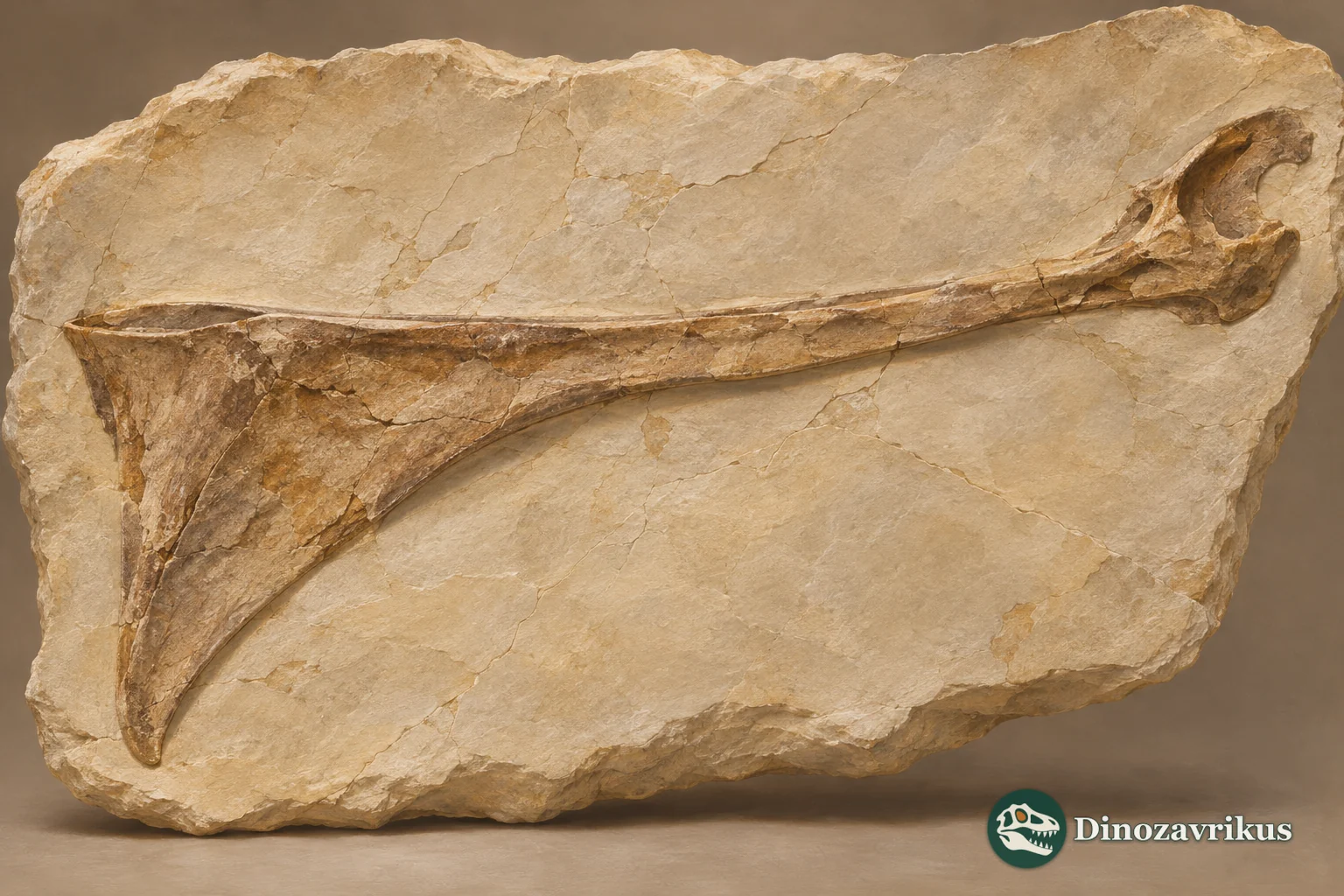
Bones lie on a main limestone slab and its counterpart. The postorbital region is crushed, while the body and wings are absent.
Las Hoyas limestone formed in an Early Cretaceous wetland system. Its flora does not show food inside Europejara.
A skull split between limestone slabs
Romain Vullo and colleagues named Europejara olcadesorum in 2012. The genus combines Europe with Tapejara; the species honours the Olcades, an ancient people of the Cuenca area. Holotype MCCM-LH 9413 is kept in the Museo de las Ciencias de Castilla–La Mancha. Its jaws and bones behind the orbit are preserved on a laminated limestone slab and counterpart. Ultraviolet light helped examine one surface; acid preparation exposed delicate bone on the other.
The postorbital skull is crushed and displaced, but the lower jaw is better preserved. It measures 230 mm as preserved and was reconstructed at about 255 mm in total. Those are jaw lengths, not body lengths. The type contains no wings, legs or trunk. The upper head is incomplete, so a full upper crest in art cannot be copied directly from this specimen.
What makes the lower jaw distinctive
Europejara's preserved jaws are toothless. The front upper margin of the mandible has a tapejarine step, and a bony midline crest projects below it. The crest's rear margin is concave and curves backward. The original authors estimated its height at about 90 mm, compared with roughly 22 mm for the depth of the jaw ramus. That ratio of around four exceeded the tapejarids they compared, although deformation limits precision.
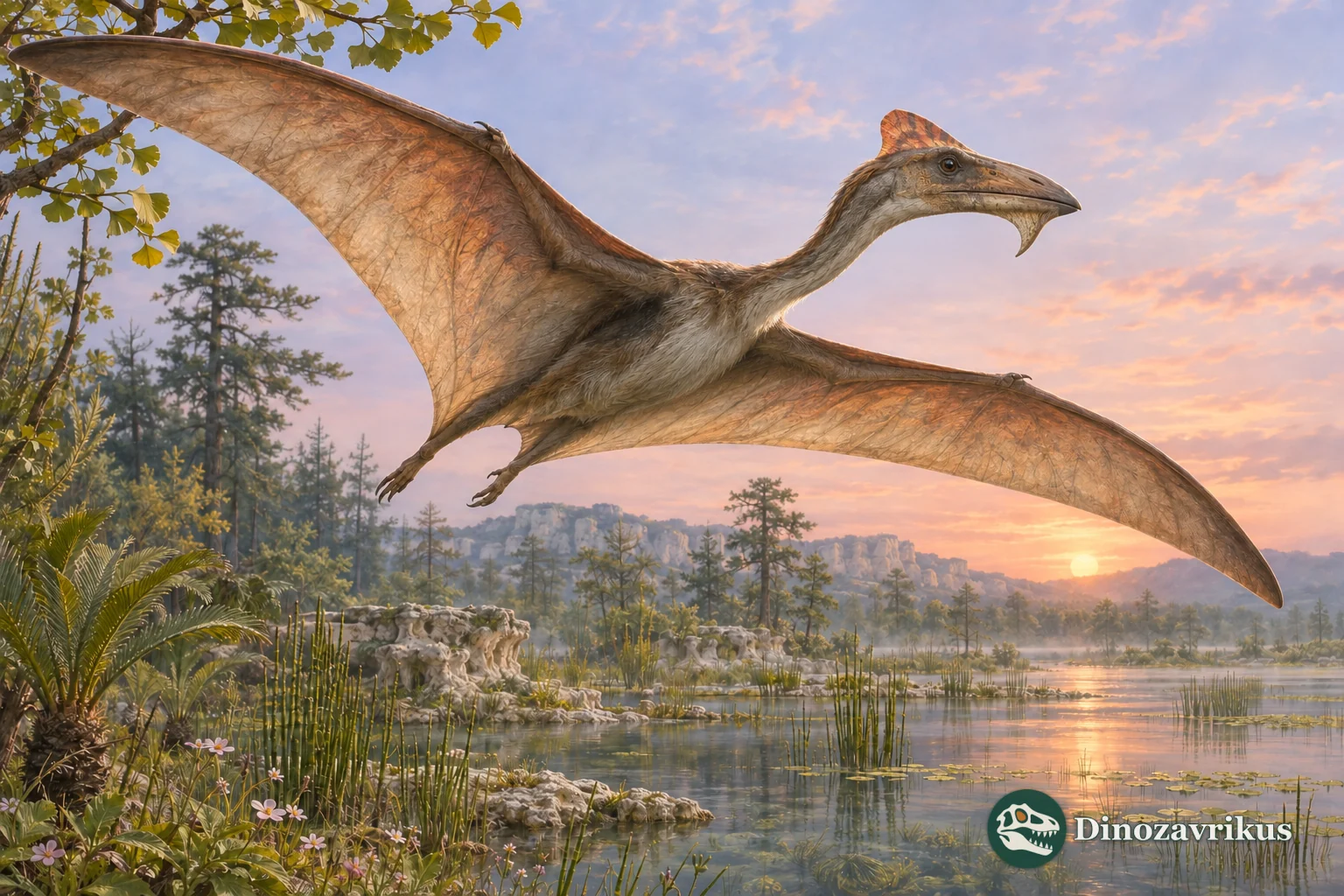
The lower-jaw crest of Sinopterus, another tapejarine, is lower relative to its jaw ramus. Such a comparison concerns bone shape rather than direct ancestry. A high upper head crest was proposed by analogy, but the complete crest, soft tissues and horn covering are absent. Their outlines and colours in life art are choices.
Estimated size and possible food
The describers suggested a wingspan of about two metres using proportions of other tapejarines. Not one Europejara wing bone is present in the holotype, so the span cannot be measured for this individual. It is a scale estimate, not a precise dimension.
The toothless beak prompted a hypothesis of fruit or seed eating. Early flowering plants occur in the Las Hoyas ecosystem, and possible seed dispersal by pterosaurs was discussed in the 2012 study. No stomach contents, fruit remains associated with the animal, or feeding traces have been found. Afrotapejara shows that relatives later occurred in Africa, but its fossils do not establish Europejara's diet.
Las Hoyas and tapejarid relationships
The type came from late Barremian laminated limestone of the La Huérguina Formation. Las Hoyas preserves evidence of a freshwater wetland with diverse plants and animals. Burial in that setting does not show that this pterosaur always stayed by water or ate any one local plant.
The original phylogenetic analysis placed Europejara among tapejarines. At publication it was an early and geographically important European member of the group. The authors proposed a Eurasian origin for tapejarids, but uneven fossil sampling makes that wider history uncertain. The closest relationships within the group also remained unresolved.
Frequently asked questions
Where was Europejara found?
Its holotype came from Las Hoyas in Spain's Cuenca Province, in late Barremian limestone of the La Huérguina Formation.
Is its crest preserved?
Yes. A bony crest on the lower jaw with a backward-curving rear edge survives. The full upper crest and soft tissues do not.
Did Europejara have teeth?
No teeth occur in the preserved jaws. This helped identify it as a tapejarid, but does not determine a specific food.
Is fruit eating proven?
No. It is a hypothesis based on beak form, relatives and regional flora. No direct food remains are associated with the holotype.