

Tiny pits give the broad crown of a Favusodus tooth a honeycomb-like texture. Those low teeth identify an otherwise poorly known cartilaginous fish at several Triassic sites in South China. A tooth from the Permian of Sichuan may belong to the same genus. Its incomplete root makes the identification less secure.
Quick facts
| Group | Elasmobranchs of unresolved ordinal placement |
|---|---|
| Type species | Favusodus orientalis |
| Holotype | Tooth GMPKU P-3527 |
| Type locality | Nimaigu, Guizhou Province |
| Type interval | Ladinian–Carnian, Triassic |
| Fossils | Isolated teeth |
What can the fossils tell us?
The distinctive surface helps identify loose teeth. Researchers also use features at the crown–root junction and on the base.
The authors assigned teeth from the Early Triassic Zuodeng section to the same species as the younger Guizhou fossils.
The Permian crown shares several traits with Triassic Favusodus, but there is too little of the root to identify the species confidently.
The Guizhou and Guangxi records
Jiachun Li and colleagues named Favusodus orientalis from teeth at Nimaigu in Guizhou Province. The description appeared online in 2021 and in the journal’s 2022 issue. The Geological Museum of Peking University houses the type tooth, GMPKU P-3527. The type material comes from the Ladinian–Carnian interval, spanning the end of the Middle Triassic and the beginning of the Late Triassic.
Li and colleagues reported teeth of the same species from the older Early Triassic Zuodeng section in Guangxi in 2023. The same study described Omanoselache in the local fauna and placed it with the hybodonts. The affinities of Favusodus were left open within a broader group of elasmobranchs.
Pits, ridges and changing tooth shapes
Teeth identified as front teeth are arched at the base of the crown. They carry a moderately prominent central point with small points to either side. The cusplets diminish towards the back of the inferred tooth row, and the base straightens. A blunt crest runs along the working face of the crown, with almost parallel ridges and tiny pits marking the surface.
On the inner side, a small projection sits below the main point. A groove runs at the base of the crown, and open channels are visible on parts of the root base. A low working surface is compatible with processing hard food. The fossils do not reveal specific prey, the arrangement of the complete jaws or the length of the animal.
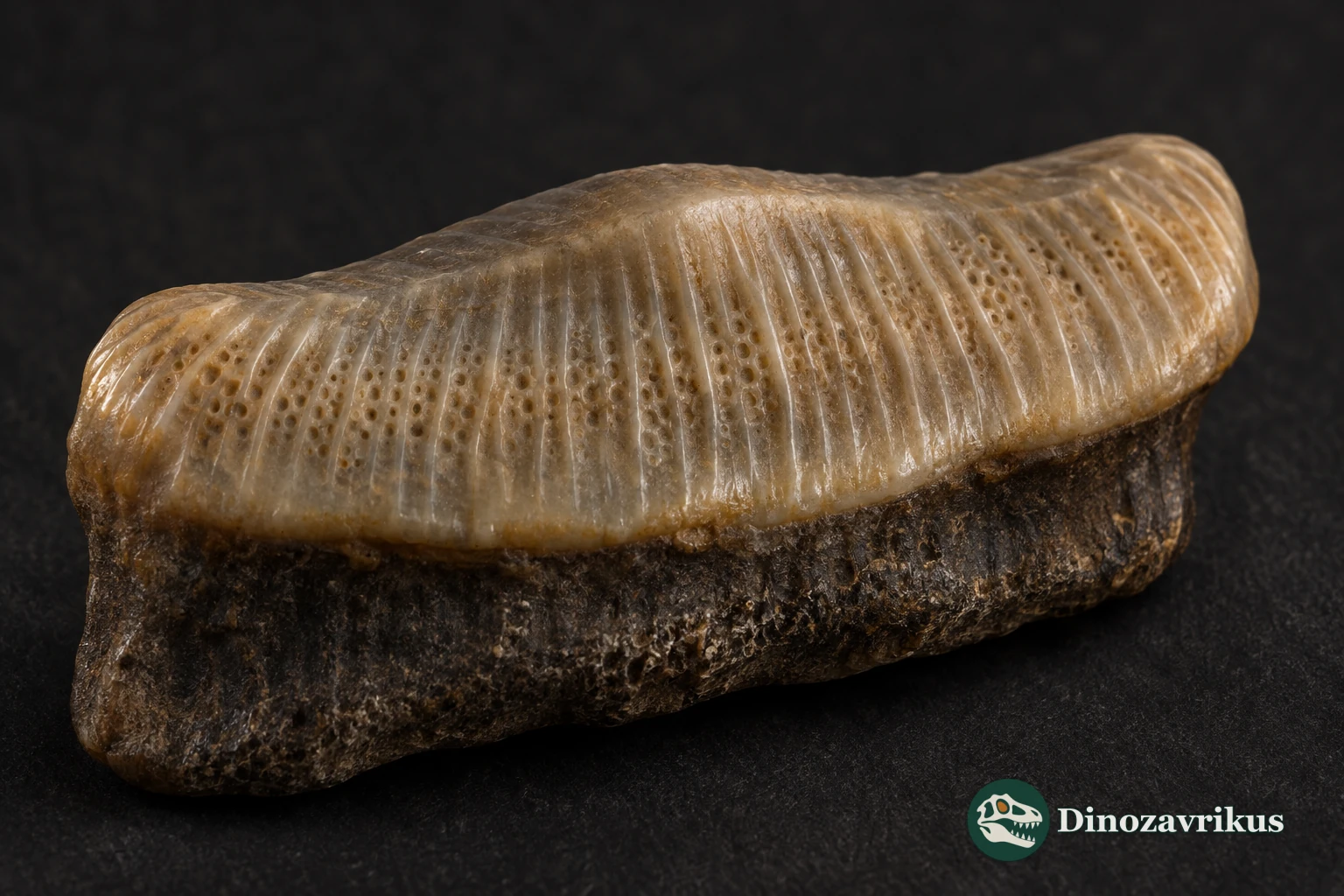
The incomplete tooth from Sichuan
In 2025, Li’s team described GMPKU P-3808 from Changhsingian rocks of the Dalong Formation at Chaotian, Sichuan. The fragment stands 1.1 millimetres high and extends more than 3 millimetres along the crest. It was the only tooth in the reported sample that the team assigned to Favusodus.
The crown preserves a blunt crest, near-parallel ridges and faint pits. Its ornament resembles that of Triassic teeth, though the honeycomb texture is less prominent than in some younger specimens. The team used the provisional name Favusodus cf. orientalis because the root is damaged. The tooth is evidence of a possible Permian occurrence of the genus, with continuity across the extinction still unresolved.
Frequently asked questions
What gives the crown its honeycomb texture?
Small pits form a pattern beside the ridges on the surface.
What does “cf.” mean in the name of the Permian tooth?
It signals a comparison with the named species and leaves the identification provisional.
How do the teeth vary along the inferred jaw?
The front crowns are arched and have larger cusplets. Rear crowns are straighter and their cusplets are reduced.
What might Favusodus have eaten?
The crown shape is compatible with processing hard food. The known fossils preserve no specific prey.