

Fenghuangopterus lii was named from an incomplete skeleton in western Liaoning. Teeth and surviving wing bones permit comparisons with other long-tailed pterosaurs. The flattened specimen cannot establish its colour, prey or exact wingspan.
Quick facts
| Scientific name | Fenghuangopterus lii, Lü and colleagues, 2010 |
|---|---|
| Holotype | CYGB-0037, incomplete compressed skeleton |
| Locality | Linglongta, Jianchang County, Liaoning, China |
| Rock and age | Tiaojishan Formation, Jurassic |
| Upper teeth | More than eleven pairs reported in the original description |
| Wing | Fourth metacarpal about 55% of humerus length |
| Food | Particular prey not established |
What can the fossils tell us?
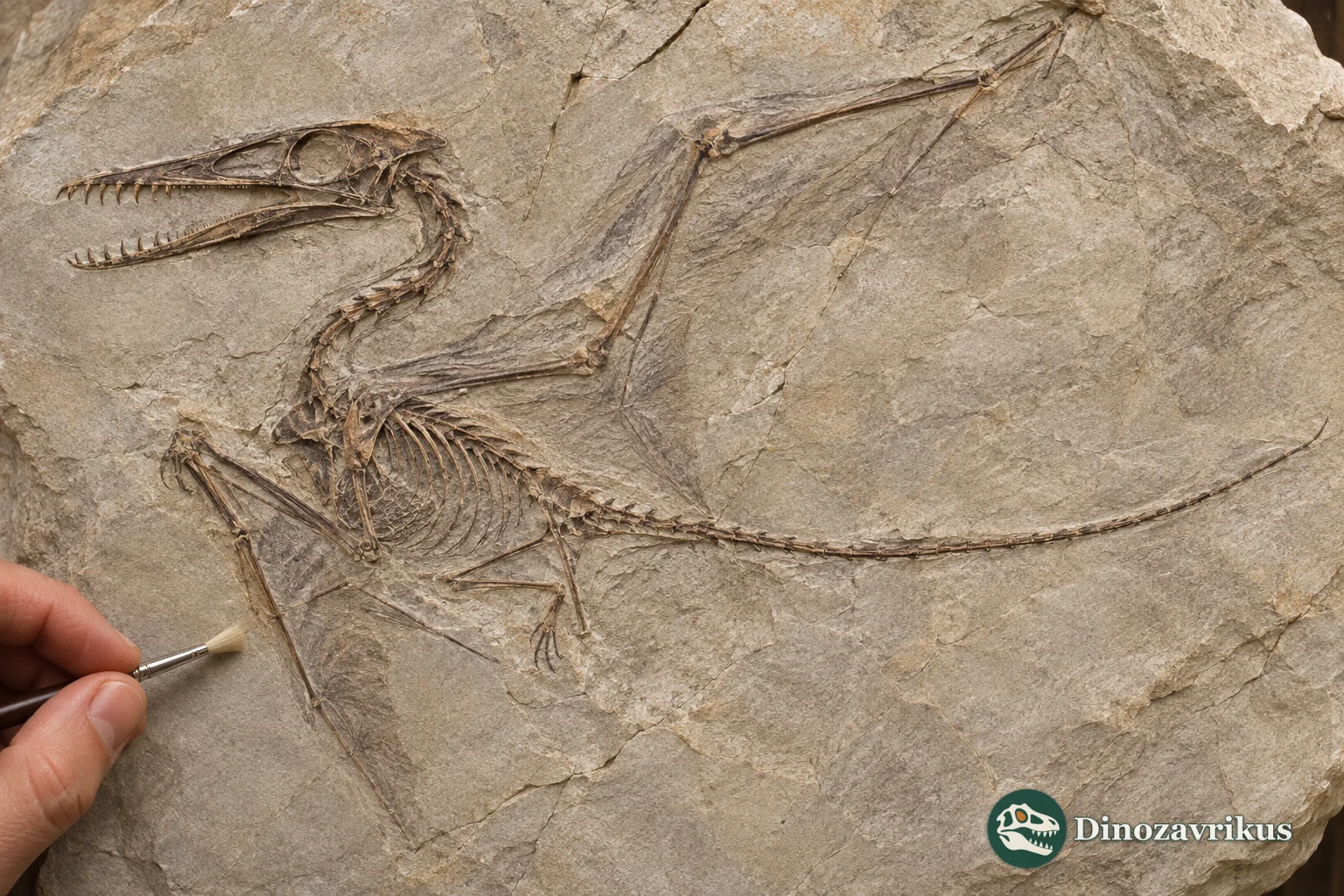
The name rests on CYGB-0037. Its bones are incomplete and flattened within a slab, limiting some anatomical readings.
The original authors reported more than eleven pairs of upper teeth, with the last beneath the rear of the antorbital opening. This does not identify prey.
The fourth metacarpal is about 55% of humerus length. A surviving bone ratio is firmer than an exact wingspan inferred from missing parts.
The original paper allied this animal with scaphognathines. Later comparison treated its exact position among scaphognathids more cautiously.
A find from Linglongta
Lü Junchang and colleagues named Fenghuangopterus lii in 2010 from specimen CYGB-0037, discovered near Linglongta in Jianchang County, Liaoning. The locality exposes the Tiaojishan Formation and its Jurassic vertebrates. The original paper referred to a Middle Jurassic age. Later work has refined the age boundaries of these beds, so an age assigned to the whole formation should not be treated as a direct date for this slab.
The skeleton is incomplete and compressed. The describers used its skull, tooth row and wing bones, not a complete three-dimensional body. Jianchangnathus from the same area provides a valuable comparison, but the two fossils must not be blended into one animal.
What the teeth and wing preserve
The initial diagnosis counted more than eleven upper tooth pairs. The rear tooth lies below the posterior corner of the antorbital opening. Tooth number and position help distinguish jaws, although compression and missing portions qualify fine details. Teeth alone cannot establish whether it caught fish, insects or another food.
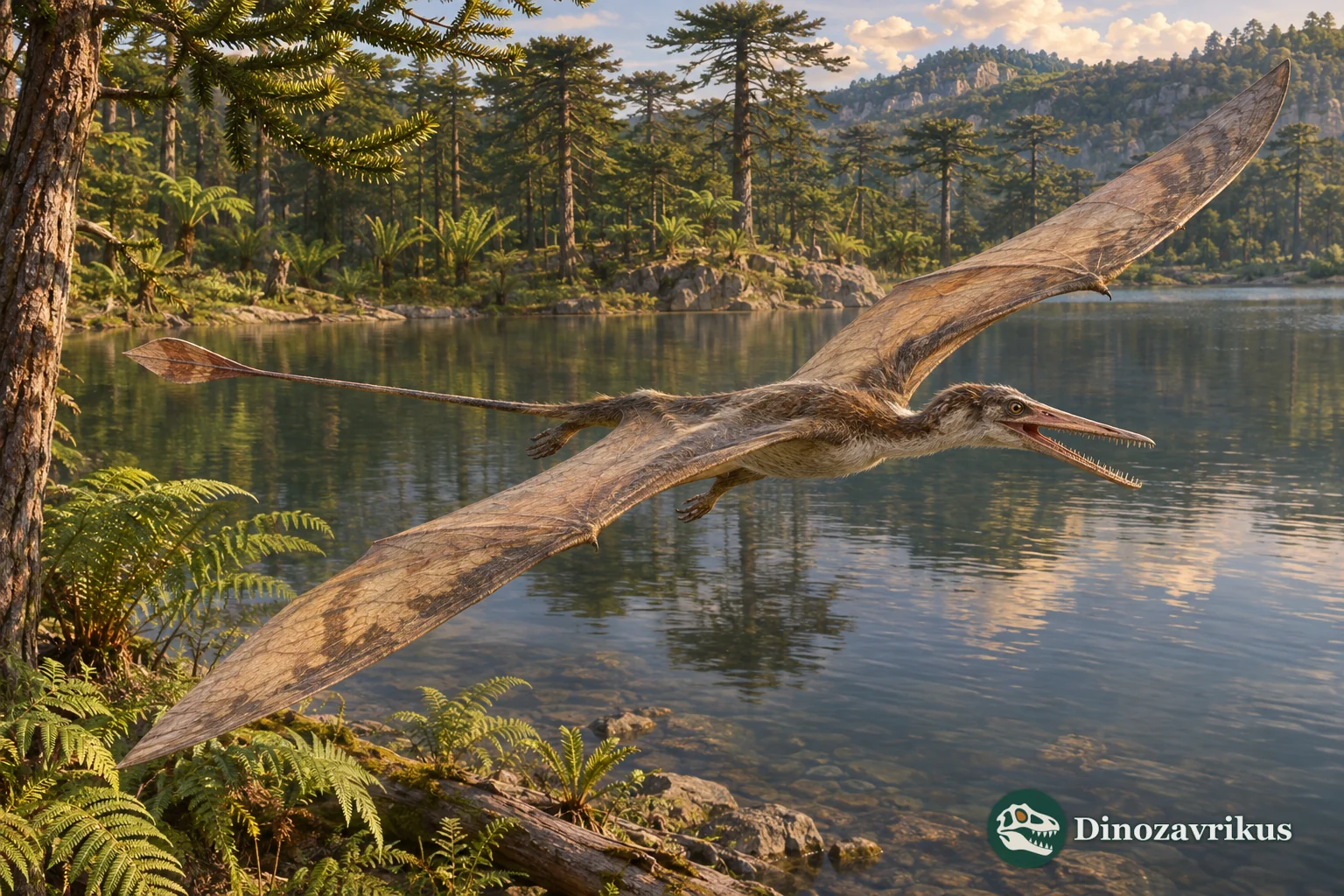
The fourth metacarpal, which supports the wing finger, measures about 55% of the humerus length. That is a ratio between preserved bones. A whole wingspan needs reconstruction of absent elements and wing position; the illustrated flying animal is therefore not a scale diagram.
A debated position among long-tailed forms
The original authors called Fenghuangopterus a scaphognathine based on its combined skull and limb characters. A later study of pterosaurs from western Liaoning compared it with Jianchangnathus and left its precise position among scaphognathids uncertain. The disagreement concerns fine placement, not the existence of the fossil itself.
Dorygnathus is another toothed long-tailed Jurassic pterosaur. A broad resemblance in silhouette does not demonstrate direct ancestry. Comparisons depend on corresponding bones, tooth placement and wing proportions.
Setting and reconstruction limits
The Linglongta beds preserve a Jurassic ecosystem with small vertebrates and plants. This is the geological setting of the fossil rather than a record of a particular day in the animal's life. No stomach contents identify its prey, and fossil evidence does not preserve its living colour.
The cover and lake scene imagine a live long-tailed pterosaur. Wing outline, pose and behaviour are artistic reconstructions informed by the group as a whole. CYGB-0037 does not record flight itself.
Frequently asked questions
Where was Fenghuangopterus found?
Holotype CYGB-0037 came from Linglongta in Jianchang County, Liaoning, China, in Jurassic strata of the Tiaojishan Formation.
How many upper teeth did it have?
The original description reported more than eleven pairs, with the rear tooth positioned beneath the back of the antorbital opening.
Is its exact wingspan known?
No. A ratio between the fourth metacarpal and humerus is known, but absent wing parts prevent a direct full-span measurement.
What did it eat?
The jaws had teeth, but no prey or stomach contents establish a particular diet.