

A fossil burrow is not a preserved home with a label identifying its occupant. It records an organism’s interaction with sediment. The structure may survive as an open-space fill, a cast or a pattern visible only in cross-section. Its geometry, fill and position in a rock layer can help palaeontologists reconstruct which organisms were active and how the substrate changed.
The strongest interpretations come from studying a burrow in context: alongside the host sediment, nearby traces, body fossils, roots and bedding surfaces. An isolated tube rarely distinguishes one maker from another. This approach makes burrows valuable evidence for ancient ecosystems without turning every shape into a confident species identification.
How a burrow becomes visible in rock
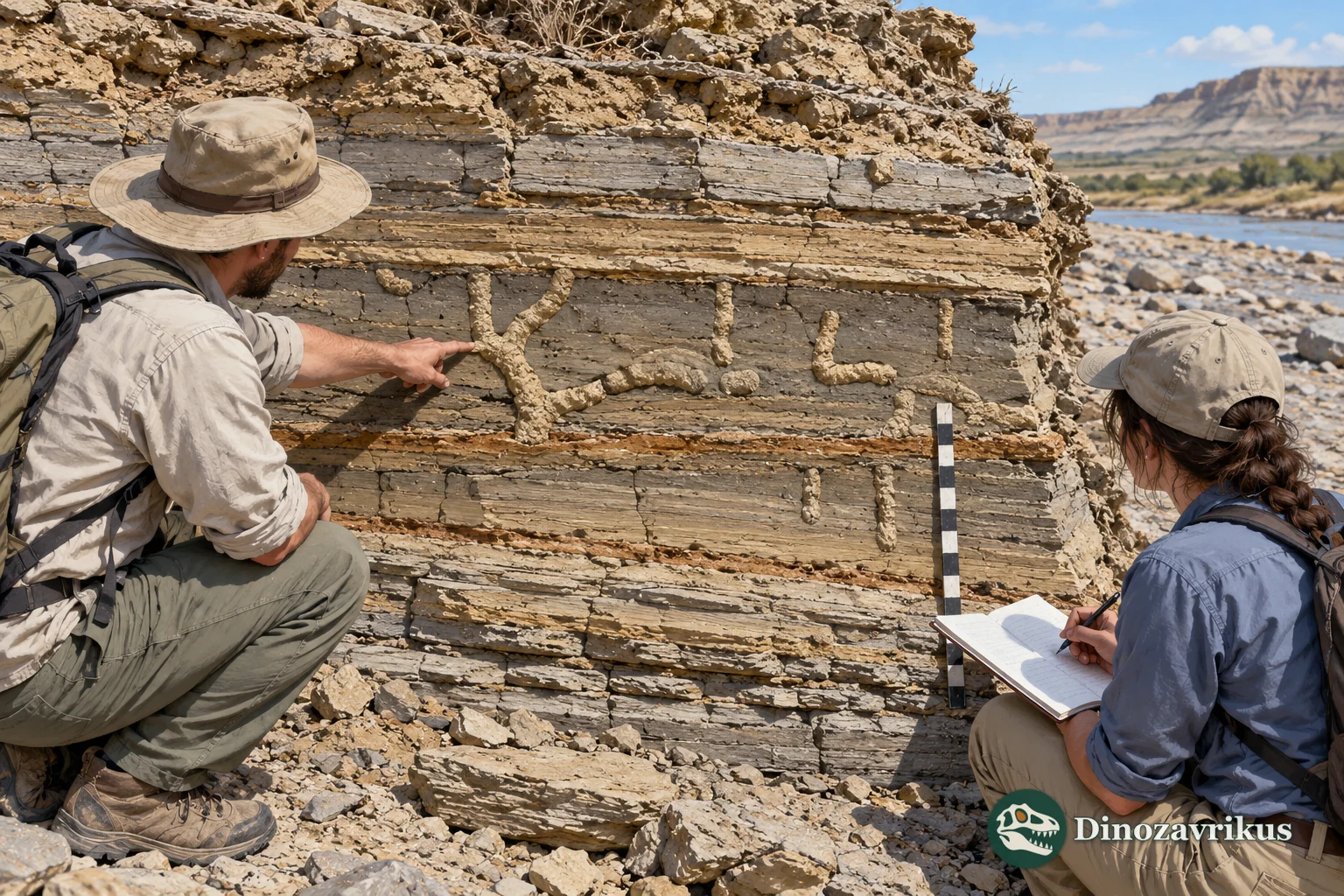
An animal may excavate a tunnel, move through sediment while feeding or alter the ground as it searches for shelter. After the passage is abandoned, grains can settle into it. The fill may differ in grain size or composition from the surrounding sediment. Burial and compaction then preserve a tube, gallery, chamber or branching network. Later erosion can expose only a small cross-section of the original structure.
Not every rounded feature is a burrow. Roots, desiccation cracks, gas escape and sediment movement can create similar shapes. Researchers look for a combination of clues such as a defined wall, repeated geometry, branching, patterned fill, and consistent relationships to bedding. A series of examples and their geological context are needed to test the biological interpretation.
What geometry and fill can tell us
Vertical, inclined and horizontal passages reflect different ways of entering or moving through sediment, but orientation alone does not measure water depth or current strength. Scale, repetition and association matter. A network that crosses several layers points to activity inside the sediment over multiple episodes; an isolated passage may represent a shorter event. Its position relative to bedding helps locate the former surface and the paths below it.
Fill can add another line of evidence. Coarser or finer material may have entered from a different source, moved with water or accumulated after the cavity opened. Internal curved layers can preserve gradual movement of sediment. Differences among adjacent burrows may help separate events, but colour or grain size must be compared with the surrounding rock sequence.
The density of traces can show how intensely animals reworked a substrate. In a heavily burrowed bed, original sedimentary layers may be mixed and individual episodes can merge. This is not a direct animal count: one organism may make several passages, some traces preserve better than others, and later burrowing may erase earlier structures.
Clues from ancient soils and extinction boundaries
Late Ordovician burrows in buried soils of Pennsylvania were described by Retallack and Feakes from the Juniata Formation. Their distribution within the palaeosols, backfill patterns and associated carbonate features supported an interpretation of early land activity. Millipede-like animals were proposed as possible makers, but the burrows do not preserve the occupants. The evidence supports terrestrial activity; it does not identify a species or prove a single behavioural story.
Horizontal burrow networks in North Dakota occur just above the Cretaceous–Palaeogene boundary, at the interface of lignitic coal and silty sandstone. Sedimentation estimates placed the activity within a short interval after the impact event. The traces were interpreted as consistent with earthworm burrows. Their presence records rapid activity in the recovering environment; the proposed importance of detritivores to later food webs is an ecological inference, not a food chain captured directly in the rock.
Upper Triassic burrow casts in Colorado Plateau deposits have been attributed to lungfish. Their form and occurrence in river, floodplain and lake deposits were compared with modern lungfish burrows. The proposed link to seasonally dry conditions depends on that comparison and on sedimentary evidence. A single tunnel does not record the climate on its own.
Why the maker often remains unknown
Different animals can produce similar passages, and one animal can alter its burrow in different substrates. A structure can also be modified by later activity or physical processes. Researchers therefore describe the trace form separately from a likely producer and explain which evidence supports the association.
Ancient ecosystems are reconstructed from multiple lines of evidence: sedimentary structures, body fossils, soils, burrows and their sequence of formation. The evidence for dinosaur burrowing is unusually specific because skeletal remains occur with a tunnel-like structure. Other examples, such as burrows associated with fossil dung, answer different ecological questions. The broader distinction between body remains and activity traces is explained in this guide to fossil evidence.
Frequently asked questions
Can a burrow reveal the species that made it?
Usually not. Shape can narrow the possibilities, but different animals can make similar structures and a single maker can produce different burrows in different substrates.
How do researchers distinguish a burrow from a crack or root trace?
They compare wall structure, branching, fill, repeated geometry and the feature’s relationship to sediment layers. A single outline is rarely enough.
What can burrows reveal about an ancient ecosystem?
With sedimentary and fossil evidence, they can show substrate conditions, organism activity, reworking and changes in colonisation. They do not provide a complete census or food web on their own.
Do fossil burrows prove that an animal lived underground permanently?
No. A burrow records activity in sediment. Its purpose and duration require separate evidence and may remain uncertain.