

A fossil find can carry several different ages. Bone histology may estimate how long an animal grew before death. Sedimentary structures and the position of remains help reconstruct how and when it was buried. Dating minerals or rock layers constrains the geological age of the deposit. These values are related, but they are not the same date.
If a fossil lies between two volcanic ash beds, the dates of those beds can constrain when the enclosing sediments formed. They do not tell us how many years the animal lived. Researchers estimate that from tissues and anatomical development, while remains may have lain exposed, travelled in water or been reworked before final burial.
Biological age: how long an individual grew
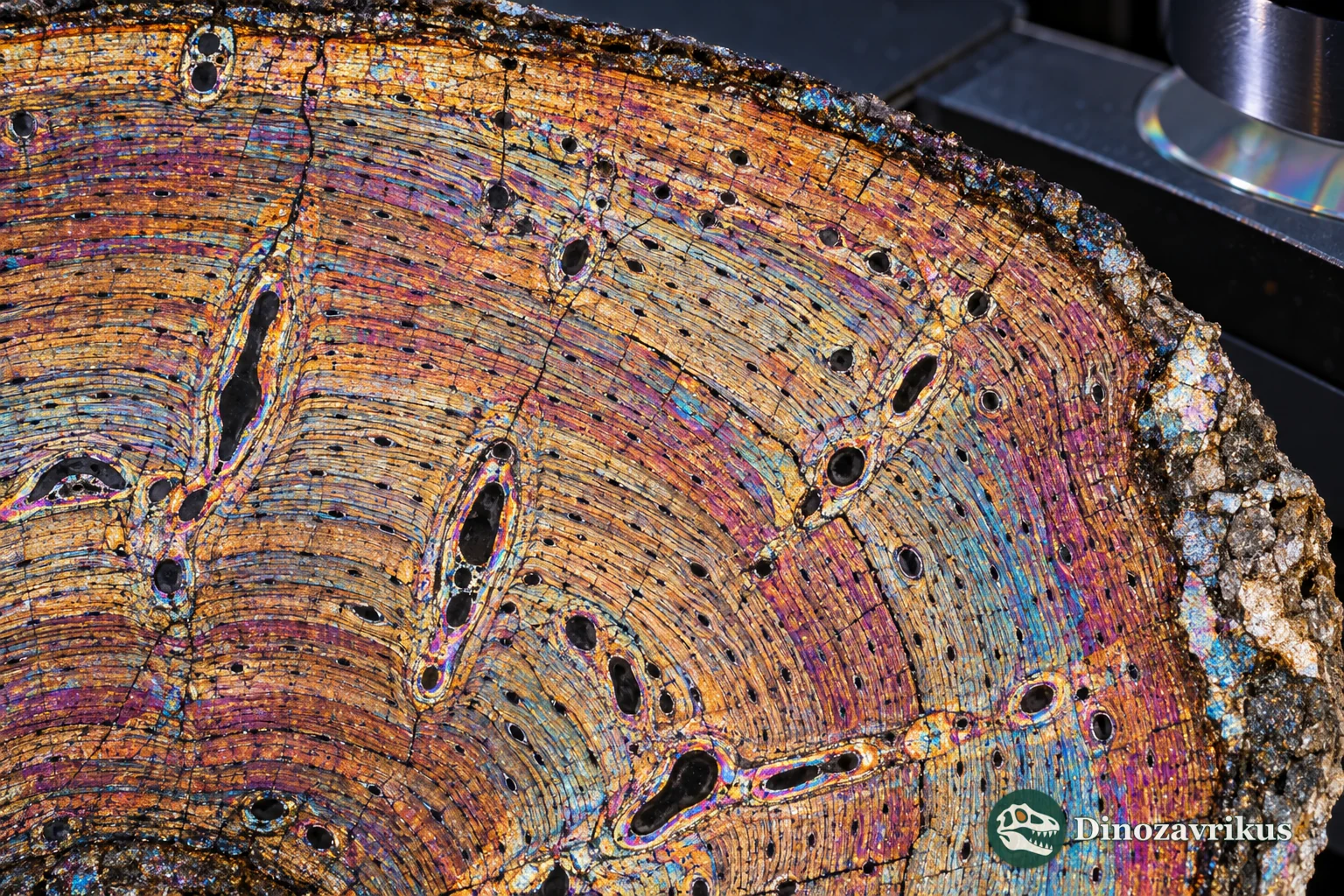
Some vertebrate bones record growth marks – lines corresponding to slower growth or pauses. Researchers examine thin sections under a microscope. Spacing between marks, tissue type, vascular canals and remodelling in the cortex help reconstruct changing growth rates. When the periodicity of marks is supported for the animal and tissue, counts can estimate age at death.
This is not simply counting tree rings. Internal bone may remodel and erase early lines; fast growth can make marks difficult to distinguish; an incomplete or damaged section records only part of the history. Researchers compare multiple skeletal elements, tissue structure and external development. An estimate may be reported as a range or minimum age rather than a precise birthday.
Bone histology describes tissue development, not sexual maturity by itself. Slowing skeletal growth, fusion of bones and reproductive maturity may occur at different times. Studies of dinosaur growth combine histology with anatomical change; a single line does not independently identify adulthood. The broader account of how Jurassic dinosaurs grew illustrates why developmental histories require several lines of evidence.
Death and burial are separate events
The age of an animal at death does not set the length of its post-mortem history. A bone may have been buried soon after death, or it may have weathered, broken, moved in water or remained exposed for a long time. Surface abrasion, bite marks, bone orientation, sorting by size, articulation and the sediment filling cavities help evaluate those processes.
If remains erode out of an older layer and enter younger sediment, they are reworked. The bone’s history and the age of the rock now surrounding it can then differ. Geologists examine bed contacts, cement and mineral grains; palaeontologists assess bone condition and associated material. A fossil’s presence in a layer does not by itself prove the animal died when that sediment formed.
Geological age: what event was dated?
Geochronology estimates the timing of geological events. Radiometric dating of zircon in volcanic ash usually concerns mineral crystallisation and formation of the ash bed. If dated horizons bracket a fossil-bearing layer, they can constrain an interval for the sediments. Other approaches use magnetic polarity, stratigraphic order, index fossils or correlation with dated sections.
No method automatically dates the death of an individual animal. Every result is tied to the event measured and the geological relation between that event and the fossil. A formation assigned one rounded number may have accumulated over a substantial interval.
The useful question is not only “How old is this fossil?” but “Which event was dated, and how is it connected to the specimen?” The overview of how fossils and their layers are dated covers geological methods. Isotope measurements used to reconstruct ancient environments answer another question; they do not automatically provide an age for the individual.
How to read an age estimate
Check what the number describes: an individual’s age at death, a rock layer, a taxon’s time range or a geological event. Then check the evidence. The basis may be a count of growth marks, comparison with an anatomical growth series, a position between dated horizons or a radiometric measurement of a mineral.
Uncertainty has more than one source. A laboratory date has analytical uncertainty; its relationship to the enclosing bed adds stratigraphic uncertainty. A histological estimate adds assumptions about periodicity and may be affected by remodelling or missing growth marks. These limits should be reported separately rather than hidden in a single precise-looking value. The larger toolkit is part of how palaeontologists study fossil evidence.
Frequently asked questions
Can the age of a rock layer tell us the age of an animal?
No. A layer dates geological history and may constrain when remains were buried. The animal’s age at death is estimated from its own tissues and developmental evidence.
How do growth marks estimate age?
Researchers count preserved cyclic lines in a thin section and study the surrounding tissue. The result depends on section completeness, bone remodelling and whether the marks are periodic.
Are bone growth lines always annual?
Not automatically. Periodicity must be supported by biology and tissue structure; rapid growth may obscure early marks, and later remodelling can erase them.
Why can a fossil be older than the rock around it?
Remains may erode from older strata and be redeposited in younger sediment. Researchers test for reworking using the fossil’s condition and geological context.