

Gansus could fly and had webbing between its toes. Early Cretaceous fossils from a lake deposit in northwestern China preserve both the bones and traces of soft tissue. Its legs have been compared with those of modern swimmers, while two isolated feathers retain microscopic and chemical evidence of dark pigment.
Quick facts
| Group | Early ornithuromorph bird |
|---|---|
| Age | Early Cretaceous, Aptian |
| Locality | Changma, Gansu Province, China |
| Rock unit | Xiagou Formation |
| Holotype | IVPP V 6862, lower left leg and foot |
| Type species | Gansus yumenensis |
| Described | Hou Lianhai and Liu Zhicheng, 1984 |
| Soft tissues | Traces of webbing, scales and feathers |
What can the fossils tell us?
Foot webbing survives in some fossils. It would have enlarged the surface available for a stroke in water. Bone proportions support the possibility of shallow diving.
Microstructures and chemical signatures from dark parts of the feathers are consistent with eumelanin. The overall plumage pattern remains unknown.
The cluster contains skeletal material assigned to Gansus and areas of possible digestive damage. Its proposed origin as a pellet leaves the identity of the producer open.
The first specimen and the Changma skeletons
The first known specimen was collected in 1981 from the Xiagou Formation near Yumen. Hou Lianhai and Liu Zhicheng described it in 1984 as Gansus yumenensis. The type, IVPP V 6862, comprises the distal left tibiotarsus and a tarsometatarsus with four toes. This was the first Mesozoic bird to be described from China.
Hai-Lu You and colleagues described five additional specimens in 2006. They included articulated parts of skeletons, some with impressions of soft tissue. Later discoveries document most of the body skeleton more fully. The assignment of skull material remains less secure. Recent stratigraphic correlations put the bird-bearing Changma beds at roughly 124–120 million years old.

Powered flight and limited diving
Its wings and shoulder girdle are consistent with powered flight. Some feet retain the web between the toes and scale-like impressions near the ankle. A long outer toe and the web would have enlarged the surface available to push against water.
Robert Nudds and colleagues compared the proportions of wing and leg bones with data from 447 living species. Some leg proportions resemble those of grebes and cormorants. The thigh bone is comparatively slender, leading the authors to suggest shallow diving. The more specialised Cretaceous diver Hesperornis occupied a different part of their comparison.
Clues to feather colour
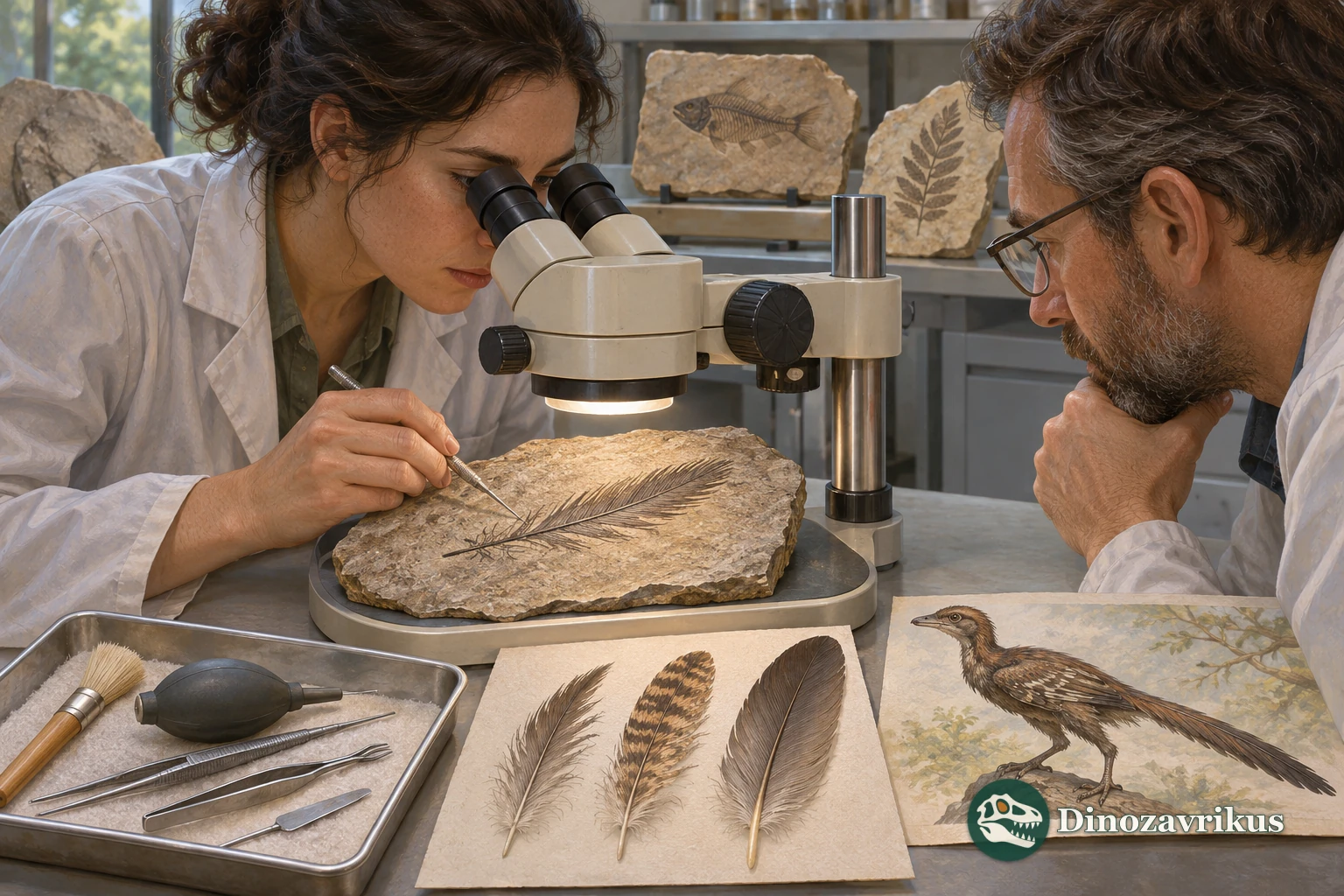
Holly Barden and colleagues studied two isolated feathers assigned to Gansus. Under a scanning electron microscope, the dark parts contained elongated bodies consistent with melanosomes, the structures that contain pigment in living birds. Infrared analysis found signals associated with eumelanin residues in the same parts of the feathers.
Taken together, the chemistry and microscopic structures support the preservation of dark pigment. Two isolated feathers cannot establish the colour pattern across the body, or show where on the bird each feather grew.
An uncertain skull and a revised name
In 2022, Jingmai O’Connor and colleagues suggested that skull IVPP V26199 from Changma might belong to Gansus. Its premaxilla was toothless and teeth farther back were slender with relatively high crowns. The referral was based on similarities to the related bird Iteravis, because the skull preserves little that can be matched directly to reliably assigned Gansus material.
A specimen from Liaoning was named Gansus zheni. A 2021 reassessment of the type specimens found it indistinguishable from Iteravis huchzermeyeri and treated the former name as a junior synonym. A later analysis put Gansus and Iteravis together in the gansuid family while retaining the two genera.
Bones in a possible pellet
In 2026, Ying Wang and colleagues described IVPP V34827, an oval patch of organic residue enclosing bones assigned to Gansus. Broken and articulated elements occur together. Small pits on the shin bone resemble traces left by digestive acid, and infrared spectra distinguish the residue from the surrounding sediment.
The researchers interpreted it as a probable regurgitated pellet, possibly produced by a non-avian theropod. The find does not identify the animal that cast the pellet or reveal how it acquired the bird.
Frequently asked questions
What part of Gansus was found first?
Its type specimen is part of the left lower leg and foot. The wings and much of the body skeleton were described from later finds.
Could Gansus both fly and swim?
Its wings and shoulder girdle support powered flight, and its webbed feet would have helped it swim. The leg comparisons suggest it may also have dived shallowly.
Do we know what colour it was?
Two feather fossils contain evidence consistent with dark eumelanin. The overall colour pattern cannot be reconstructed from them.
Did Gansus have teeth?
A skull tentatively assigned to Gansus preserves small teeth. Its assignment remains uncertain because securely identified remains include little comparable material.