

Gazellospira is an extinct Eurasian bovid recognized particularly by twisting bony horn cores. The type species, G. torticornis, occurs in early Pleistocene European deposits. A species described from Tibet in 2023 pushes a secure early record into the Pliocene, about 3.62 million years ago.
A horn core is the bone inside a horn, not the outer sheath. Neither its exact sheath shape nor the animal's coat pattern survives in these fossils. The cover therefore shows a plausible life reconstruction, not a documented individual.
Quick facts
| Group | Artiodactyla, Bovidae |
|---|---|
| Type species | Gazellospira torticornis |
| Age | Pliocene and early Pleistocene, by species and locality |
| Range | Eurasia, including Tibet, Greece and Crimea |
| Zanda holotype | Horn core IVPP V31668 |
| Dafnero sample | 65 specimens from at least 15 G. torticornis individuals |
| Preservation limit | Horn sheaths and coat color are not fossilized |
What can the fossils tell us?
The Greek sample includes 65 fossils representing at least 15 individuals. Differences in horn cores and some body bones are interpreted partly as sexual dimorphism, not direct observations of living herds.
Holotype IVPP V31668 and specimen IVPP V31669 came from one Zanda Basin site dated around 3.62 million years. Neither preserves a complete skull or body skeleton.
A partial right horn core from Taurida Cave, PIN 5644/57, has been assigned to G. torticornis. One fragment cannot map a continuous geographic range.
An early species in the Zanda Basin
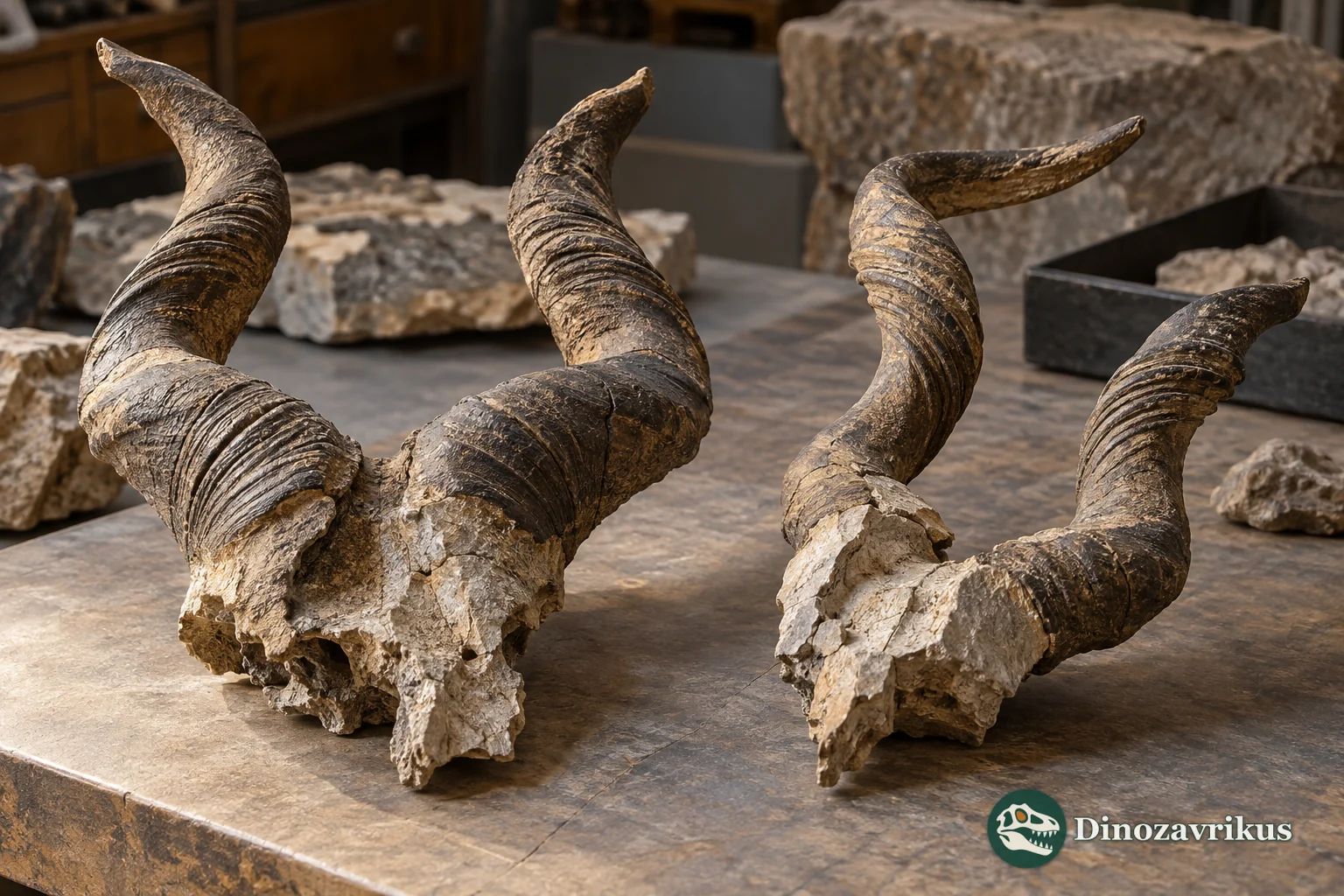
Xiaoming Wang, Qiang Li and Z. Jack Tseng named G. tsaparangensis from two left horn cores from locality ZD0701 in Tibet. Qiang Li found the holotype, IVPP V31668, in 2007; IVPP V31669 provides a second comparison. Correlation of the sedimentary sequence places the site near 3.62 million years, in the Pliocene. This is a geological estimate for the deposit rather than direct dating of the horn bone.
The Tibetan cores are relatively short and less strongly twisted than those of the European type species. Thin frontal bone without developed sinuses and small supraorbital openings also distinguish them. The authors interpreted this combination as an early branch of the genus. Because the species is known from two horn cores, its legs and body proportions cannot be reconstructed directly.
A Greek series instead of one horn
Roxane Hermier, Gildas Merceron and Dimitris Kostopoulos studied 65 G. torticornis specimens from Early Pleistocene Dafnero in northern Greece, representing a minimum of 15 individuals. They compared frontal sinuses, horn-core grooves and torsion, and several postcranial characters. Variation within the sample matters when deciding whether different-looking horns represent different species.
The authors linked some variation to probable sexual dimorphism and discussed a mixed herd. Their estimate of sex composition is an inference from fossils, not a census of living animals. A partial right horn core, PIN 5644/57, from Taurida Cave in Crimea adds another reported locality for G. torticornis; it does not establish continuous occupation between Greece and Crimea.

What the horns do and do not reveal
The Zanda study compared serial cross-sections, ridges, tapering and twisting of horn cores. These characters carry more information than a silhouette alone. The authors proposed that an early high-altitude Tibetan form might fit an 'out of Tibet' dispersal hypothesis. Fragmentary possible older records from Turkey and gaps in the fossil record prevent a definitive origin or route.
Greek body bones make comparisons between individuals stronger than at Zanda, but neither sample preserves diet in full detail, horn-sheath color or social behavior directly. Deposits across the Quaternary must be dated separately. The Zanda landscape below is an interpretive view of a former lake basin, not a photograph of the fossil site.
What remains unresolved
Some early Asian spiral-horned antelopes have moved between generic assignments as researchers compare new material. No isolated horn should be identified solely from the number of twists; associated frontal anatomy and geological age matter.
Frequently asked questions
Was Gazellospira a living gazelle?
No. It was an extinct bovid genus; a similar common appearance does not make it a species of a modern gazelle.
Did all Gazellospira species live in the Early Pleistocene?
No. The Tibetan G. tsaparangensis comes from a Pliocene deposit estimated at about 3.62 million years old.
Can each Dafnero fossil be sexed from its horn?
Not reliably. The sample supports probable sexual dimorphism, but isolated fragments retain uncertainty.
Is a Tibetan origin proven?
No. An early Tibetan form is consistent with that hypothesis, but the fragmentary record does not establish the genus' origin.