

Glanochthon was an Early Permian temnospondyl from the Saar–Nahe Basin of present-day Germany. Three species are distinguished by anatomy and fossil context, and one holotype preserves a complete skeleton with a skin impression. Published reports of fish remains in gut contents add unusually direct evidence about diet.
The genus belongs in the ancient amphibian catalogue. Its relationship to Sclerocephalus has shifted across phylogenetic analyses, while the named species remain grounded in particular fossil specimens.
Quick facts
| Scientific name | Glanochthon latirostre, G. angusta and G. lellbachae |
|---|---|
| Group | Temnospondyl amphibian; placed in Sclerocephalidae in a 2021 study |
| Age | Early Permian, lower Rotliegend |
| Range | Saar–Nahe Basin, present-day Rhineland-Palatinate, Germany |
| Best specimen | NHMM 2006/14: complete skeleton with a skin impression |
| Diet evidence | Acanthodian remains reported in gut contents of specimens attributed to the genus |
| Estimated size | Published body-length estimate approaches 1 m; not a direct measurement of every specimen |
What can the fossils tell us?
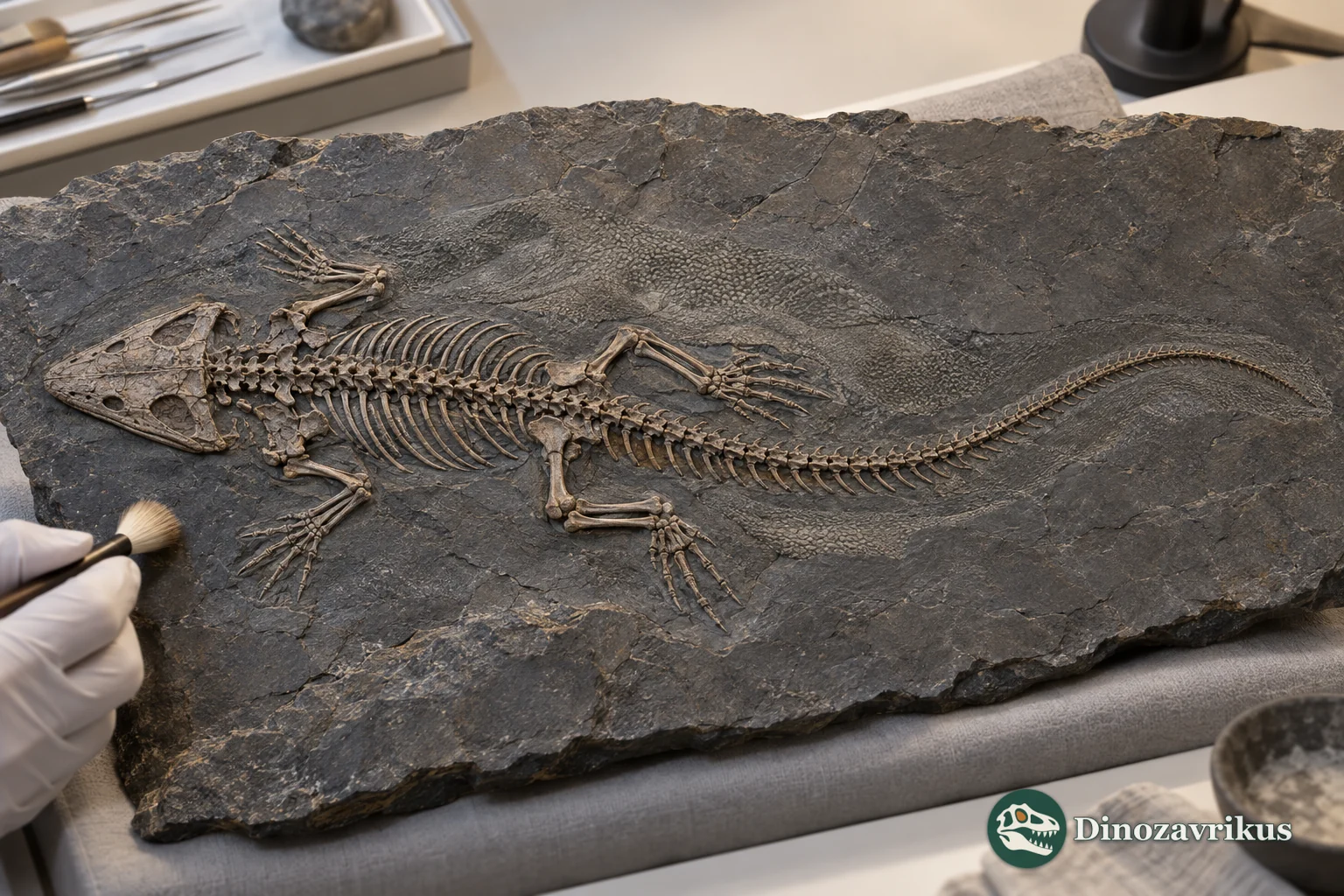
NHMM 2006/14, the holotype of G. lellbachae, is described as a complete skeleton with a skin impression and a skull length of 102 mm. It informs body proportions, but it does not reveal exact colour or the texture of soft tissue.
G. latirostre comes from Lebach ironstone concretions, G. angusta from the Humberg Black Shale, and G. lellbachae from Klauswald. Their skull proportions and bone ornament differ; not every fossil from the basin belongs to Glanochthon.
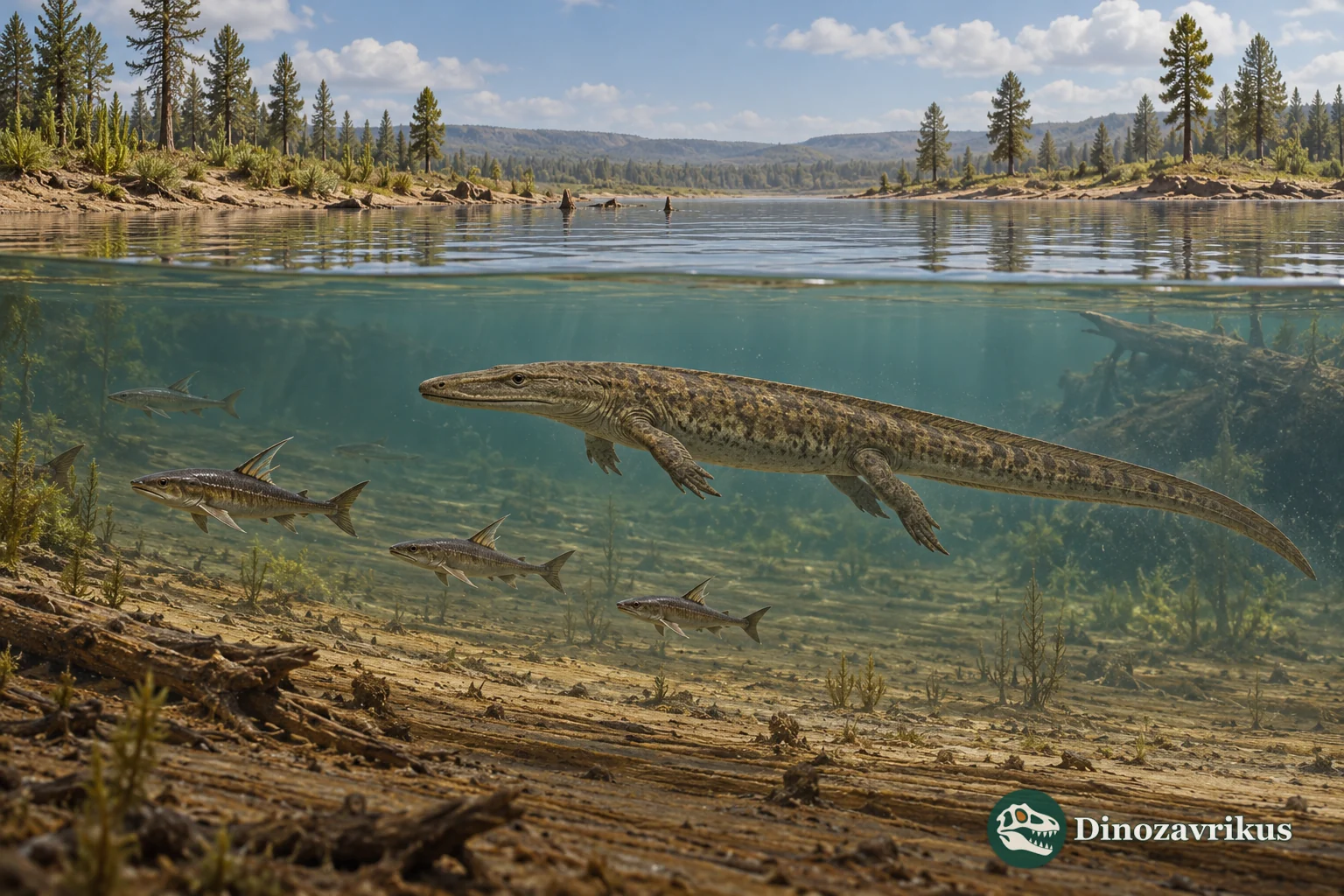
Acanthodian fish skeletons have been reported in gut contents of temnospondyls including Glanochthon. This supports fish predation in individual cases, not an exclusive diet for every species. The lake setting comes from the Meisenheim Formation and associated fauna.
The 2009 analysis recovered Glanochthon as a distinct clade. Schoch’s 2021 osteological study placed the clade close to Sclerocephalus, which then formed a paraphyletic grade. This creates a classification problem rather than erasing the diagnostic anatomy of the described fossils.
From Cheliderpeton to a separate genus
The genus was established after researchers re-examined the old assignment of latirostre to Cheliderpeton. Schoch and Witzmann described new Saar–Nahe Basin material in 2009 and named Glanochthon for latirostre and the new species G. angusta. The type species of Cheliderpeton had proved anatomically more distant than earlier classifications implied.
Private collector Klaus Krätschmer gathered much of the material from the Klauswald locality southwest of Odernheim am Glan. He named the third species, lellbachae, in 2006 as Cheliderpeton lellbachae. In 2021 Rainer Schoch transferred it to Glanochthon after comparing its skeleton with the other two species. This was a new combination for an existing species, not a fourth animal.
Klauswald produced large quantities of vertebrate fossils, but the number of fragments alone does not establish the number of species. Some forms proposed from early collections were later interpreted as variation within Sclerocephalus. The distinction rests on diagnostic anatomy and stratigraphic context.
Three species in separate fossil settings
G. latirostre is known from ironstone concretions in the Lebach region, while G. angusta was described from the Humberg Black Shale. The 2009 revision treated them as separate species with different stratigraphic and ecological settings. Their occurrence in one basin does not make them a single population or a single horizon.
The holotype of G. lellbachae, NHMM 2006/14, is a complete skeleton with a skin impression. Its skull length is reported as 102 mm. The specimen connects the proportions of the head, trunk, limbs and long tail in one individual, a rare advantage over isolated skull material.
In the 2021 comparison, the largest reported skulls of G. lellbachae reached about 17 cm, while Sclerocephalus nobilis reached about 24 cm. These are skull lengths, not direct body-length or mass measurements.
Long snout, tail and limbs
Adult skulls have a long preorbital region. In the 2009 diagnosis, its length in G. latirostre and G. angusta was about 2.0–2.3 times the posterior skull table; Schoch’s 2021 diagnosis gives about 1.8–2.0 for G. lellbachae. The values describe skull proportions and should not be used as a formula for reconstructing the rest of the animal.
In G. lellbachae, the tail is substantially longer than skull and trunk combined. Its hand and foot phalanges are relatively long and slender, and the carpals remained unossified in adults. These observations document skeletal construction; by themselves they do not prove that the animal ran quickly or spent all its time swimming.
Bone ornament also differs among species. G. lellbachae has tall radial ridges across parts of the skull roof, most pronounced in large specimens. This pattern helps compare fossil bones, but it does not reveal the animal’s skin colour or a matching surface pattern.
Fish remains and lake ecology
Published accounts report acanthodian fish skeletons in the gut contents of temnospondyls from the Saar–Nahe Basin, including material assigned to Glanochthon. This is more direct evidence of feeding than an inference from teeth alone, and it supports fish as prey for at least some individuals.
Gut contents do not give the complete menu of all three species. Nor is every fish found beside an amphibian necessarily its prey: articulation, preservation and position matter. The Meisenheim Formation records lake deposits and a rich vertebrate fauna; differences between the Lebach and Humberg settings allowed authors to discuss habitat partitioning between G. latirostre and G. angusta.
A changing phylogenetic position
Schoch and Witzmann’s 2009 analysis recovered the two then-known species as a monophyletic genus among basal stereospondylomorphs. The addition of G. lellbachae expanded the anatomical sample. In the 2021 analysis, it formed the basal sister species of the younger G. angusta and G. latirostre, and the resulting clade lay close to Sclerocephalus.
Under that topology, Sclerocephalus becomes a sequence of forms leading toward Glanochthon rather than a single clean branch. Schoch discussed either widening the boundaries of Sclerocephalus or naming additional genera. This is a classification question raised by the tree; it does not invalidate the three fossil species or their anatomical diagnoses.
Comparison with Sclerocephalus helps place Glanochthon among the Permian lake fauna. Similarity and close branching do not show that one known genus was the direct ancestor of the other.
What can be reconstructed
The complete skeleton of NHMM 2006/14 gives a stronger basis for body proportions than is available for most temnospondyls. The skin impression records surface preservation, while fish remains in gut contents support a limited dietary conclusion. Stratigraphy and associated fossils place the animals in Early Permian lake ecosystems.
Exact colour, soft-tissue thickness, movement and behaviour are not preserved. The cover uses a conservative temnospondyl body plan informed by the skeleton, but the palette and pose are artistic choices. Details from the three species should not be blended as if they all came from one skeleton.
Glanochthon is included in the ancient amphibian catalogue and lived during the Permian Period. Its story is distinctive because unusually complete fossils coexist with a live discussion over how its closest relatives should be classified.
Frequently asked questions
How many Glanochthon species are known?
Three are currently discussed: G. latirostre, G. angusta and G. lellbachae. The last was first named in another genus and later transferred to Glanochthon.
Was a complete skeleton with a skin impression found?
Yes. The holotype of G. lellbachae, NHMM 2006/14, is described as a complete skeleton with a skin impression. It does not reveal exact colour.
What did Glanochthon eat?
Acanthodian fish remains have been reported in gut contents of specimens assigned to the genus. This supports fish predation in individual cases, not a complete diet for every species.
Why is its relationship to Sclerocephalus debated?
Analyses from 2009 and 2021 sampled different taxa and characters. The later tree placed Glanochthon near a Sclerocephalus grade, raising questions about genus boundaries.