

Glossopleura was a Middle Cambrian trilobite genus. The type species had long eyes alongside the raised central lobe of the head and a broad tail shield with a smooth rim. The shield outlines and the number of thoracic segments help tell closely related species apart.
Quick facts
| Group | Trilobites |
|---|---|
| Age | Middle Cambrian, Wuliuan |
| Region | North America (Canada, United States and Greenland) |
| Diet | Unknown |
| Type species | Glossopleura boccar |
| Genus named by | Christian Poulsen, 1927 |
What can the fossils tell us?
Canadian material shows long eye lobes and a broad tail shield. The shield is roughly two-thirds as long as it is wide.
The shorter thorax helps distinguish it from the type species. Other features of its armour support its placement in Glossopleura.
The species helps correlate sections of the Telt Bugt Formation. The formation thins westwards, where the same biozone was not identified.
Long eyes and a broad tail rim
Charles Walcott described the type species as Dolichometopus boccar in 1916 from the Stephen Formation of British Columbia. Christian Poulsen established Glossopleura in 1927. The species was subsequently identified in the Mount Cap Formation of northwestern Canada and in Nevada and Arizona.
The eye lobes of G. boccar are long and narrow. The axis of its tail shield reaches the border furrow, while the lateral furrows are fainter. In G. youngi from the Mount Cap Formation, the tail axis is shorter and the thorax has six segments instead of seven. Thorax length also varies among species of Bathyuriscus, another Cambrian trilobite genus from North America.
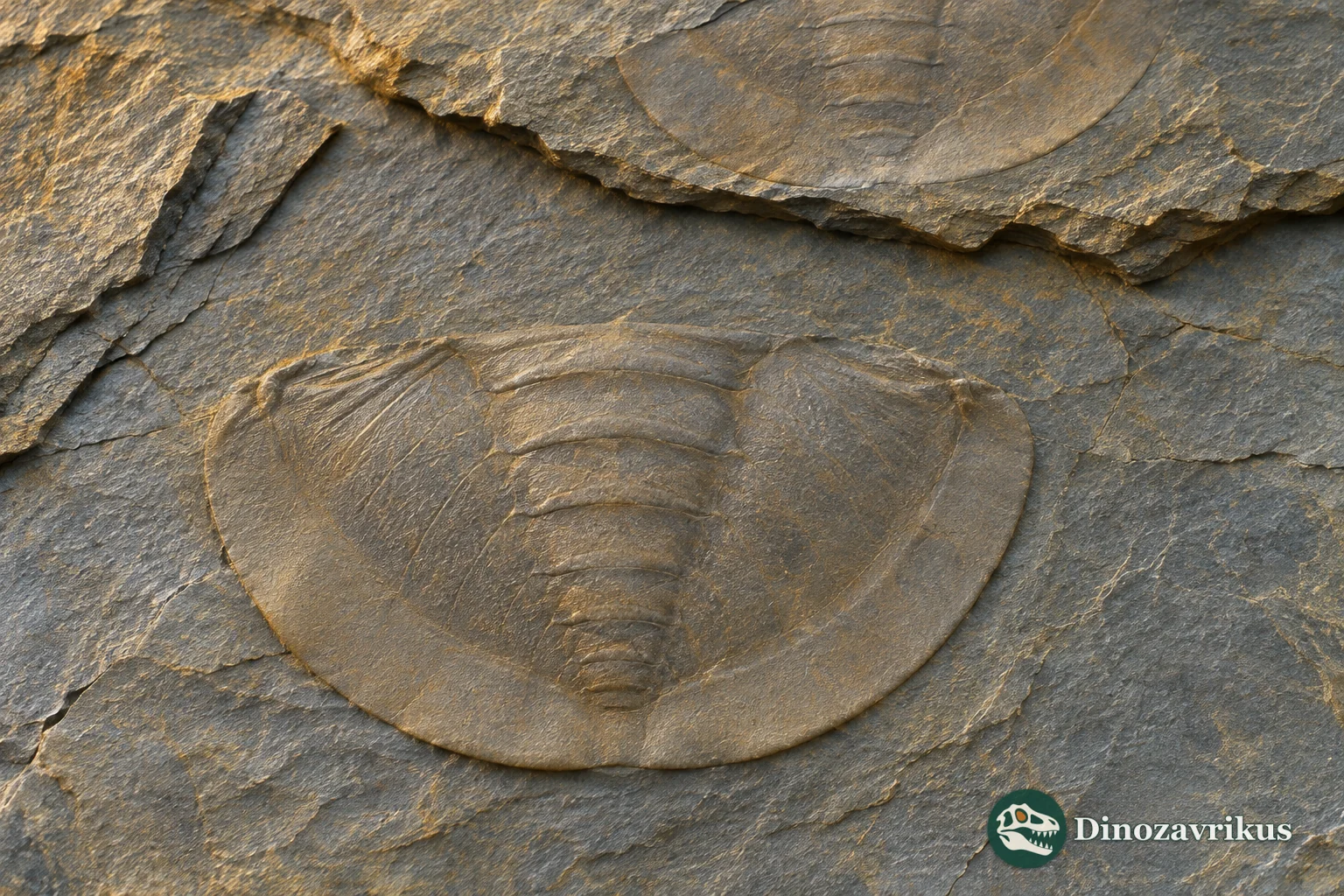
Testing the boundaries of the genus
The Cadiz Formation of California preserves related forms assigned to Glossopleura, Anoria and Sonoraspis. Frederick Sundberg found that some shield shapes and proportions grade continuously across the collection. Identification from an isolated plate therefore involves comparing several traits and their range of variation.
In North Greenland, John Peel documented G. walcotti in the Telt Bugt Formation. The biozone named for it is well represented in eastern Daugaard-Jensen Land. The formation is considerably thinner in western sections, where the trilobites did not define the same interval.
Frequently asked questions
Which species defines Glossopleura?
Glossopleura boccar, originally described from the Stephen Formation in British Columbia.
What distinguishes the head of G. boccar?
It has long, narrow eye lobes running beside the broad central lobe of the head.
Did all species have the same number of thoracic segments?
No. G. boccar had seven and G. youngi had six.
Why is there a Glossopleura walcotti Biozone?
An assemblage including this species allows geologists to correlate rocks of similar Cambrian age between sections.