

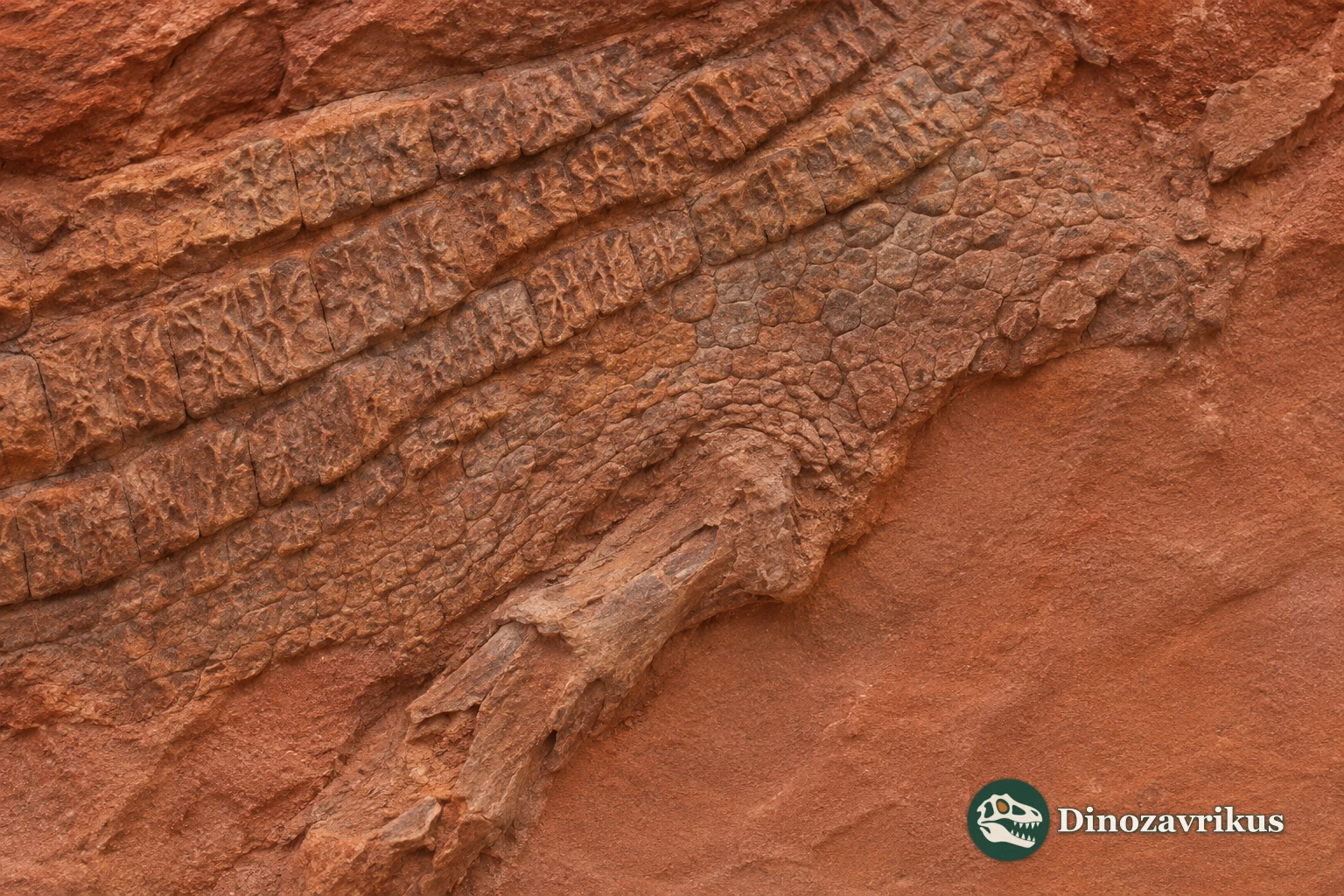
Gobiosuchus kielanae was a small crocodyliform from the Late Cretaceous of Mongolia. Its armour extended beyond the back. Articulated plates preserve rings around the neck, and smaller osteoderms cover parts of the limbs. Several specimens show how these different pieces were arranged.
Quick facts
| Species | Gobiosuchus kielanae |
|---|---|
| Family | Gobiosuchidae |
| Age | Late Cretaceous |
| Locality | Bayn Dzak, Mongolia |
| Holotype | ZPAL MgR-II/67, skull and disarticulated skeleton |
| Estimated length | About 60 cm |
What can the fossils tell us?
The holotype retains an almost complete skull. Other fossils preserve the jaws and rows of osteoderms in articulation.
Dorsal, lateral and ventral plates meet along their margins. Smaller osteoderms form patches of mosaic armour on parts of the limbs.
The researchers proposed that it may have eaten insects. The limb bones and armour offer no direct identification of its prey.
The Bayn Dzak specimens
Halszka Osmólska named Gobiosuchus in 1972 from fossils of the Djadokhta Formation. The holotype, ZPAL MgR-II/67, has a nearly complete skull flattened during preservation, with separate bones from the body and limbs. It lacks the lower jaw.
In 1997 Osmólska, Stéphane Hua and Éric Buffetaut studied additional fossils from Bayn Dzak. One preserves a skull, articulated lower jaw and front neck osteoderms together. The researchers estimated a total length of about 60 cm.
G. kielanae is the type species. A separate find from another site was named G. parvus. The 1997 review left its status open because its distinguishing features had not been adequately documented.
The construction of the armour
The neck plates joined along their edges, and the back had more than two longitudinal rows of scutes. Low ridges and pits mark their surfaces. Smaller osteoderms also survive around some limb bones, revealing differences in protection and arrangement across the body.
In the Mongolian relative Zaraasuchus, ridges on the cervical osteoderms are much higher. Comparisons of these fossils and the skulls supported an early crocodyliform branch known as Gobiosuchidae.
Life on land and the wider family
Long limbs and small body size fit the interpretation of a terrestrial animal. Protosuchus is another early crocodyliform whose limb proportions are consistent with moving on land. Insect feeding has been proposed for Gobiosuchus, although the fossils provide no direct dietary record.
Gobiosuchids are also reported from elsewhere. A 2025 analysis placed Early Jurassic Platyognathus from China in the family, extending the inferred history of this lineage. The Gobiosuchus fossils from Mongolia still date to the Late Cretaceous.
Frequently asked questions
Where was Gobiosuchus found?
Its fossils come from the Late Cretaceous Djadokhta Formation at Bayn Dzak, Mongolia.
How large was it?
A published reconstruction estimated a total length of about 60 cm.
Which parts of the body were armoured?
Preserved plates encircle the neck, form rows along the back and cover parts of the limbs.
Is its diet known?
Insect feeding has been proposed. No direct evidence identifies particular prey.