

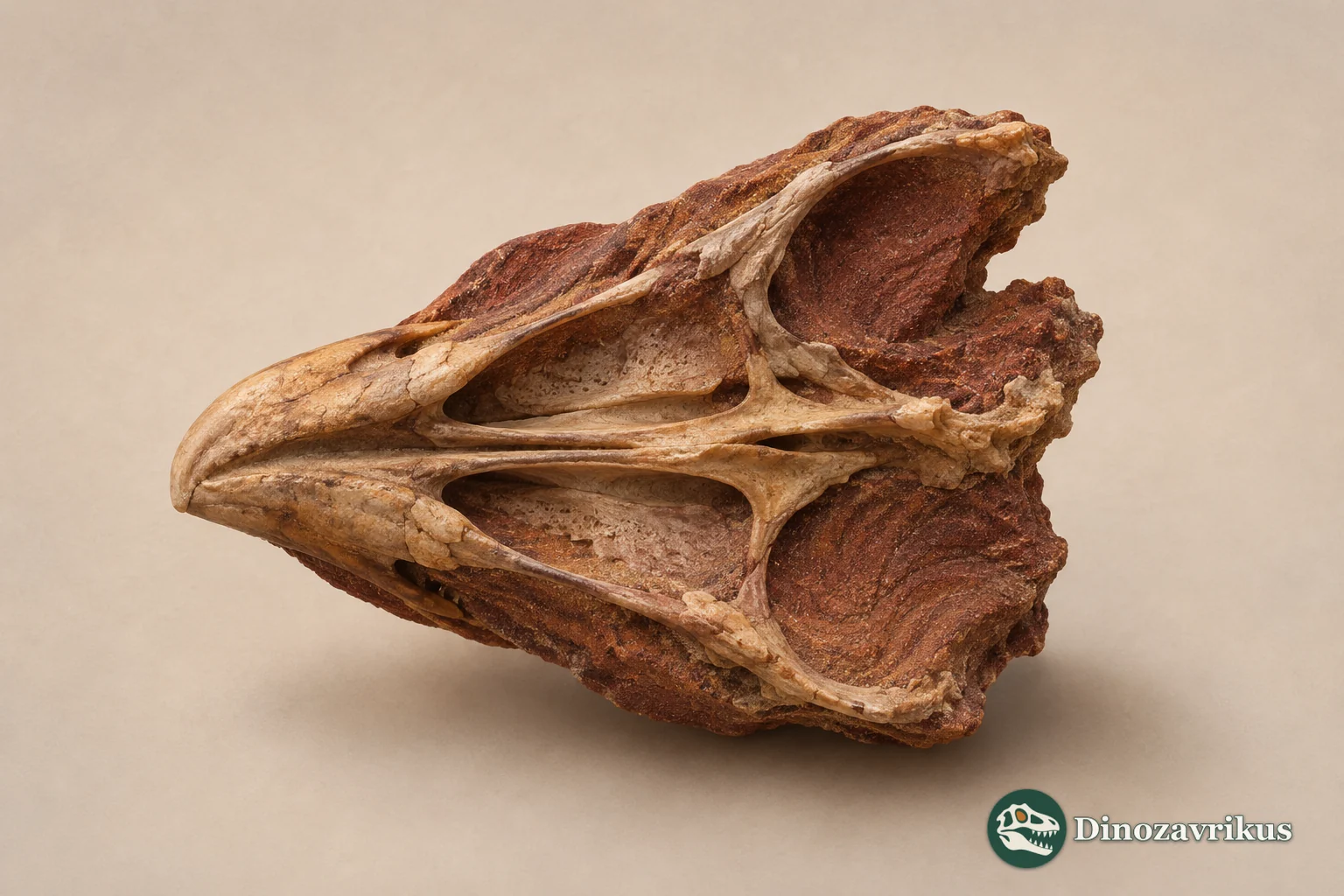
Gobipteryx was a small enantiornithine bird from Late Cretaceous Mongolia. Its upper and lower jaw bones lack teeth. The front of one skull was preserved in three dimensions, revealing the shape of the beak and the structure of the bony palate.
Quick facts
| Group | Enantiornithines (Enantiornithes) |
|---|---|
| Age | Late Cretaceous (Campanian) |
| Region | Asia (Gobi Desert, southern Mongolia) |
| Diet | Diet unknown |
| Type species | Gobipteryx minuta |
| Holotype | ZPAL MgR I/12, fragmentary skull and lower jaw |
| Strata | Barun Goyot and Djadokhta formations |
What can the fossils tell us?
The type preserves parts of the skull and lower jaw. Compression in the sediment altered some of its proportions.
The Ukhaa Tolgod fossil preserves the front of the skull in three dimensions. Its sutures and the toothless jaw margin are visible.
Embryos from Khermeen Tsav were tentatively compared with Gobipteryx. Some embryonic material from the locality later received a separate genus name.
How the identification changed
Andrzej Elżanowski described Gobipteryx minuta in 1974 from a skull found at Khulsan in the Barun Goyot Formation. Early studies compared it with palaeognaths, the group that includes living ostriches and tinamous.
Specimen IGM 100/1011 was found at Ukhaa Tolgod in 1994 and described in 2001. A sandstone concretion preserved the front of the skull and the palate in three dimensions. Its anatomy supported enantiornithine affinities and prompted a revision of the early interpretation.
What the beak bones show
The upper jaw bones are toothless. Their cutting margins rise near the tip, with a horseshoe-shaped chamber farther back on the palate. Small openings and grooves on the bone are consistent with a horny covering. The earlier Confuciusornis also had a toothless beak and belongs to a different early bird lineage.
Why the embryos are treated separately
Some embryonic skeletons from Khermeen Tsav were tentatively assigned to Gobipteryx. Later researchers described some embryos from the locality as Gobipipus reshetovi. The characteristics used to identify an adult skull and an embryo differ, so this material does not securely establish the nesting habits, diet or development of Gobipteryx.
Frequently asked questions
Where was Gobipteryx found?
Its fossils come from southern Mongolia. The type specimen was collected in Barun Goyot deposits at Khulsan.
Did it have teeth?
The preserved jaw bones are toothless. The front of the upper beak curves upwards.
What group of birds did it belong to?
It was an enantiornithine, part of an extinct branch of Cretaceous birds.
Can its eggs be identified with confidence?
The link to embryonic material from Khermeen Tsav is unresolved. Some of the embryos from there were named as a separate genus.