

Gracilineustes was a marine crocodyliform in the metriorhynchid family. The English type species had a slender snout and numerous teeth. English fossils supply the strongest evidence for the genus. A skull from France survives only through published figures and descriptions, leaving its classification open to debate.
Quick facts
| Type species | Gracilineustes leedsi |
|---|---|
| Family | Metriorhynchidae |
| Age of type species | Callovian, Middle Jurassic |
| Type locality | Peterborough area, England |
| Holotype | NHMUK PV R 3540, flattened skull |
| Deposits | Oxford Clay Formation |
What can the fossils tell us?
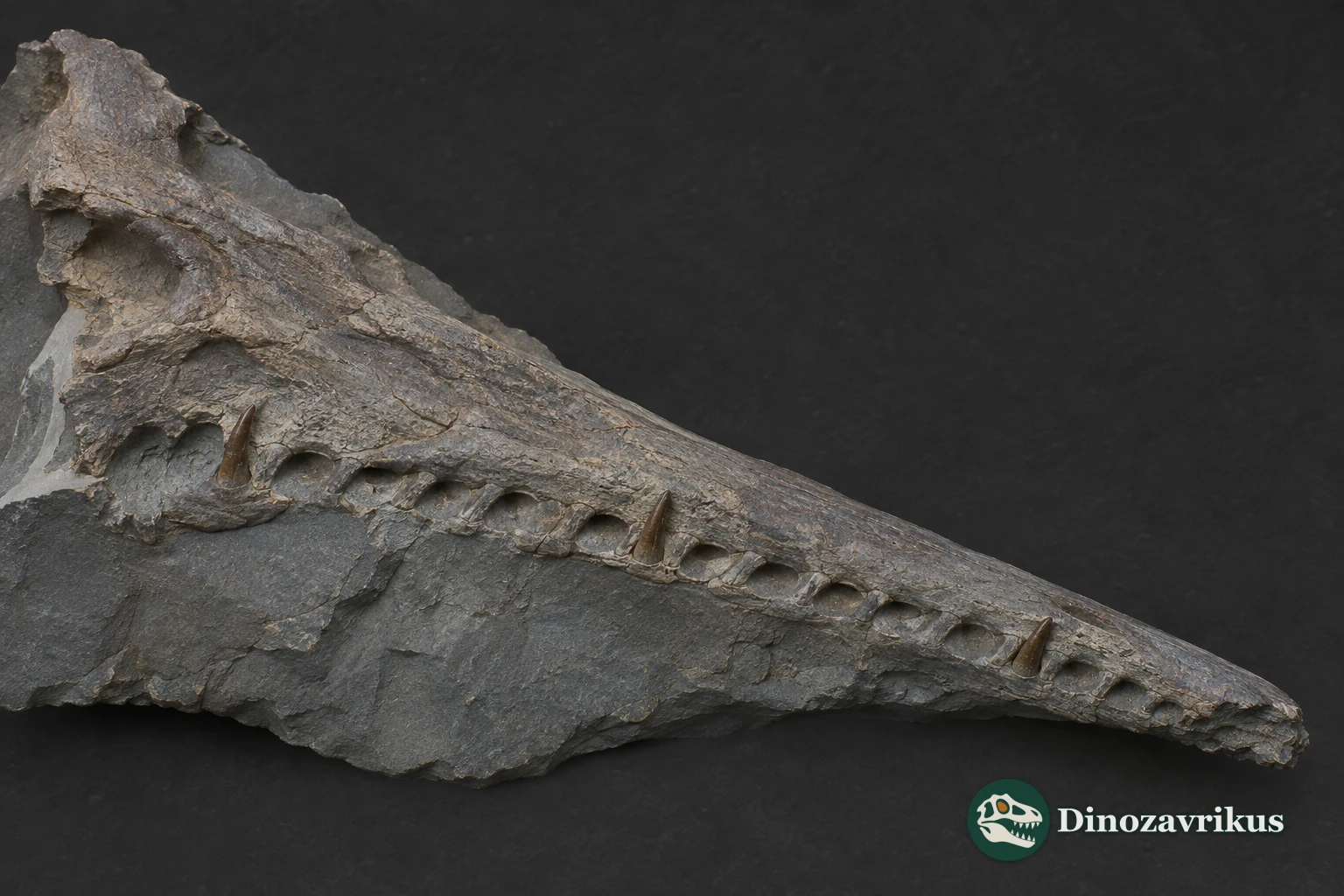
The holotype lacks the premaxilla. Other skulls and jaws help reconstruct the outline and compare the lengths of the tooth rows.
The type species was described with a soft-tissue upper lobe above the tail bend, complementing the shape of the preserved bones.
The skull named G. acutus was destroyed in 1944. The published figures permit comparison of shape but leave details of the actual bone inaccessible.
The Oxford Clay specimens
Charles Andrews described the English species as Metriorhynchus leedsi in 1913. It honours Alfred Leeds, who collected from the Oxford Clay. In 2010 Mark Young and colleagues placed the species in the new genus Gracilineustes. The holotype, NHMUK PV R 3540, is held at the Natural History Museum in London.
The fossils come from middle and late Callovian strata. The type skull is flattened and lacks the frontmost bones of the snout. Multiple specimens show the long, slim jaws and relatively smooth skull surfaces. Comparative studies give about 34 maxillary tooth positions, with some variation in what can be counted on individual fossils.
Long jaws and marine locomotion
A slender snout with numerous small teeth would have suited catching mobile prey. The jaws alone give little evidence about which animals it actually ate. Comparable snout proportions occur in other metriorhynchids, while tooth counts and details of the skull help distinguish genera.
Metriorhynchids evolved paddle-like limbs and a tail fin. In Gracilineustes the description records a soft upper lobe above the bend of the tail. Skeletons of Cricosaurus provide another comparison for marine adaptations within this family.
A French skull known from drawings
Gustave Lennier named a narrow-snouted skull from Kimmeridgian deposits in Normandy Metriorhynchus acutus in 1887. It was assigned to Gracilineustes in 2010. The type was destroyed in 1944, so subsequent comparisons have relied on the published illustrations.
A 2026 study questioned the strength of that identification. The lightly ornamented bone surfaces, for example, might reflect a young individual. The French material therefore carries a different level of certainty from the well-represented English type species.
Frequently asked questions
Where did the type specimen come from?
From Callovian Oxford Clay deposits near Peterborough, England.
How many teeth were in the maxilla?
Comparative studies give about 34 positions in a single maxilla of the English species.
What is preserved around the tail?
A soft upper lobe was described above the characteristic tail bend of this marine crocodyliform.
Why is the French identification disputed?
The original skull was destroyed. Its illustrations preserve useful features, but some characteristics cannot be checked directly.