

Habelia optata was a small marine arthropod of the Middle Cambrian Burgess Shale in British Columbia. Its fossils matter because some slabs preserve details of the head and limbs that are rarely available for early arthropods. A 2017 redescription combined Charles Doolittle Walcott's original material with later Royal Ontario Museum collections.
Cédric Aria and Jean-Bernard Caron compared 41 specimens and proposed a position in Habeliida, close to the stem of chelicerates. That is a phylogenetic hypothesis, not a claim that Habelia was a direct ancestor of spiders, scorpions or horseshoe crabs. The ancient arthropod catalogue places Habelia among other animals whose relationships are reconstructed from incomplete fossil anatomy.
Quick facts
| Scientific name | Habelia optata Walcott, 1912 |
|---|---|
| Group | Extinct arthropod; Habeliida in the 2017 analysis |
| Age | Middle Cambrian, about 505 million years ago |
| Locality | Burgess Shale, British Columbia |
| Type specimen | USNM 57693, Smithsonian National Museum of Natural History |
| Measured size | Complete specimens about 26–32 mm including the posterior spine |
| Main evidence | 41 specimens compared in the 2017 redescription |
What can the fossils tell us?
The 2017 redescription compared 41 specimens from ROM and USNM. Different fossils preserve different details, so the whole-animal model combines evidence rather than copying one complete slab.
Fossils preserve anterior limbs, gnathobases and mouth-region structures. Their assignment to particular segments depends partly on comparative anatomy.
The fossil record shows a tuberculate surface and lateral armature. It does not directly reveal colour, most soft tissues or a precise swimming posture.
Aria and Caron's 2017 phylogenetic analysis supports that placement and notes mandibulate-like feeding structures. This is not evidence that Habelia was a direct ancestor of spiders.
Walcott's fossil and a later redescription
Charles Doolittle Walcott named Habelia optata in 1912 from material at Walcott Quarry. The holotype, USNM 57693, is held by the Smithsonian National Museum of Natural History. The genus name refers to Mount Habel, later renamed Mount Des Poilus. In exceptionally preserved deposits, later collections can reveal anatomy that the first type specimen cannot show by itself.
New Royal Ontario Museum material enabled a detailed review in 2017. Researchers compared specimens from Walcott and other Burgess Shale localities with Walcott's USNM material. Preservation varies: one fossil may show the cuticle clearly, another the limbs or underside of the head. A complete reconstruction therefore combines observations across specimens and must account for flattening and missing parts.
Head, feeding structures and segmented body
The animal had a convex head shield, a segmented trunk and a long posterior region. Its exoskeleton carries numerous small tubercles; lateral plates end in spines, and the compound posterior telson was long relative to the body. Complete specimens measured about 26 and 32 millimetres including the rear spine, so Habelia was only a few centimetres long.
The most informative area is the front of the body. Fossils show several pairs of appendages, including robust toothed bases interpreted as gnathobases. These may have helped process food, but the reconstruction of the mouth region and the segment identity of appendages rely on comparative anatomy. Eyes are visible in some suitably preserved specimens, so Habelia should not simply be described as blind.
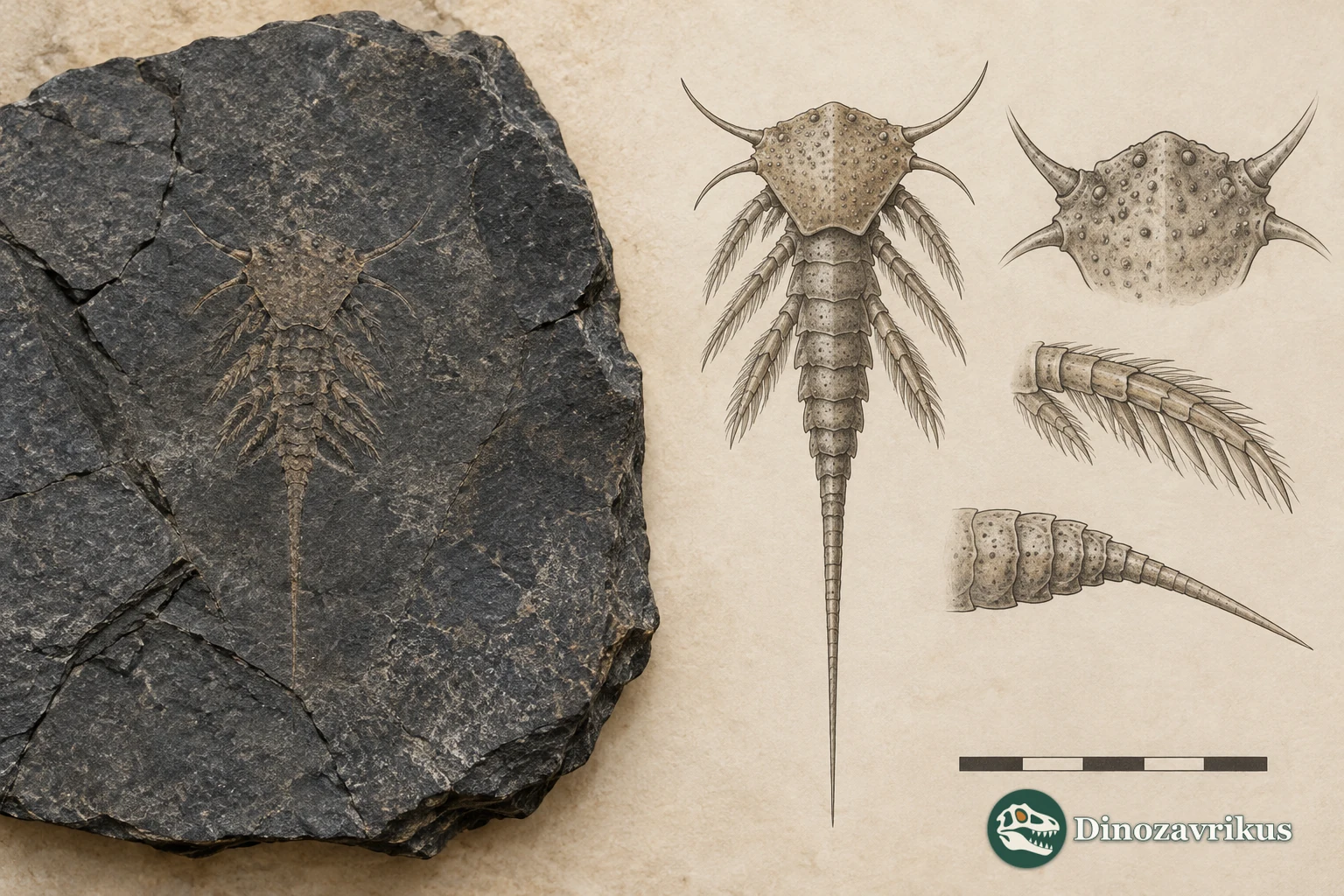
Burgess Shale arthropods are usually preserved as flattened impressions rather than bones. Their films can retain outlines and delicate appendages but rarely provide a complete three-dimensional anatomy. The illustration separates that fossil evidence from a reconstruction assembled from multiple specimens.
Relationships: a mosaic of characters, not a settled answer
Aria and Caron's 2017 analysis grouped Habelia with Sanctacaris uncata in Habeliida and recovered the group on the stem of Chelicerata. Chelicerates include spiders, scorpions and horseshoe crabs, but a fossil on the stem of a group need not be a direct ancestor of any living member. A phylogenetic tree is a testable model built from coded anatomical characters.
Habelia is unusual because some of its anterior appendages resemble structures involved in food processing among mandibulates, the group that includes crustaceans, myriapods and insects. The authors treated this as a notable resemblance across different branches, not as simple proof of close kinship. The arrangement of head segments and the evolutionary origin of the appendages remain active topics in comparative palaeontology.
Similar questions arise in Sanctacaris and Leanchoilia, but these fossils are not interchangeable examples of an “ancient spider.” Comparisons must use particular features such as shield shape, appendage structure, segmentation and eye position. New specimens or a revised character matrix can change the branching pattern.
Possible ecology and its limits
Toothed gnathobases and complex anterior limbs suggest that food may have been processed near the mouth. This has supported interpretations of Habelia as a predator or active consumer of animals. A confidently identified prey item in the gut is not the main basis for that conclusion, however. Function is inferred from the shape and arrangement of appendages and should be labelled as an interpretation.
Spines may have strengthened the body outline or discouraged predators, but a defensive role is not directly recorded either. The fossils do not establish swimming speed, exact locomotion or how often Habelia stayed close to the seabed. The marine deposit records where the specimen was buried, not every detail of its daily habitat.
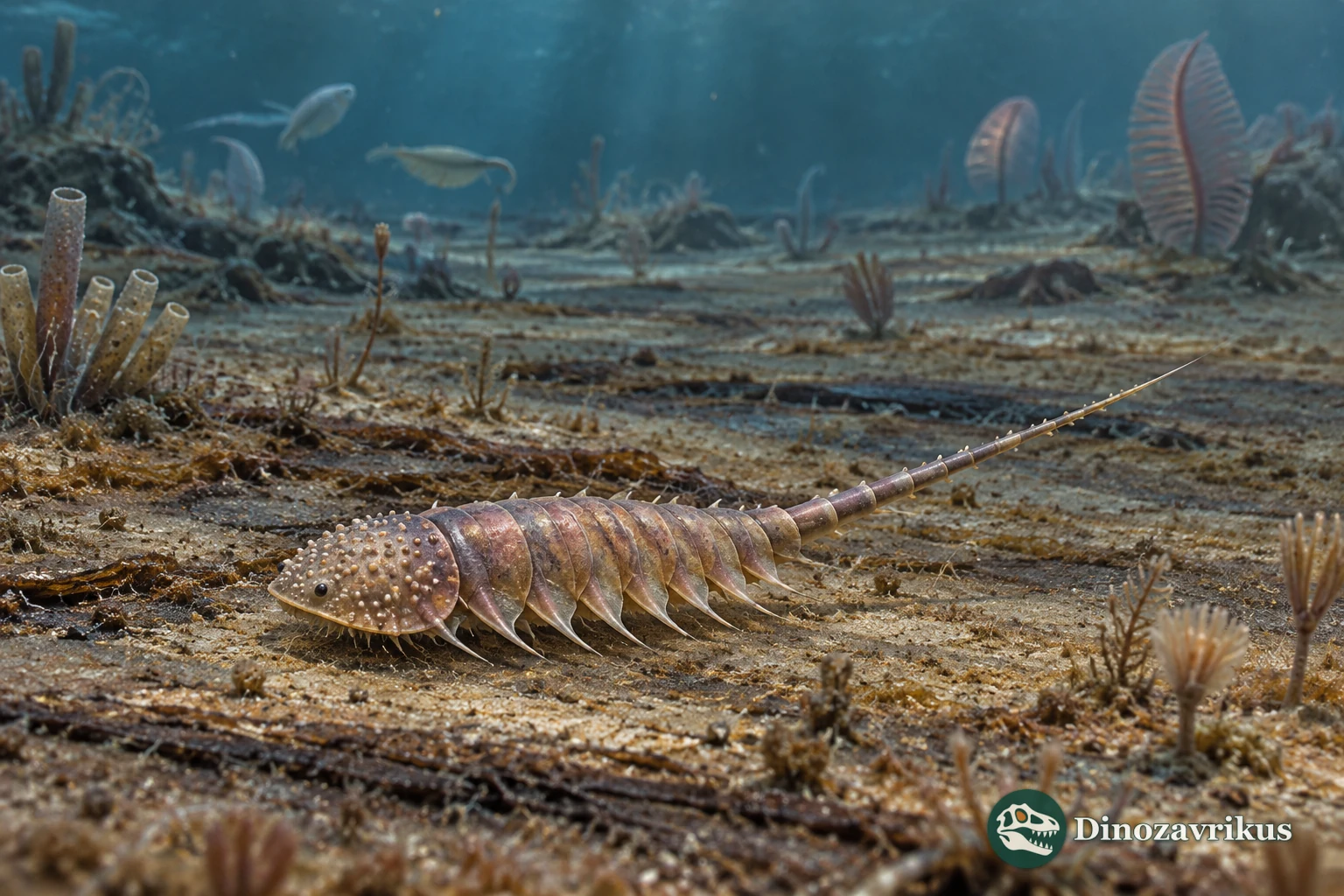
What remains unknown
Even a series of dozens of impressions cannot reveal original colour, physiology or a precise diet. Different parts of the body are visible in different specimens, and flattening changes how appendages appear to overlap. The proposed position near the chelicerate stem depends on a specific phylogenetic analysis and does not eliminate every alternative.
The strongest evidence concerns the external segmentation, tuberculate exoskeleton, spines and complex anterior appendages. These features document the diversity of early arthropods but do not justify copying the anatomy of modern spiders or crustaceans. Habelia is valuable precisely because it clarifies several structures while leaving questions about its exact relationships open.
Evidence, inference and reconstruction
| Direct evidence | Compression fossils, tuberculate cuticle, trunk segments, spines and anterior appendages |
| Research inference | Placement near the chelicerate stem and possible food-processing function of gnathobases |
| Uncertain | Exact ecology, diet, swimming posture and some head-segment interpretations |
| Reconstruction | Colour, soft tissue and a specific living posture on the seafloor |
Frequently asked questions
When did Habelia live?
Habelia optata lived in the Middle Cambrian. Its fossils come from the Burgess Shale of British Columbia, around 505 million years old.
How large was Habelia?
It was only a few centimetres long. The Burgess Shale site records complete specimens measuring 26 and 32 mm including the posterior spine; size differs by specimen.
Was Habelia an ancestor of spiders?
There is no evidence that it was a direct spider ancestor. A 2017 analysis placed it near the stem of chelicerates, which describes a proposed branching position, not direct ancestry.
What did Habelia eat?
Its diet is not established. Toothed bases on the anterior limbs support an interpretation of food processing, but they do not identify a particular prey or menu.