

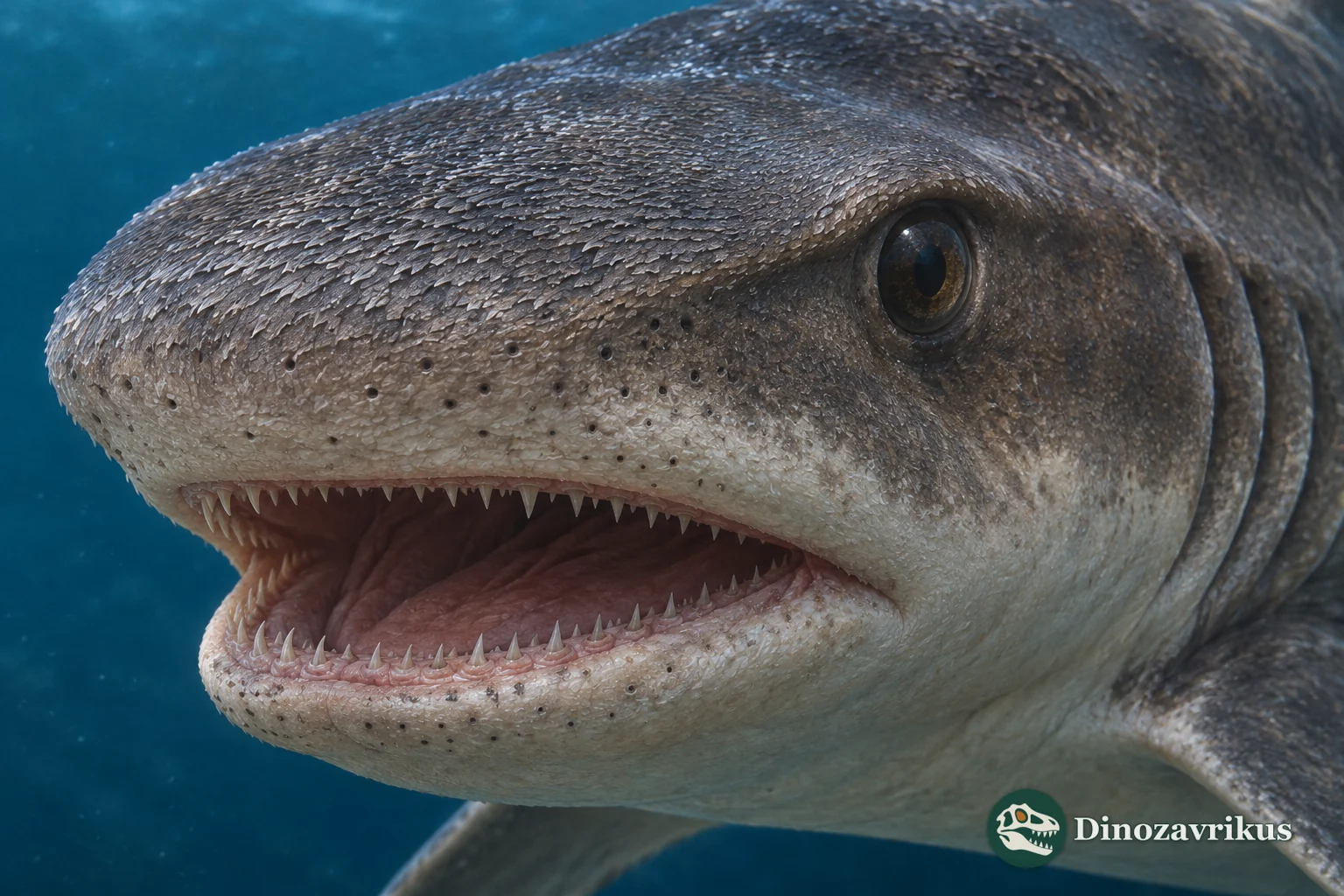
Haimirichia amonensis was a Cretaceous lamniform shark first recognized from isolated teeth. An articulated anterior skeleton from Agoult, Morocco, preserved its broad head, short flattened snout, jaws and sensory structures. The back half of that specimen is absent; the whole animal on the cover is an artistic reconstruction.
Quick facts
| Species | Haimirichia amonensis |
|---|---|
| Group | Lamniformes, Haimirichiidae |
| Original name | Odontaspis amonensis, 1975 |
| Type fossil | UM ACA 3, a tooth from Woodbine Formation, Texas |
| Articulated fossil | UM AGT 1, anterior body from Agoult, Morocco |
| Agoult age | Late Cenomanian to possibly earliest Turonian |
| Estimated total length | Approximately 1–1.2 m, model-dependent |
What can the fossils tell us?
UM ACA 3 from Texas documents tooth shape but no body outline.
UM AGT 1 includes the rostral cartilages, dentition, gill arches, anterior vertebrae and one pectoral fin. It lacks the tail.
Researchers identified structures interpreted as denticle-embedded ampullary organs. The fossil cannot show a particular hunting event.
From Texas tooth to Moroccan skeleton
Cappetta and Case named Odontaspis amonensis in 1975 from a lateral tooth, UM ACA 3, in the late Cenomanian Woodbine Formation near the former Amon Carter Airfield in Texas. Later authors moved similar teeth among lamniform genera because a single crown had limited anatomical context.
Vullo, Guinot and Barbe described the articulated Agoult specimen in 2016. Its preserved dentition links it to amonensis, while skull and vertebral characters justified the new genus Haimirichia and family Haimirichiidae. A loose tooth is also less informative than associated anatomy in Cretalamna.
What survived at Agoult
The slab and counterslab of UM AGT 1 preserve rostral cartilages, nasal capsules, orbits, tooth rows, gill arches, anterior vertebrae and a pectoral fin. The preserved distance from snout tip to the rear of that fin is about 26 cm. This is the surviving front portion, not the shark's total length.
Agoult's laminated marine limestones belong to the lower Akrabou Formation and are dated to the late Cenomanian, possibly extending into the earliest Turonian. The authors judged that the rear of the carcass was already gone before burial. Its absence was not simply excavation damage.
An uncommon head shape
The head is longer than broad, but the cranium itself is broader than long. The short rostrum has a flattened, bell-like outline and a divided rostral node. The connected tooth rows show how anterior and lateral teeth differed; a detached crown could not reveal that positional sequence.
The fossil preserves cartilage rather than the exact contour of all the living soft tissues. The head illustration highlights the documented broad shape, while skin colour and some surface detail are interpretive.
Skin and electroreception
A separate 2015 study described ampullary structures embedded among specialized denticles on the snout. Their preservation gives rare anatomical evidence for a sensory system in an extinct shark. A proposed role in detecting prey is a functional inference by comparison with living sharks; no prey remains or hunting behavior are documented in this specimen.
Body size and reconstruction
The 2016 authors estimated approximately 1–1.2 m in total length using preserved vertebrae and a comparative model of the absent tail. The estimate is conditional on body proportions. The fossil directly establishes the anterior skeleton, teeth and some skin structures; the complete fin and tail arrangement shown in art is reconstructed.
Frequently asked questions
Where was the Haimirichia type fossil found?
The type specimen UM ACA 3 is a tooth from the Woodbine Formation in Texas. The articulated partial skeleton UM AGT 1 came from Agoult in Morocco.
Why was a new genus named?
The Moroccan fossil preserved head, dentition and vertebrae that together differed from the genera previously used for isolated amonensis teeth.
Is a complete Haimirichia skeleton known?
No. UM AGT 1 retains the front of the animal and one pectoral fin but no tail or most of the trunk.
How was its total length estimated?
The approximate 1–1.2 m estimate uses preserved vertebrae and a comparative model for the missing rear body.