

Hainosaurus is a genus of large mosasaurs known from Late Cretaceous fossils in Europe and North Africa. Its name refers to the Haine River in Belgium, near the locality associated with the type material. The genus has a complicated history because researchers disagree over whether its dental and cranial differences justify keeping it separate from Tylosaurus. The evidence-led profile belongs in the marine reptile catalogue among the most actively debated tylosaurines.
Quick facts
| Scientific name | Hainosaurus Dollo, 1885 |
|---|---|
| Type species | H. bernardi Dollo, 1885 |
| Group | Mosasauridae, Tylosaurinae |
| Age | Late Cretaceous, Campanian to Maastrichtian reports |
| Known regions | Belgium and Morocco; older referrals are disputed |
| Evidence | Skulls, teeth and incomplete postcranial remains |
| Diet | Predatory mosasaur; exact prey is not established |
| Body length | Species-specific estimates; no secure genus-wide maximum |
What the fossils show
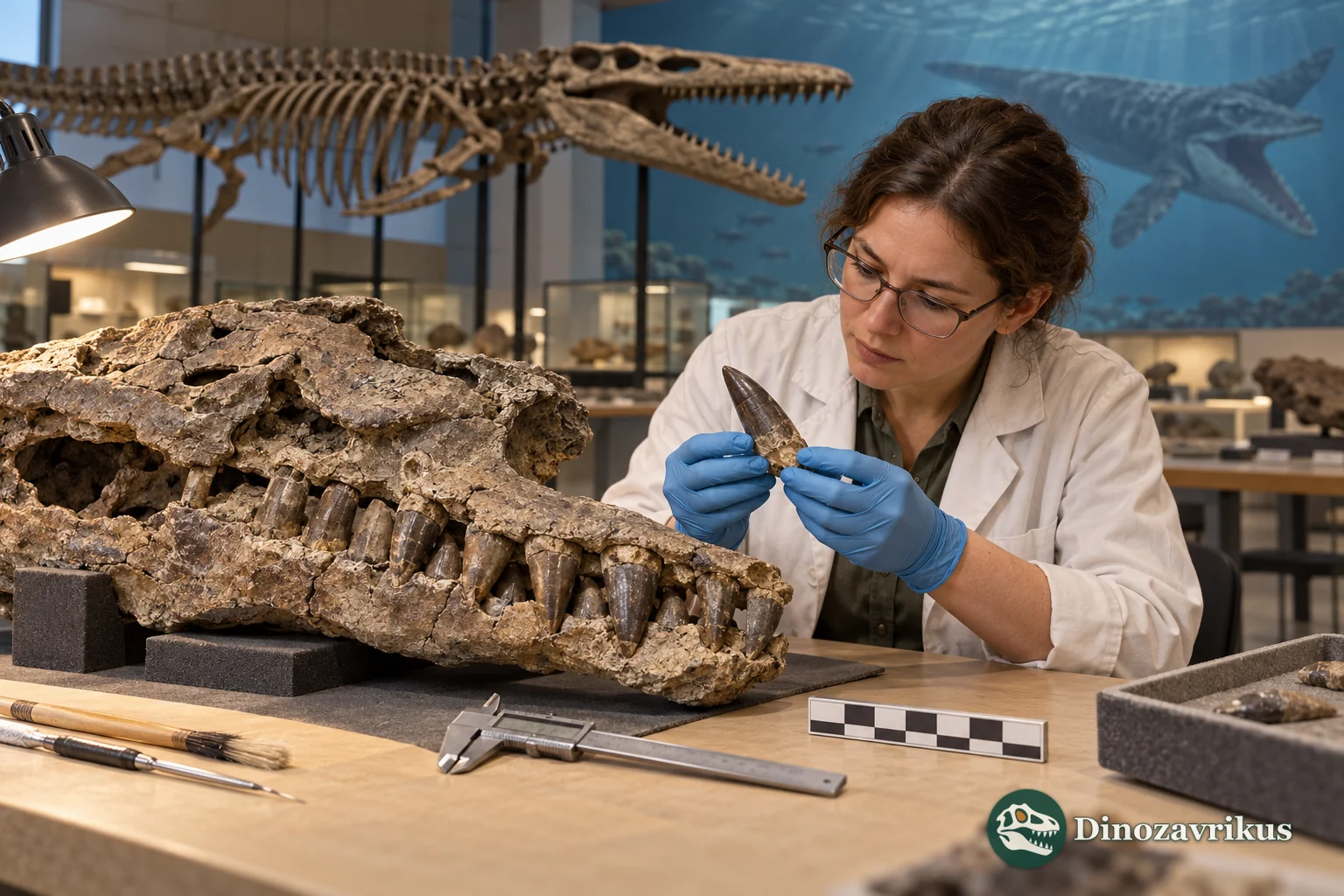
The compressed shape and cutting edges of some teeth have been used to distinguish Hainosaurus from Tylosaurus. These traits are most useful in combination with cranial anatomy, not as a stand-alone label for an isolated tooth.
Revisions compare the type material of H. bernardi and related tylosaurines. Those direct comparisons have produced different taxonomic conclusions, including synonymy in 2016 and renewed separation in 2026.
H. bernardi and H. boubker are central to current discussions. H. pembinensis and H. gaudryi have been transferred to Tylosaurus in revisions, so older assignments should not be treated as settled.
The name and type material
Louis Dollo established Hainosaurus in 1885. The type species, H. bernardi, comes from the Belgian Cretaceous phosphate complex around Ciply. Later phylogenetic matrices scored the type material IRSNB R 23 and IRSNB R 471, held by the Royal Belgian Institute of Natural Sciences. These specimens preserve important cranial and skeletal anatomy, but they do not form the kind of complete, continuously articulated skeleton from which total body length can simply be read.
Nineteenth-century descriptions referred a substantial set of bones to the animal and portrayed it as exceptionally large. Modern work has to separate elements preserved in the name-bearing material, additional bones referred by comparison, and parts restored in illustrations. A complete skeleton of the type species is not known.
Why researchers merged it with Tylosaurus
In 2016, José Jiménez-Huidobro and Michael Caldwell redescribed H. bernardi and concluded that the genus could not be diagnosed independently from Tylosaurus. They transferred the species as Tylosaurus bernardi, based on comparisons of cranial characters. The proposal challenged the long-used separation between the genera.
Other researchers continued to use Hainosaurus and emphasised its dental character combination. A 2014 study of tylosaurines from northern Germany retained it as distinct: teeth attributed to Hainosaurus were described as more laterally compressed and finely serrated, whereas typical Tylosaurus teeth are more oval in cross-section and lack those cutting edges. This distinction helps frame comparisons in our article on Tylosaurus and other mosasaurs, but it must be tested against variation and the exact specimens being compared.
A 2026 revision describing Tylosaurus rex and revising mosasaur character data rescored the type specimens of Hainosaurus bernardi and several historically assigned forms. Its authors found enough morphological differences to justify generic distinction between Hainosaurus and Tylosaurus, and used the former name again for taxa previously placed there. This is a recent, evidence-based position, not a guarantee that the genus will never be revised again.
Species and disputed referrals
The best-supported core includes the Belgian type species H. bernardi and the Moroccan H. boubker, described in 2022. The latter is based on several partial skulls and isolated teeth from the Couche III level of the Sidi Chennane phosphate quarry near Oued Zem. Its authors estimated a body length of about 8–12 metres from incomplete cranial material and comparisons with other mosasaurs. That is a reconstruction range, not a measurement of a whole skeleton. The species name honours Boubker Rempert.
H. pembinensis and H. gaudryi have been transferred to Tylosaurus in taxonomic revisions. Their use in a 2026 comparison matrix does not by itself make them uncontroversial members of Hainosaurus. The diagnostic basis for H. neumilleri is also weak; a 2019 phylogenetic study treated it as a doubtful name within Tylosaurus.
Age, geography and setting
The type species H. bernardi comes from Late Cretaceous marine phosphate deposits in Belgium. H. boubker is from latest Maastrichtian phosphates in Morocco. The sites lie far apart and represent separate marine basins and intervals. Together they document tylosaurines in more than one setting, not a single continuous population or range.
The Moroccan phosphates accumulated in a shallow marine system with a diverse vertebrate fauna. Other mosasaurs, sharks, bony fish and marine turtles occur in the broader assemblage. The Belgian material belongs to a different north-west European chalk-sea complex. The two environments can be compared as marine ecosystems, but details from one formation should not be transferred to the other.
Anatomy and body size
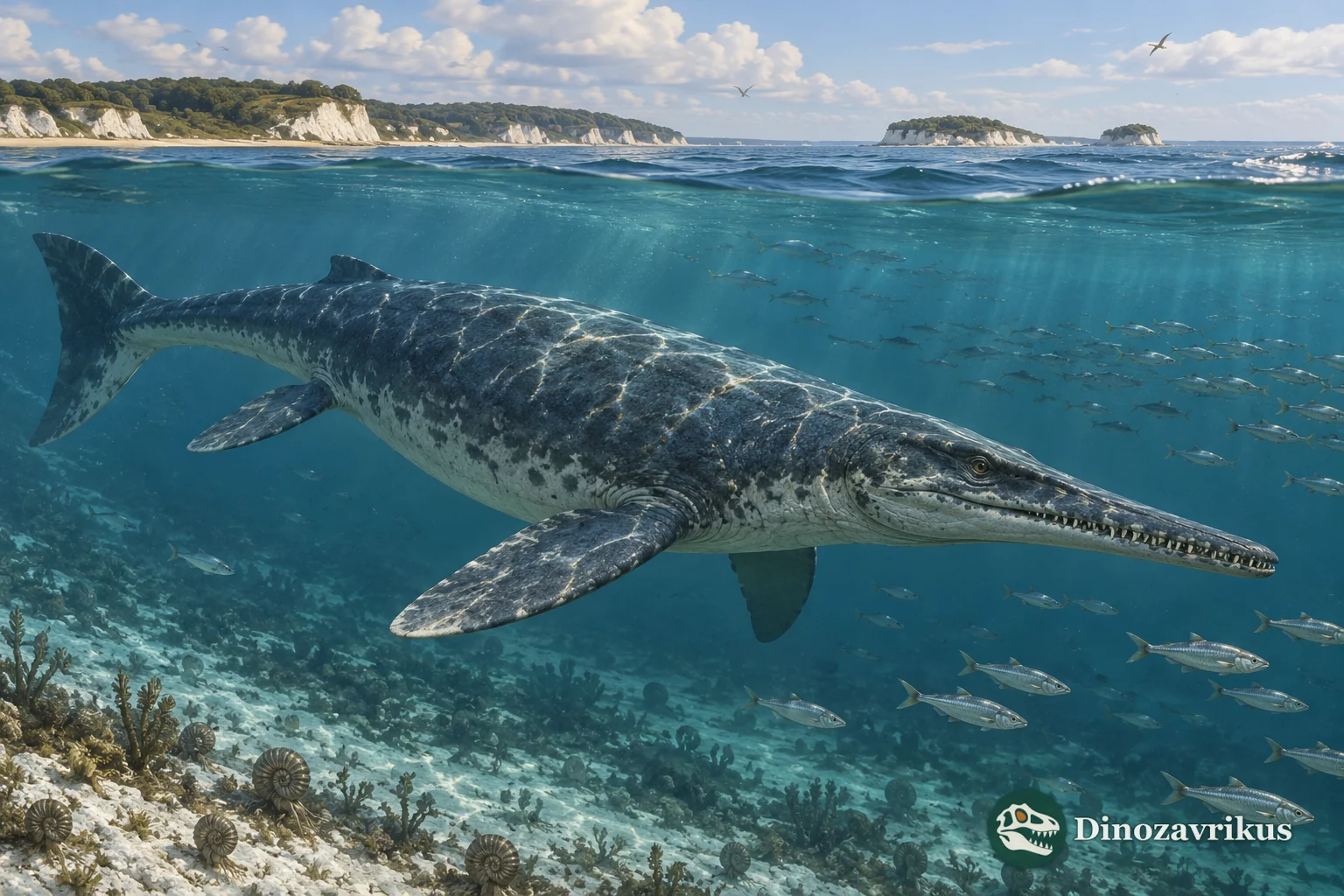
Tylosaurines were marine squamates with elongated bodies, four paddle-shaped limbs and a tail adapted for propulsion. In Hainosaurus, researchers especially discuss the long skull and a specialised, partly serrated dentition. Teeth support an interpretation of gripping and cutting prey, but they do not identify the exact prey species or prove one exclusive hunting technique.
There is no single dependable maximum length for the genus. The estimate of 8–12 metres for H. boubker comes from incomplete skull material and comparison with other mosasaurs. Popular estimates for H. bernardi vary substantially and often depend on scaling from isolated bones. The Moroccan range should not be transferred automatically to the Belgian type species or every taxon historically called Hainosaurus.
Feeding and life in the sea
Tooth form, skull size and membership in Mosasauridae indicate a predatory animal. The Moroccan phosphates preserve a rich community of potential prey, but fossils from the same formation do not show that a particular individual ate a particular species. Stomach contents, appropriately sized bite marks and tooth morphology would provide more direct evidence for diet.
The large paddles and tail fluke indicate active swimming, as in other mosasaurs. Exact speed and manoeuvrability have not been measured directly for Hainosaurus. Colour, social behaviour and parental care are also unknown. The illustrations suggest possible appearance; they are not observations of behaviour.
What the fossils support
Fossils document large mosasaurs with distinctive cranial and dental features named Hainosaurus. Researchers disputed the genus boundary, but a 2026 analysis again supported separation from Tylosaurus. The species list remains uneven: some names were reassigned and others are too fragmentary for confident diagnosis.
The cover shows a generalised long-snouted tylosaurine. Body proportions, skin pattern, colour and swimming scene are artistic choices, not details preserved by the bones. Length estimates are included only where a published comparative basis is available.
Explore the marine reptile catalogue for related fossil profiles.
Frequently asked questions
Is Hainosaurus a separate genus or a species of Tylosaurus?
The answer depends on the revision. A 2016 paper transferred H. bernardi to Tylosaurus, while a 2026 analysis judged the differences between the genera sufficient to use Hainosaurus again.
Which species are assigned to Hainosaurus?
The Belgian type species H. bernardi and Moroccan H. boubker are central to current discussion. H. pembinensis and H. gaudryi have been transferred to Tylosaurus, while other names have limited diagnostic evidence.
How long was Hainosaurus?
A published estimate for H. boubker is about 8–12 metres, based on incomplete skull remains. It is not a direct measurement of a complete skeleton or a universal size for the genus.
What did Hainosaurus eat?
It was a large predatory mosasaur. Teeth and skull anatomy support prey capture, but a specific diet is not established without direct feeding traces.