

Haliskia peterseni is based on one of the most complete Australian pterosaur skeletons. The skull, lower jaw, hyoid bones and parts of the wing were preserved together in late Albian Queensland rocks. Its tooth pattern is directly observable; wingspan and feeding style require inference.
Quick facts
| Scientific name | Haliskia peterseni, Pentland and colleagues, 2024 |
|---|---|
| Holotype | KK F1426, partial skull and skeleton |
| Discoverer | Kevin Petersen found and prepared the fossil |
| Locality | Northwest of Richmond, Queensland, Australia |
| Rock and age | Toolebuc Formation, late Albian |
| Teeth | 43 preserved teeth, with diagnostic pair sizes |
| Wingspan | About 4.6 m by comparison, not direct measurement |
What can the fossils tell us?
KK F1426 includes the front skull, complete lower jaw, hyoids, vertebrae, ribs and parts of wings and legs. Major wing bones remain absent.
The fourth and fifth tooth pairs are smaller than the third and sixth. Together with socket dimensions, this helps distinguish Haliskia.
The hyoid rods are approximately 70% of lower-jaw length. They inform a feeding hypothesis but do not preserve a meal.
The authors estimated about 4.6 m from preserved bones and relatives. The humerus and forearm bones are missing, so a full wing was not measured.
Kevin Petersen's Queensland find
Kevin Petersen found and prepared specimen KK F1426 at Dig Site 3 northwest of Richmond, Queensland. Adele Pentland and colleagues named it Haliskia peterseni in 2024, honouring its discoverer in the species name. The fossil came from the Toolebuc Formation of the Eromanga Basin, dated to the late Albian of the Early Cretaceous.
Its front skull and part of a premaxillary crest, complete mandible, both hyoid elements, vertebrae, ribs, wing and leg bones, and 43 teeth are preserved together. Such associated material is rare for Australian pterosaurs. Nevertheless the humerus and forearm are absent, and other wing parts are incomplete.
A distinctive dental sequence
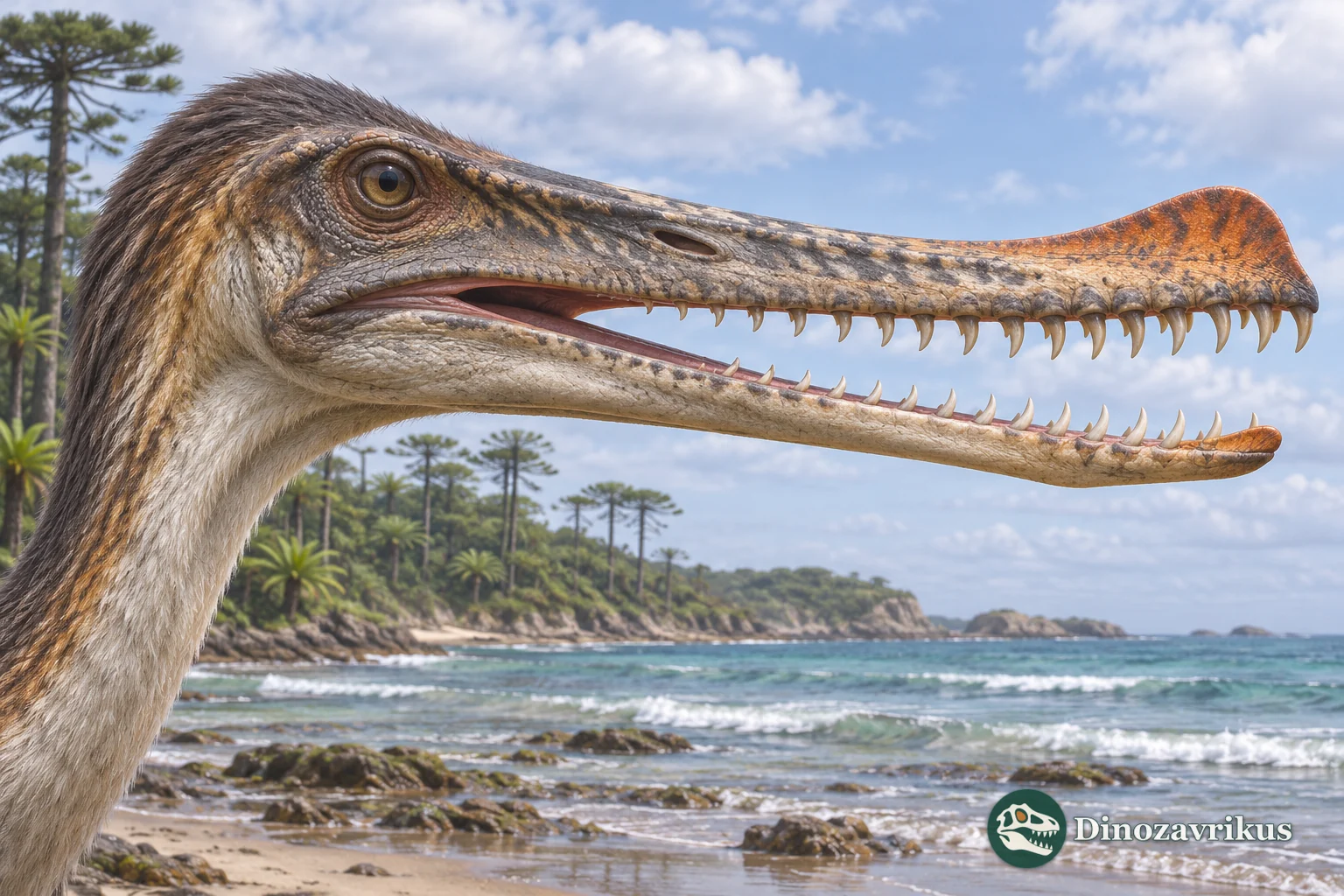
Haliskia had long jaws with curved teeth and a low crest near the front of its snout. The fourth and fifth tooth pairs are smaller than the third and sixth; neighbouring tooth sockets also show a distinctive size sequence. The authors used these observable features and shoulder-girdle anatomy to place it among anhanguerians.
The long hyoid rods measure about 70% of the lower-jaw length. Their structure prompted discussion of tongue movement during feeding. No stomach contents or captured prey survive, so a particular prey species or precise swallowing method cannot be established.
Wingspan and relationships
Comparing the preserved coracoid, fourth metacarpal and first wing-finger phalanx with related pterosaurs, the authors estimated a span near 4.6 m. This is a model, not a measurement of a fully extended wing. Missing humerus and forearm bones limit its precision.
One phylogenetic analysis recovered Haliskia close to Ferrodraco. Another left Haliskia, Ferrodraco and Mythunga unresolved within their group. The broad relationship is supported, but the exact branching remains unsettled. Thapunngaka, known from much less material, illustrates why Australian size comparisons need particular care.
The inland sea and life art
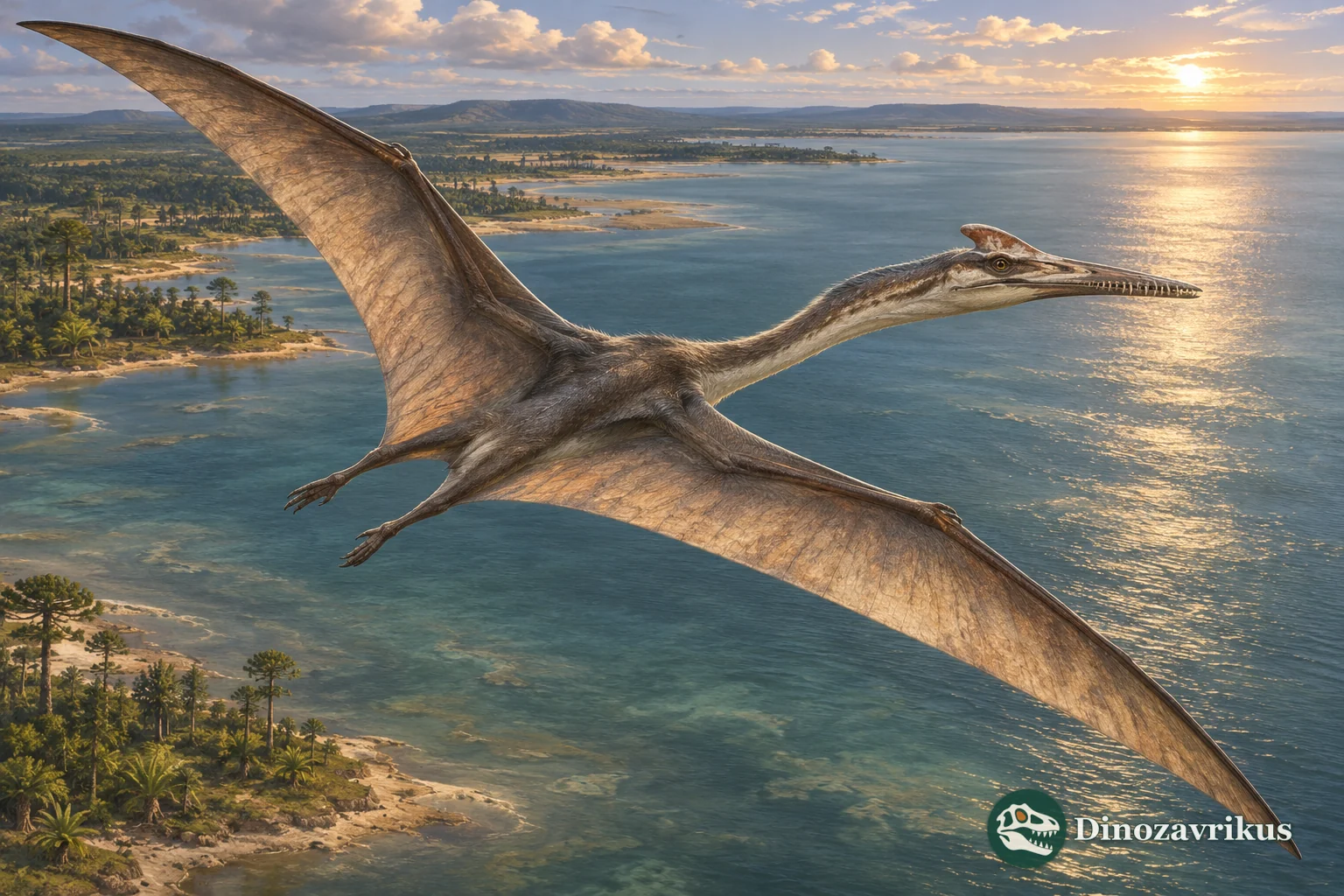
The Toolebuc Formation was deposited in the ancient Eromanga Sea. That is a geological setting for burial, not a direct record of how often Haliskia flew over water or what it caught there. Aussiedraco is another Australian pterosaur, but shared regional context cannot establish an identical feeding niche.
The cover and flight scene show a possible living animal. Pose, colour and shoreline are artistic reconstructions. Fossils establish toothed jaws and a flying skeleton, not one particular flight.
Frequently asked questions
Who discovered Haliskia?
Kevin Petersen found and prepared holotype KK F1426. The species honours him and was described by Pentland and colleagues in 2024.
Where was its skeleton found?
At a site northwest of Richmond in Queensland, Australia, in the late Albian Toolebuc Formation.
Was the 4.6-metre span measured directly?
No. It is an estimate from comparisons of surviving wing bones with related pterosaurs; several major elements are missing.
Do we know what it ate?
Teeth and the long hyoid apparatus inform feeding hypotheses, but the fossil preserves no direct prey or stomach contents.