

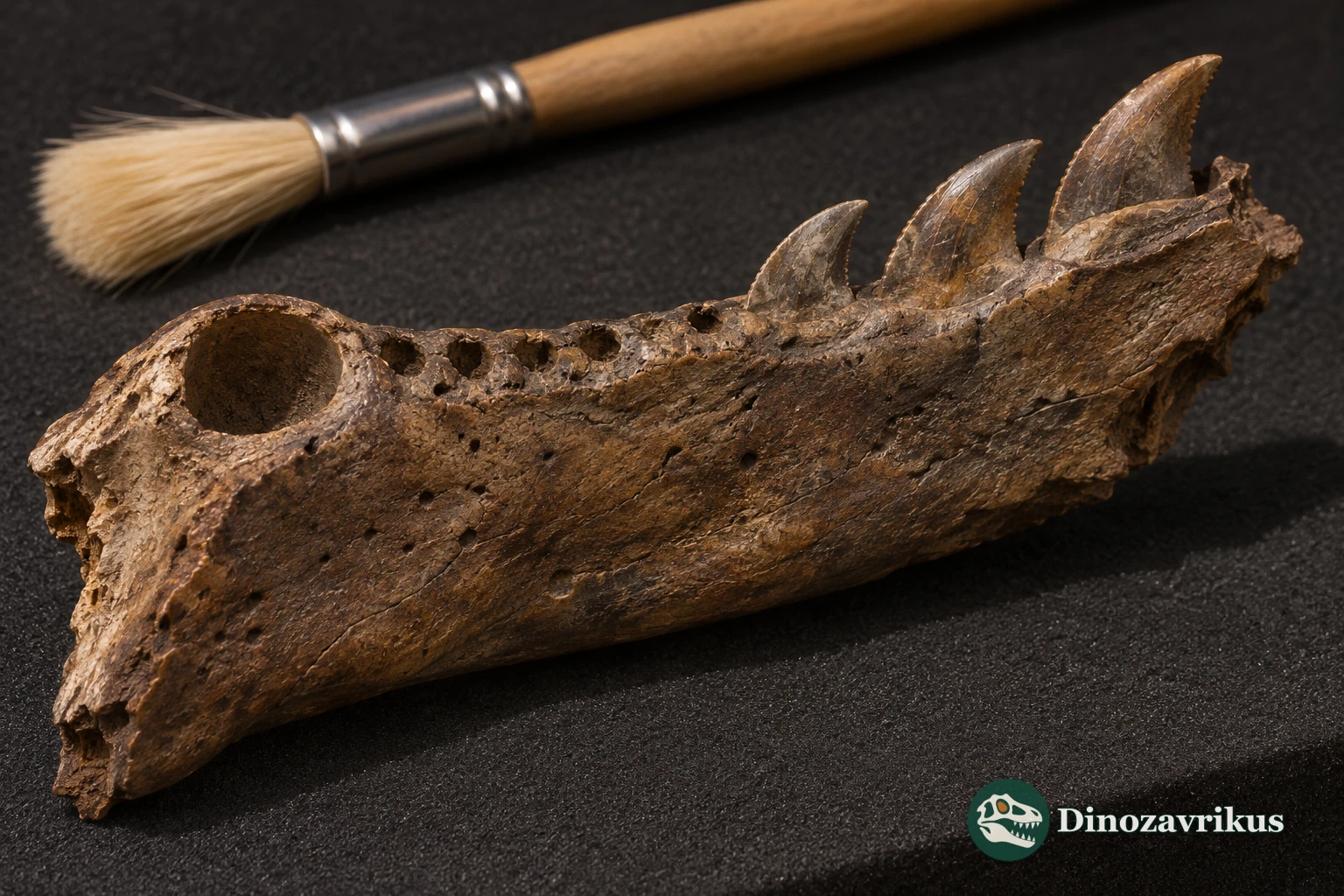
Hamadasuchus rebouli was a Cretaceous crocodyliform from North Africa. Its name was based on an incomplete left dentary with markedly different tooth sockets along the jaw. A CT study checked features of the original specimen and helped researchers reassess more complete fossils from Morocco and Algeria.
Quick facts
| Type species | Hamadasuchus rebouli |
|---|---|
| Group | Peirosauridae |
| Age | Late Albian to Cenomanian |
| Type locality | Hamada du Guir, Kem Kem Group, Morocco |
| Holotype | MDE C001, partial left dentary |
| Repository | Musée des Dinosaures, Espéraza, France |
What can the fossils tell us?
The bone is incomplete and has some restored areas. CT scans revealed preserved socket margins beneath damage and preparation.
Four small sockets follow the enlarged fourth. Farther back, tall and laterally flattened tooth crowns have serrations along their cutting edges.
Some jaws previously assigned to the species have fewer sockets within the area joining the two halves. The Algerian jaw shares several distinctive traits with the type, but a species-level match remains tentative.
The dentary that gave the species its name
Roland Reboul collected the fragment that Éric Buffetaut described in 1994. The species name honours Reboul. The Musée des Dinosaures in Espéraza holds the fossil as MDE C001. Its provenance is Hamada du Guir in the Kem Kem deposits of Morocco.
Yohan Pochat-Cottilloux and colleagues scanned the holotype for a study published in 2024. They confirmed fifteen tooth sockets, seven of them in the part of the dentary that joined the opposite half of the lower jaw. In the damaged front of the fossil, scans revealed part of the third socket and its tooth.
Serrated teeth and an uneven tooth row
The fourth socket is about 9.5 mm across in both measured directions. The fifth is much smaller, about 5 by 4.7 mm. The row expands again farther back, where preserved tall crowns have flattened sides and finely serrated edges.
The teeth are consistent with grasping and slicing prey. The jaw gives no direct record of which animals were eaten. Paired depressions on its outer surface may be tooth marks from another animal. The fossil alone does not establish the maker or the timing of the marks.
Why the more complete skulls are under review
Hans Larsson and Hans-Dieter Sues described more complete material under the name Hamadasuchus in 2007, including the skull ROM 52620. The fragmentary type jaw overlaps with few of the areas preserved in a skull like this. Two referred jaws, ROM 49282 and NMC 41784, were found to have only five sockets completely enclosed within the dentary part of the jaw joint, compared with seven in the type.
In 2023 a study identified MNHN-SAM 136 from La Gara Samani in Algeria as belonging to the genus on a combination of characters, including tightly spaced sockets and the large fourth socket. The authors called it Hamadasuchus cf. rebouli. The abbreviation marks a close comparison with the Moroccan species with uncertainty about its species identity.
Rivers and deltas in Cretaceous Morocco
The Kem Kem Group includes sand and finer sediment laid down in ancient channels and deltas. Spinosaurus is also known from these deposits. Fossils from the group document the broader fauna. Their occurrence in the same rock group does not establish direct coexistence at one site or time.
Frequently asked questions
What did CT scanning confirm?
The type has fifteen visible tooth sockets. Seven lie within the part of the dentary that joined the other half of the jaw.
Can its whole head be reconstructed with confidence?
The original fossil records only part of the lower jaw. The rest of the head depends on which skulls can eventually be assigned to the species.
Does it occur in Algeria?
A jaw from La Gara Samani was assigned to the genus. Its identification as the same species as the Moroccan fossil is tentative.
What does the name Hamadasuchus mean?
The genus name refers to a stony plateau and uses a Greek word for crocodile. The species honours Roland Reboul, who collected the type.