

Hauffiopteryx was a small- to medium-sized ichthyosaur of the Early Jurassic. Its fossils show a streamlined body, four paddles, a relatively short slender snout and a large rounded orbit. Several skeletons allow useful comparisons of its skull and limbs, though not every part of the animal is equally well known.
Quick facts
| Type species | Hauffiopteryx typicus; a second species, H. altera, is recognised |
|---|---|
| Age | Late Pliensbachian and Toarcian, Early Jurassic |
| Localities | South-western Germany; referred material from England and Switzerland |
| Type specimen | Lectotype GPIT 1491/4, a nearly complete skeleton with a partial soft-tissue outline |
| Estimated length | About 2–3 m for the genus; several individual skeletons are incomplete |
| Key features | Short, slender snout, large rounded orbit and tightly packed fin bones |
Evidence guide
Lectotype GPIT 1491/4 preserves nearly the whole skeleton and a partial soft-tissue outline. The bones are strongly compressed, so the slab is not a perfect three-dimensional record of body proportions.
Diagnostic skulls show a relatively short, slender rostrum and a large rounded orbit. Differences in several skull bones distinguish H. typicus from H. altera; orbit size alone cannot establish visual ability or diving depth.
Angular proximal limb elements fit closely together, and the leading edge of an anterior digit has notches in both fore- and hindfins. These features describe anatomy, not swimming speed by themselves.
The 2020 revision recognised H. altera from differences in skull bones and their contacts around the external naris. Its holotype had previously been treated as a juvenile Eurhinosaurus.
From an old species name to a separate genus
In 1931 Friedrich von Huene described the animal as Stenopterygius hauffianus forma typica. It was later placed in the separate genus Hauffiopteryx. The genus name honours the Hauff family, associated with the famous fossil beds of Württemberg, and combines the name with a Greek word for fin or wing.
Hauffiopteryx typicus remains the type species. In 2020 Laura Maxwell and Denis Cortés revised the material assigned to the genus and named a second species, H. altera. Its holotype had once been considered a juvenile Eurhinosaurus longirostris, but skull anatomy showed a distinct Hauffiopteryx species. The authors also reassessed which German, English and Swiss specimens could confidently be referred to H. typicus.
The revision did not treat every small skeleton as a juvenile. One H. typicus specimen, about 1.93 m in preserved skeletal length, shows limb-bone fusion that is consistent with an adult or near-adult animal. Body size alone is not a reliable age diagnosis.
Skeletons from Jurassic shale
The best-studied material comes from south-western Germany’s Posidonia Shale, a finely bedded marine deposit. Some finds date to the late Pliensbachian, others to the Toarcian. The genus therefore should not be assigned to a single narrow interval.
Lectotype GPIT 1491/4 is held in the palaeontological collection of the University of Tübingen. It preserves a nearly complete skeleton in lateral view and part of a soft-tissue outline, but the body is strongly flattened. The preserved outline is not a three-dimensional model of the living animal. Other specimens are held in German collections, including Stuttgart. Material referred to H. typicus has also been reported from Ilminster in England and from Switzerland, although confidence varies among individual finds.
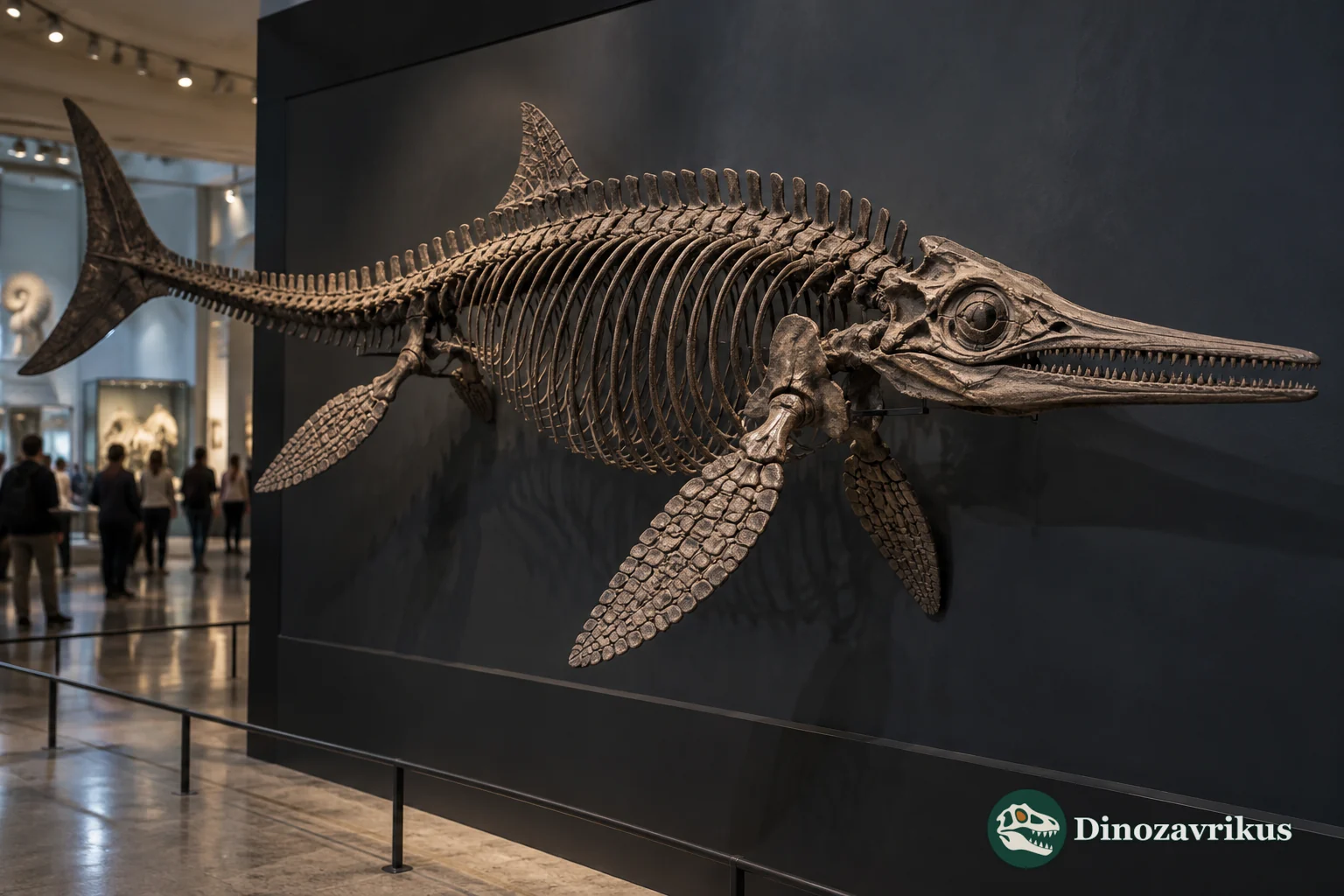
Anatomy of Hauffiopteryx
H. typicus can be recognised by a combination of skull features, including a large rounded orbit and the contribution of several bones to the margin of the external naris. The snout is relatively short and slender. A collection of characters is more informative than any one striking feature, because orbit shape and rostrum length occur in many ichthyosaurs and can be affected by preservation.
The fore- and hindlimbs were modified into paddles. Near the shoulder and hip, angular bones fit into a compact mosaic. Notches occur along the leading edge of an anterior digit in both sets of paddles. This is a direct anatomical observation; it does not reveal how fast the animal swam or exactly how it manoeuvred.
The jaws were not extremely elongated or upturned, and the teeth had smooth enamel. These features are consistent with a small marine predator that could have taken fish or cephalopods. No stomach contents from the type specimen establish a particular diet.
Size, growth and movement
The 2020 revision characterises Hauffiopteryx as a small- to medium-sized ichthyosaur about 2–3 m long. This is a genus-level range, not the measurement of one complete adult. Some specimens preserve only part of the skull, trunk or limbs, so a slab measurement should not be mistaken for total body length.
Bone fusion offers limited information about growth. Closure of some limb-bone sutures may indicate skeletal maturity, but a growth history requires several indicators and a comparison among specimens. The available fossils do not reveal the exact age or growth rate of every individual.
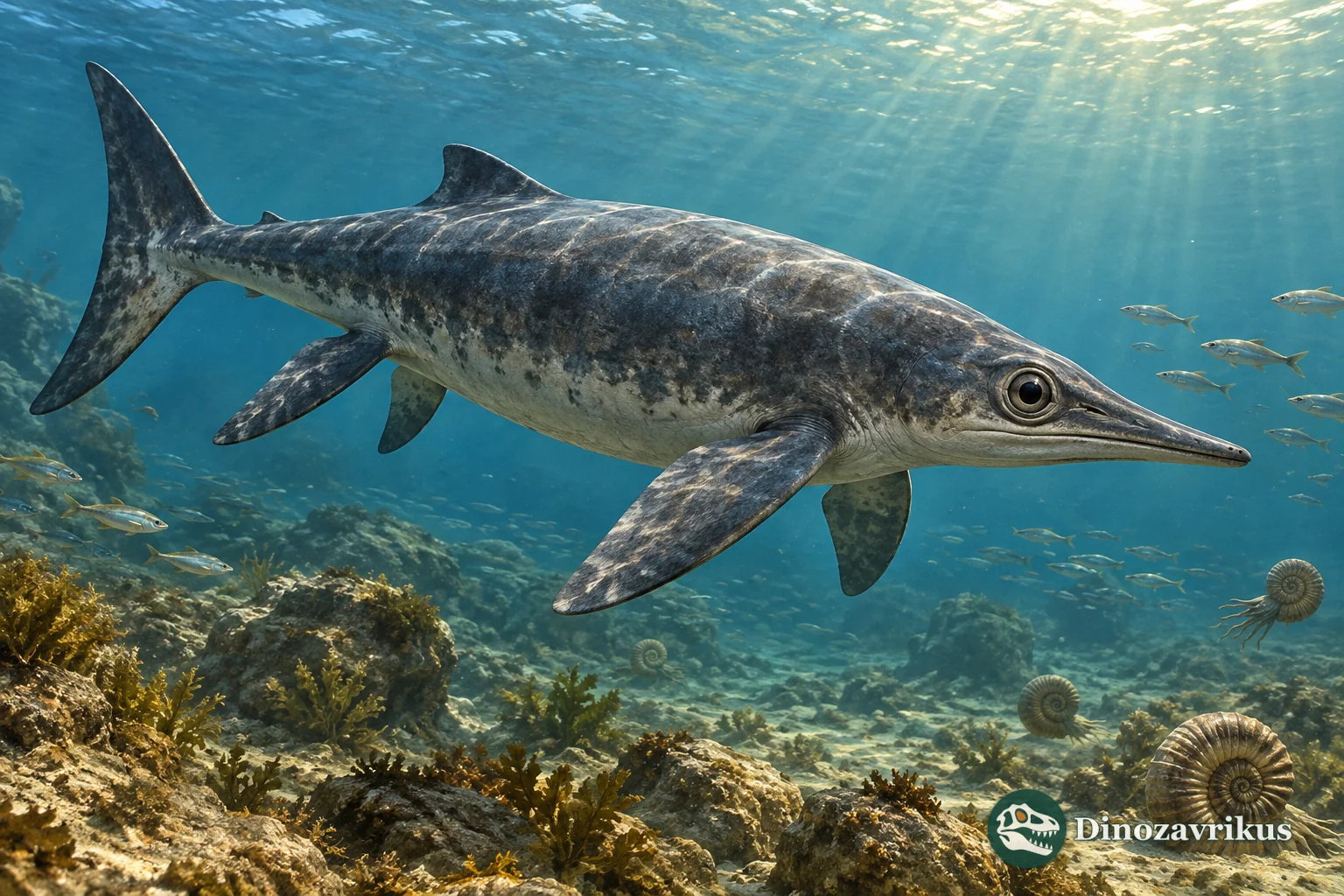
The cover art follows the general ichthyosaur body plan and known Hauffiopteryx proportions. Fossils do not preserve its colour, skin pattern or the movement of soft parts at the tail. The image represents a plausible animal, not a portrait of the lectotype.
Comparisons with Stenopterygius, Leptonectes and Suevoleviathan show how varied Early Jurassic ichthyosaurs were. Similar body plans do not prove that one of these genera was the direct ancestor of another.
Frequently asked questions
When did Hauffiopteryx live?
Its fossils date from the late Pliensbachian and Toarcian stages of the Early Jurassic. The richest material comes from the Posidonia Shale of south-western Germany.
How many Hauffiopteryx species are known?
The 2020 revision recognises two: Hauffiopteryx typicus and H. altera. The second species was distinguished by skull anatomy.
How long was Hauffiopteryx?
The genus is estimated at about 2–3 m. That range comes from comparing multiple specimens rather than measuring one complete adult.
Were small Hauffiopteryx fossils juveniles?
Not necessarily. Limb-bone fusion in one specimen about 1.93 m long is consistent with an adult or near-adult individual.