

Hesperorthis is a genus of marine brachiopods known from paired mineralised shells. Fossils reveal the outline and convexity of each valve, radial ribs and, in some specimens, internal structures around the hinge and muscle scars. The genus was established by Charles Schuchert and George Cooper in 1931, with Orthis tricenaria, named by Timothy Conrad in 1843, as its type species.
Its compiled range runs from the Dapingian Stage of the Ordovician to the Homerian Stage of the Silurian. Those records represent multiple species and regions. The early animal catalogue compares Hesperorthis with other marine fossils without treating its broad catalogue placement as a geological age.
Quick facts
| Scientific name | Hesperorthis Schuchert & Cooper, 1931 |
|---|---|
| Type species | Orthis tricenaria Conrad, 1843 |
| Group | Rhynchonellata, order Orthida |
| Reported range | Dapingian Ordovician to Homerian Silurian in compiled records |
| Material | Paired valves, ribs and internal shell features |
| Shell | Usually semioval, from flattened to convex |
| Feeding | Suspension feeding inferred from brachiopod biology |
| Limit | Measurements vary by species and growth stage |
What can the fossils tell us?
Fossils preserve paired mineralised valves, their convexity, outline and radial costae. These features allow comparison, but do not expose the soft body or its exact posture.
Descriptions use the hinge area, muscle impressions and internal plates. These may be hidden by matrix or damage, so an unexposed feature cannot be scored as absent.
Sample series reveal size ranges and changing proportions. A single small shell is not automatically an adult size or a genus-wide estimate.
Compiled occurrences span Ordovician and Silurian stages. This does not prove an uninterrupted lineage or one continuous population.
Shell form and diagnostic traits
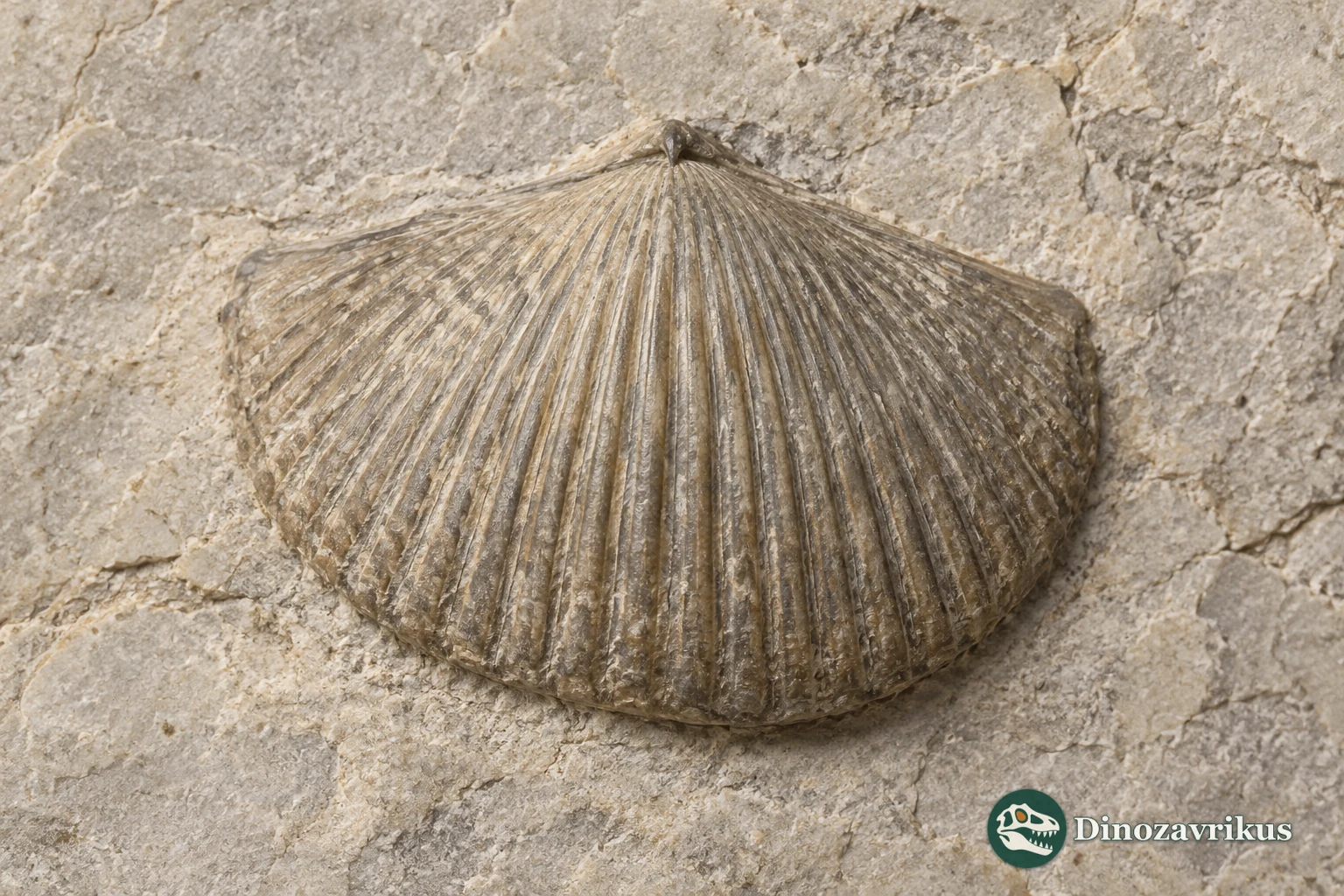
Brachiopod valves are dorsal and ventral rather than left and right as in clams. Descriptions of Hesperorthis report a semioval shell, varying from nearly flat to convex, with radial costae. Fine growth lines may cross the ribs. Identification relies on combinations of exterior shape and internal traits rather than a ribbed surface alone.
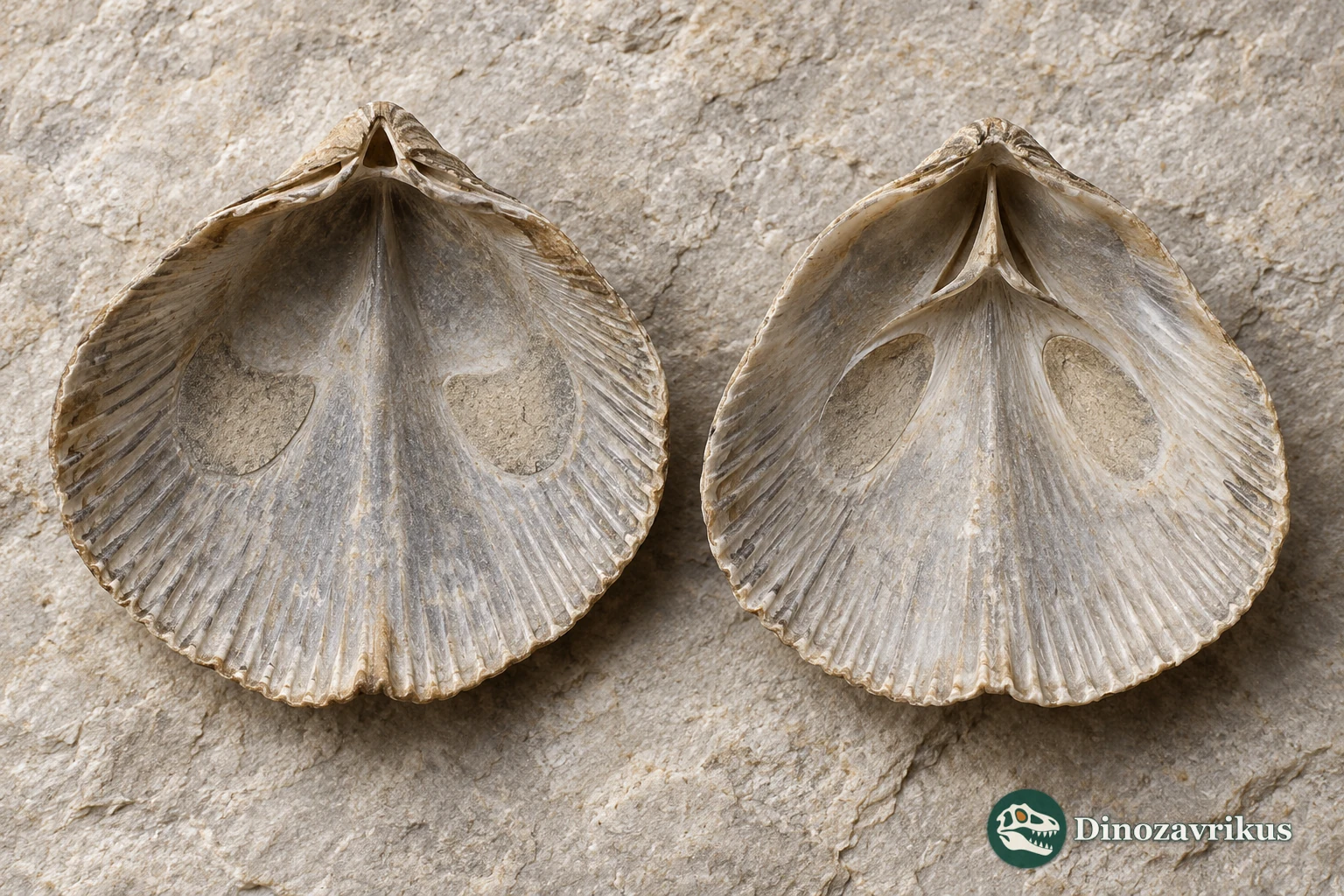
Researchers examine the hinge platform, sulcus and fold, muscle scars and internal plates where these can be exposed. A broken or matrix-filled valve may conceal the diagnostic structures. A photograph of the exterior can therefore support a tentative comparison but not always a secure genus identification.
Type species and classification
Conrad described Orthis tricenaria in 1843. Schuchert and Cooper later designated it as the type species when they established Hesperorthis. A type species anchors the use of a genus name; it does not imply that every other assigned species descended directly from it or shared identical proportions.
Modern references place the genus in class Rhynchonellata, order Orthida and family Hesperorthidae. These groupings depend on shell architecture and internal structures, and may change as specimens are compared with type material. Similar ribs alone do not demonstrate close relationship because shell sculpture can be shared across separate brachiopod lineages.
Age, localities and measurements
Compiled records place Hesperorthis between the Dapingian Stage and the Homerian Stage. The interval combines different species; a particular fossil must be dated from its formation and associated fauna. A label such as “cf.” means that a specimen resembles a named species but is not assigned to it with full confidence.
Late Ordovician Alaskan material assigned to Hesperorthis pyramidalis illustrates size variation. Many shells in the studied sample were small and likely immature; the reported sample average was about 3.5 by 4.9 by 2.1 mm, while one large valve measured 12.3 by 20.3 mm. These measurements describe that species sample, not the entire genus.
Growth and ecological interpretation
Shell length-to-width ratios, convexity and rib strength vary among species and can change during growth. Compaction after burial may flatten a valve, while a chipped margin changes its measured outline. Growth series help distinguish juveniles from adults and ontogenetic changes from species differences.
Like other brachiopods, Hesperorthis probably filtered suspended particles with a lophophore. That is an inference from brachiopod biology; the soft feeding organ and specific food are not preserved in this genus. Marine sedimentary rocks establish a sea-floor setting, but taxonomy alone does not fix water depth or current strength for every occurrence.
Evidence and its limits
Shells preserve shape, ribs, growth lines and some interior features. Their stratigraphic position constrains age, and series can document size variation. Soft anatomy, colour, precise feeding behaviour and reproduction remain unknown. A reconstruction should identify which features follow the shell and which are comparative biological inference.
Frequently asked questions
When did Hesperorthis live?
Compiled records range from the Dapingian Stage of the Ordovician to the Homerian Stage of the Silurian. Individual finds need local dating.
How is Hesperorthis identified?
Descriptions combine valve outline and convexity, radial ribs, hinge features and internal structures. Ribbing alone is not enough.
How large was it?
Size varied by species and growth stage. Measurements from H. pyramidalis in one Alaskan sample cannot be applied to the whole genus.
What did Hesperorthis eat?
It probably filtered suspended particles, as other brachiopods do. No direct evidence establishes a specific menu for this genus.