

Himalayasaurus tibetensis was a large ichthyosaur of the Late Triassic, described from fragmentary fossils in southern Tibet. It is often portrayed as one of the largest Triassic marine predators, but the familiar estimate near 15 m cannot be tested against a complete skeleton. The fossils establish a large ichthyosaur with substantial teeth; its exact size and relationships remain uncertain.
Quick facts
| Type species | Himalayasaurus tibetensis |
|---|---|
| Age | Norian, Late Triassic |
| Locality | Tulong area, Nyalam County, Tibet, China |
| Holotype | IVPP V 4003, a fragmentary skull and postcranial material |
| Size | A length near 15 m has been proposed, but is poorly constrained and not measured from a complete skeleton |
| Classification | Ichthyosaur with uncertain placement because the fossil material is incomplete |
Evidence guide
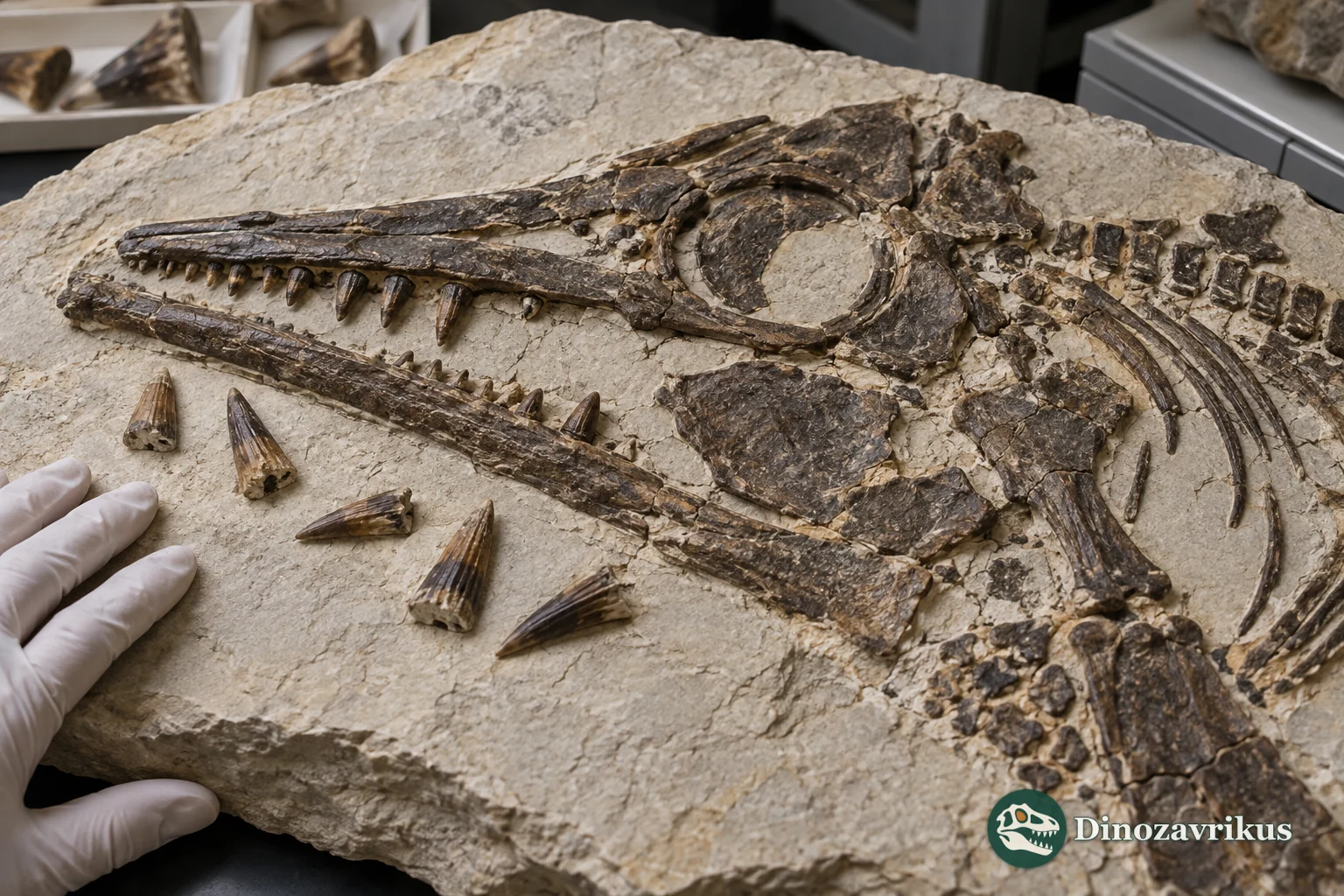
Type material IVPP V 4003 includes skull and jaw fragments, teeth and parts of the postcranial skeleton. Disarticulation and incomplete preservation limit comparisons and whole-body proportions.
Teeth with cutting edges and jaw anatomy directly document the feeding apparatus. They are consistent with gripping or cutting prey, but do not identify a particular victim or hunting behaviour.
The type material is associated with marine deposits of the Qulonggongba Formation near Tulong. The Norian age is based on geological context and associated fossils, not on the age of an individual bone.
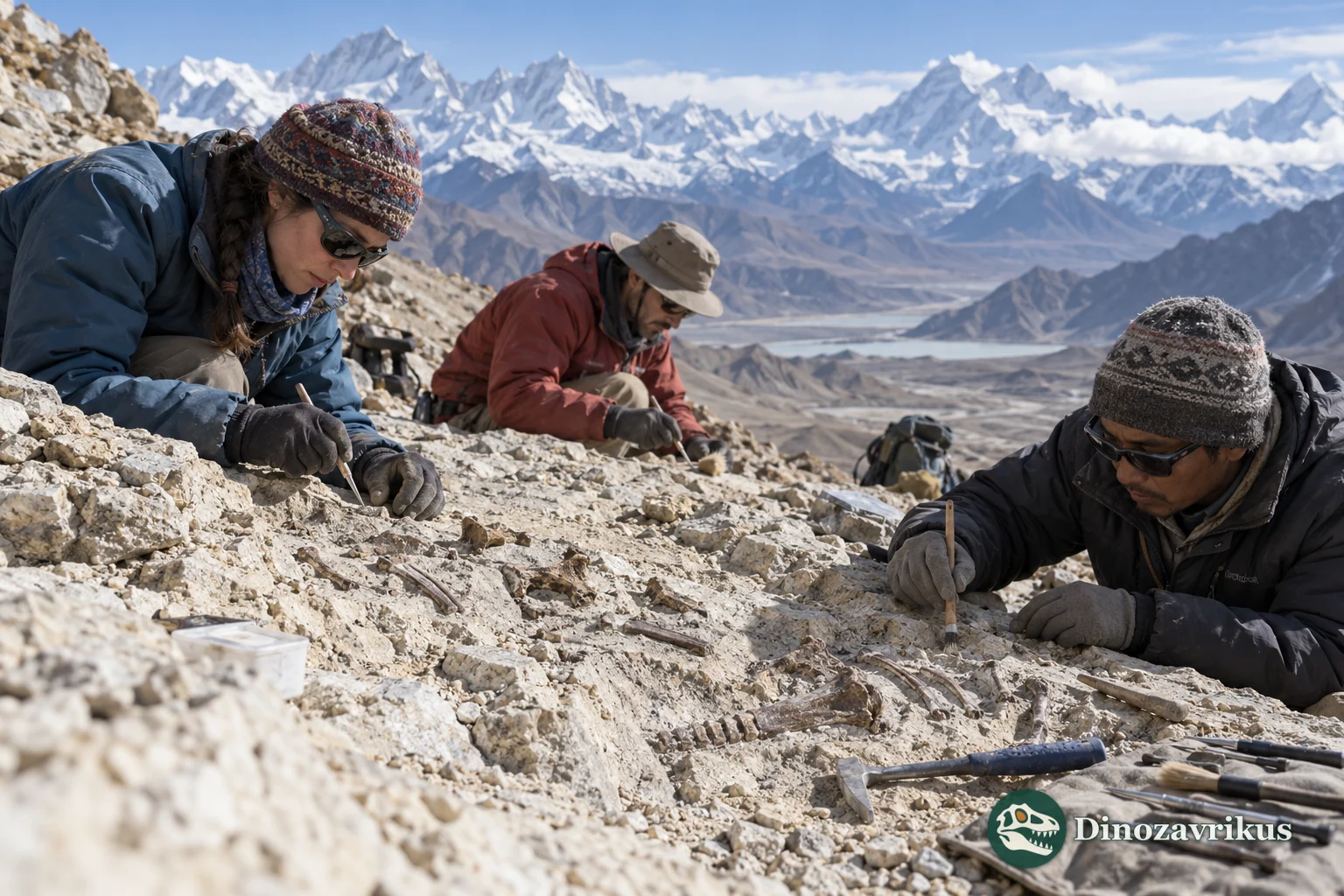
Ichthyosaur bones were reported from the Nyalam and Tingri areas during 2023 fieldwork. A regional discovery is not automatically part of the holotype or securely assignable to H. tibetensis without a comparative description.
Discovery and the history of the name
Fossils were collected during geological and palaeontological work near Tulong, in what is now Nyalam County in southern Tibet. Himalayasaurus tibetensis entered the scientific literature in the early 1970s. References do not always give authorship and bibliographic year consistently; the name is commonly cited as Young and Dong, 1972, while some reviews credit Dong alone.
Holotype IVPP V 4003 is held by the Institute of Vertebrate Paleontology and Paleoanthropology of the Chinese Academy of Sciences. It is not a complete articulated skeleton. The material comprises skull and jaw fragments, teeth, parts of the shoulder girdle and fins, and vertebrae. Some bones are disarticulated and preservation varies across the collection.
In 2023, researchers returned to the original region and reported additional Triassic ichthyosaur remains from southern Tibet. Institutional accounts describe the renewed fieldwork and its importance. However, nearby fragments should not automatically be treated as part of the type specimen or assigned to H. tibetensis without a detailed anatomical comparison.
A Norian sea near the Tethys margin
The fossils are associated with the Qulonggongba Formation and the Norian stage of the Late Triassic. The region lay near the northern margin of the Indian Plate, beside the Tethys Ocean. Ichthyosaurs, fishes and marine invertebrates lived in these waters. This regional setting comes from geological evidence, not from the bones of one animal alone.
Expeditions in 2023 also reported marine fossils and ichthyosaur remains from the Nyalam and Tingri areas. Some accounts considered whether particular fragments represented a young Himalayasaurus or a smaller ichthyosaur from another group. Until those remains receive a full taxonomic description, those suggestions remain provisional.
What the bones and teeth show
The skull material is incomplete but includes parts of the upper and lower jaws. Descriptions report large teeth with cutting edges; the crowns are laterally compressed and dagger-like. Such teeth could grip and cut prey, but they do not identify a particular prey species or show whether the ichthyosaur hunted other marine reptiles.
The shoulder girdle and fin elements confirm a specialised marine vertebrate. Vertebrae provide evidence about the axial skeleton, but the disarticulated material does not securely reconstruct the tail or whole-body proportions. Compared with Cymbospondylus, whose fossil record includes more complete specimens, Himalayasaurus offers fewer ways to test growth and variation within the species.
Did Himalayasaurus reach 15 metres?
Scientific reviews and popular accounts have repeated a total-length estimate close to 15 m, sometimes phrased as more than 15 m. It is an extrapolation, not a measurement of a complete skeleton. The estimate depends on which bones belong together and how their proportions are compared with better-known ichthyosaurs. Studies of giant Triassic ichthyosaurs have described the 15 m figure as poorly constrained.
Comparisons with other large Triassic ichthyosaurs can suggest a possible scale, but they do not turn an uncertain estimate into a precise measurement. The safest description is a large animal with an unresolved upper size limit. The cover art conveys that broad impression without setting a reliable scale.
The genus’ position within Ichthyosauria has also been debated. It has traditionally been associated with shastasaurids, but some phylogenetic analyses omit it or cannot place it confidently because of incomplete material. Older group assignments should not be presented as a settled result of current analysis.
Where the evidence ends
Direct evidence consists of scattered bones and teeth and the geological deposits associated with Tulong. A large body is inferred by comparing fragments with more complete ichthyosaurs. A specific hunting strategy is a functional hypothesis based on teeth. Exact body length, colour and soft tissues belong to reconstruction, not to the preserved fossil.
New Tibetan fossils could clarify the genus if they are described in detail, compared directly with the holotype and published with clear anatomical grounds. For now, Himalayasaurus is best understood as an unusual, poorly known taxon, rather than as a precisely measured record-breaking giant.
Comparisons with Shastasaurus and Guizhouichthyosaurus show why classification and body-size estimates become more secure when researchers can study associated skeletons.
Frequently asked questions
When did Himalayasaurus live?
It is assigned to the Norian stage of the Late Triassic. The type material comes from the Tulong area of southern Tibet.
What fossils have been found?
Holotype IVPP V 4003 includes skull and jaw fragments, teeth, shoulder-girdle and fin bones, and vertebrae. No complete skeleton is known.
Was Himalayasaurus 15 metres long?
A figure near 15 m has been proposed by extrapolation from incomplete material. No complete skeleton has been found to measure that length directly.
What did the 2023 Tibetan expeditions find?
Researchers reported additional scattered ichthyosaur remains from the Nyalam and Tingri areas. Assignment to a particular species requires a detailed description and comparison with the holotype.