

A fossil track can receive a scientific name even when no skeleton identifies the animal that made it. The name applies to a recurring form of trace, not automatically to a biological species. Researchers can also group traces by the activity they may record or compare whole assemblages with their sedimentary setting. Those classifications are related, but they answer different questions.
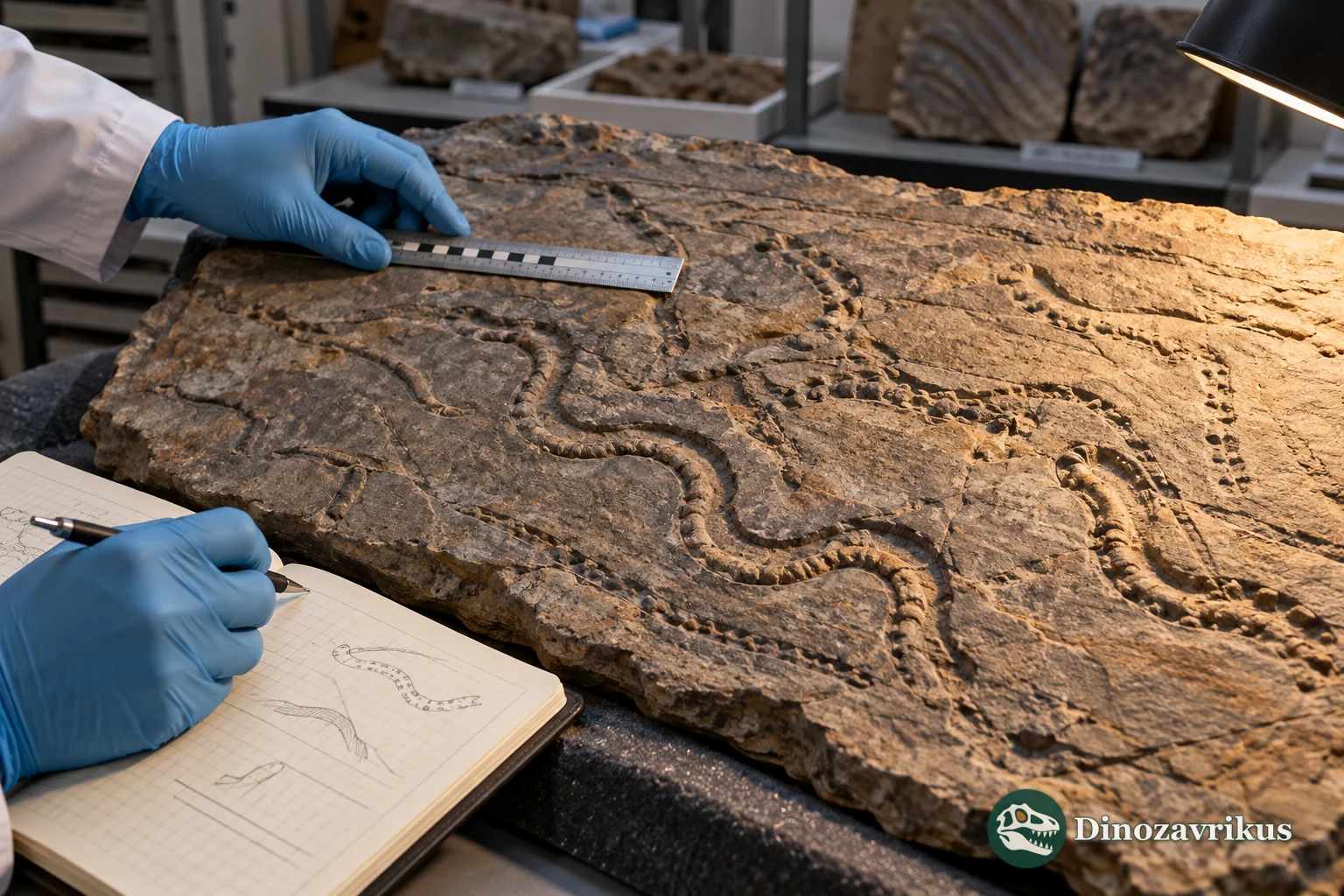
Ichnology studies preserved evidence of organisms interacting with a substrate. The evidence includes footprints, trackways, burrows, feeding marks and other structures. First, researchers must show that a feature is biological rather than a crack, current mark or other physical structure. Then they describe what is directly visible before interpreting its function or producer.
An ichnotaxon names a trace form
Formal trace names are organised as ichnogenera and ichnospecies. The International Code of Zoological Nomenclature includes names based on fossilised animal activity. A trace name remains separate from the name of an animal known from bones: under the Code, the name of an ichnotaxon does not compete in priority with the name of the animal that may have made it.
Descriptions compare the geometry and arrangement of repeated features. For a trackway, useful observations can include footprint proportions, digit traces, spacing and orientation. A burrow may be described by its cross-section, branching, wall texture, fill and arrangement of segments. The relevant characters vary with the kind of trace. Recent ichnotaxonomic guidance also treats the arrangement of components and, in restricted settings, substrate or size as possible criteria. A presumed producer, geological age or environmental interpretation cannot substitute for a morphological diagnosis.
This distinction is useful for vertebrate tracks. The name Pteraichnus refers to a recognised kind of track fossil associated with pterosaurs; it does not identify the exact species that crossed a particular surface. A name allows researchers to compare the trace across sites while keeping the animal assignment open.
Behavioural groups are interpretations
An ethological classification asks what activity may have produced a trace. Repichnia are locomotion traces, domichnia are dwelling structures, cubichnia record resting, fodinichnia are associated with feeding within sediment, and pascichnia with systematic grazing or feeding trails.
These categories can help describe how animals used a substrate, but behaviour is inferred rather than observed. One structure may record more than one activity, and interpretations can be revised when new comparisons become available. Researchers have proposed and debated categories over time, so a behavioural group should not be treated as a formal ichnospecies. Calling a trackway a locomotion trace does not give it the same name as its ichnotaxon.
Assemblages help reconstruct environments
A third scale is the trace assemblage. An ichnofacies is a characteristic association of traces considered together with the sedimentary conditions in which they occur. It can help compare environmental settings, including substrate consistency, water energy and oxygen availability. It is an ecological and sedimentological tool, not a taxonomic rank.
Position within a bed and the style of preservation provide further evidence. A trace may appear as a depression on a bedding plane, a raised cast on the underside of a layer or a cross-section through sediment. Burrows that cut through earlier structures record a different sequence from traces preserved on the original surface. Erosion, compaction and later activity can alter those relationships, so the whole bed matters more than a single dramatic mark.
From observation to classification
A careful description records the orientation of the bed, dimensions, shape, repeated elements, branching and fill. The researcher compares the specimen with established ichnotaxa, notes what cannot be observed, and only then discusses possible behaviour and environmental meaning. Each claim should remain at the level supported by its evidence.
This is why trackways as evidence of movement can be informative even when their maker is uncertain. The fossil record includes body fossils and traces, and the two preserve different information. An ichnotaxon gives a stable name to one part of that evidence without pretending to recover the animal’s entire identity.
Frequently asked questions
What is an ichnotaxon?
It is a formally named group of fossil traces defined by a recurring form. The name applies to the trace, not automatically to the biological species that produced it.
Can a footprint name identify the dinosaur that made it?
Usually not to species level. Similar feet may produce similar prints, and sediment can distort a track. The trace can be classified while the maker remains uncertain.
How is a behaviour group different from an ichnospecies?
An ichnospecies is a formal name for a trace form. A behaviour group gathers traces by an inferred activity such as locomotion, dwelling or feeding.
What does an ichnofacies describe?
It describes a characteristic trace assemblage considered with its sedimentary setting. It can support environmental interpretation but is not a formal taxonomic rank.