

A fossil description is more than a list of bones and shapes. It connects a scientific name to material researchers examined, records what they observed and explains why they assign those features to a particular taxon. Journals and organism groups arrange sections differently, but recurring elements help readers follow the evidence.
Find the specimen before following the name
Look for a repository – a museum or another scientific collection – and a catalogue number. The number is an address for the physical object: it may let you request information from the institution or locate photographs and a digital model. A collection prefix is not part of an animal’s scientific name, and it does not by itself tell you which features diagnose the fossil.
Next ask what the number represents. It may identify a complete skeleton, one bone, a tooth, several articulated elements or a set of disarticulated pieces. Do not assume every bone on one slab came from a single animal. Researchers need to justify an association through articulation, matching size, repeated elements or the context of discovery. Also distinguish specimens authors examined directly from those cited only for comparison.
Locality and stratigraphic information connect a specimen with its geological setting. Records may be incomplete, and journals do not all require the same detail. If a paper gives only a formation or broad region, a reader cannot infer an exact quarry or excavation point.
Type status and catalogue number do different jobs
When authors establish a new species-group name, they designate or otherwise fix name-bearing type material. A holotype is the single specimen to which the name is anchored. It need not be the most complete, largest or most average member of the species: its role is nomenclatural. If the original description was based on several specimens without selecting one holotype, they may be syntypes; a later author can sometimes designate one as a lectotype.
The repository number helps locate the object; type status explains its role in applying the name. Check for both. Older papers may provide incomplete information or use terminology differently. A specimen should not be called the holotype merely because it looks most representative or appears first in a list. The separate guide to what a holotype does explains how type material anchors a name.
Tell a diagnosis from a description
A diagnosis is a concise set of traits that helps distinguish a taxon from comparable forms. It does not have to describe every part of the skeleton. It answers a comparative question: which features matter here, and against which taxa were they evaluated?
A description is usually more detailed and proceeds through anatomical regions: shape, proportions, surfaces, sutures, openings or tooth rows. Some statements are direct observations; others interpret them. “The bone has a canal” records a visible feature. Inferring that a particular vessel passed through it adds an anatomical interpretation that should be read as such.
A discussion explains the taxonomic choice: why the material belongs to this taxon, how it differs from related forms and which alternatives were considered. Compare that argument with the listed characters, rather than relying on the heading alone. The account of how palaeontologists study fossils shows how different evidence types answer different questions.
Follow the figure references
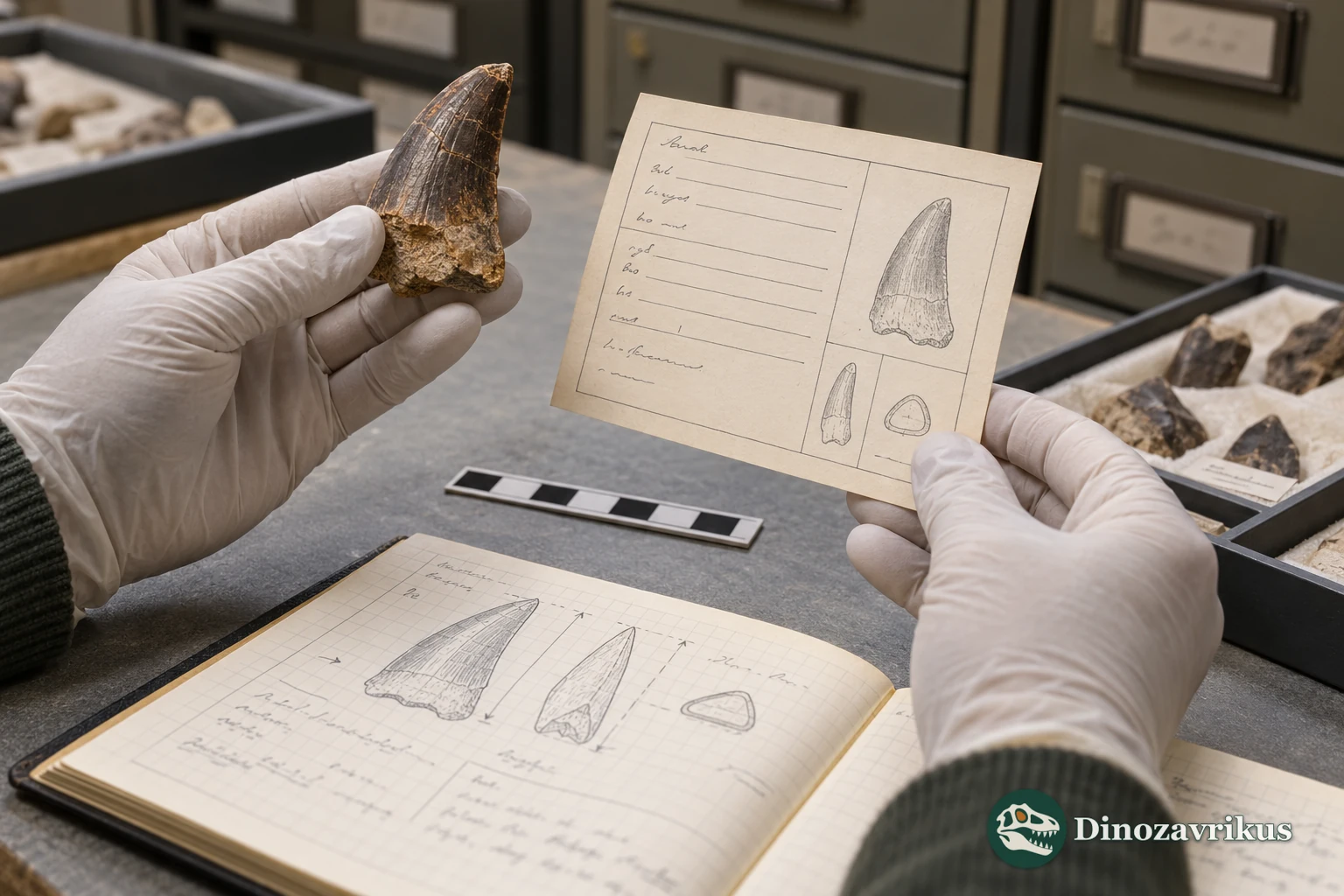
A sentence may refer to a figure, table or panel – for example, figure 4B may show a feature named in the diagnosis. Match the panel to its caption and scale bar. A photograph records surface texture and preservation; a diagram may clarify boundaries or proposed anatomy. Do not mistake an interpretive drawing for a photographic record.
Captions may identify the bone, side, view, magnification, scale and imaging method. If a paper shows several specimens, check which catalogue number belongs to each panel. Figures help readers test a description, but they do not replace it: perspective, preparation and breakage can hide or distort features.
Notice uncertainty and limits
Wording such as “possibly belongs to” or “compared with” signals that authors are cautious. Abbreviations such as cf. and aff. are often used for comparative or tentative assignments, but their precise use depends on context and the paper’s conventions. Indet. indicates that material could not be identified to the desired taxonomic level; it does not mean the fossil has no scientific value.
Ask: is this one specimen or a series; which traits are preserved; were comparable specimens examined; are a collection number and figure provided; and where does observation end and interpretation begin? That sequence helps readers understand both the proposed classification and how readily it can be checked.
Frequently asked questions
What is a fossil specimen number?
It is the collection identifier assigned by a repository such as a museum. It helps locate an object, but does not by itself determine its type status or identification.
Does a holotype have to be the most complete fossil?
No. A holotype anchors the application of a name; it is not a ranking of completeness or typicality.
How is a diagnosis different from a description?
A diagnosis highlights traits that distinguish a taxon from others. A description gives a fuller account of the specimen’s observed morphology.
Can a figure show everything about a fossil?
No. Figures show selected views and features. Preservation, scale and preparation limit what can be seen, so read them with the text and caption.