

Hulkepholis was an Early Cretaceous goniopholidid with a slender snout, eyes directed to the sides and several conspicuously enlarged teeth in its upper jaw. A nearly complete English skull anchors the genus. Fossils from two sites in Spain preserve parts of the palate and body in addition to the skull.
Quick facts
| Type species | Hulkepholis willetti |
|---|---|
| Group | Goniopholididae |
| Age | Early Cretaceous, Valanginian to early Albian |
| Localities | Southern England and Teruel Province, Spain |
| Type material | BMNHB 001876, nearly complete skull |
| Other named species | Hulkepholis plotos and Hulkepholis rori |
What can the fossils tell us?
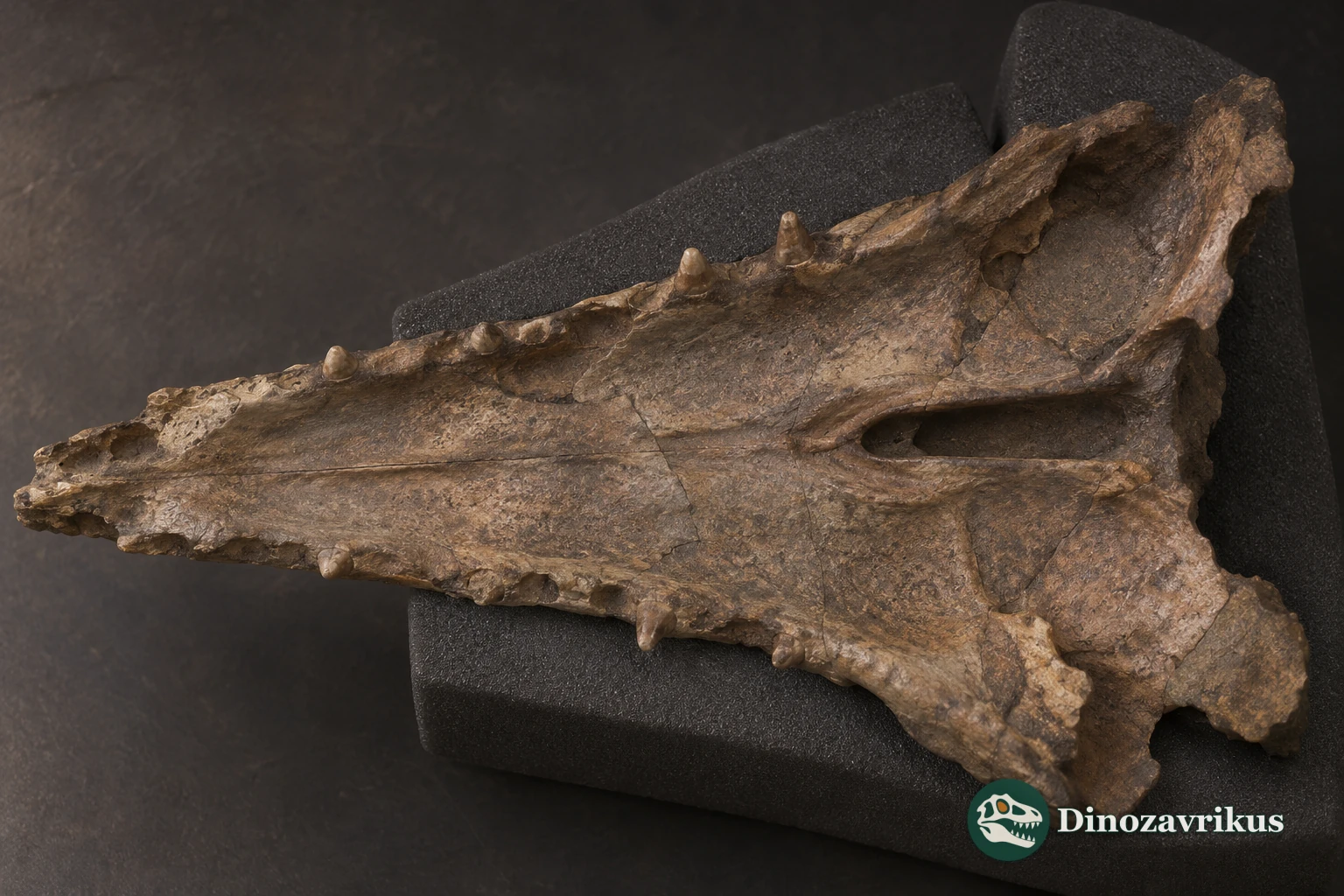
Several teeth in the forward part of the upper jaw were larger than their neighbours. At the fifth maxillary tooth, the snout was about a fifth to a quarter as wide as it was long.
The type of Hulkepholis plotos preserves a skull, some vertebrae and bony armour. It provides comparisons the English skull cannot.
One set of results placed the English type species outside the group formed by the two Spanish species. The shared ancestry of all three within one genus remains open to testing.
The English skull behind the name
BMNHB 001876 came from the Grinstead Clay Formation at Cuckfield in West Sussex. John Whitaker Hulke described it in 1878 as Goniopholis crassidens. In 2011 Steven Salisbury and Darren Naish named it Goniopholis willetti, honouring the collector Henry Willett.
Ángela Buscalioni and colleagues transferred the English species to Hulkepholis in 2013 and named the Spanish H. plotos. The genus honours Hulke. The Booth Museum of Natural History in Brighton holds the English type skull.
Two finds in the province of Teruel
The type specimen of H. plotos, AR-1/56, is from coal-bearing beds of the early Albian Escucha Formation at Ariño. It includes an almost complete skull, three vertebrae, a rib, a metapodial and three osteoderms. The fossils are held in the Aragonese palaeontological collection at Dinópolis.
Ignacio Arribas and colleagues described H. rori in 2019 from the early Barremian Camarillas Formation at Galve. The material includes separate pieces of the skull and lower jaw, teeth and osteoderms. Reassembly of the damaged skull yielded an estimated length of about 24 centimetres. The body length of that individual is unknown.
Teeth, palate and possible habits
At the front of the maxillary row, the third, fourth and fifth sockets form a run of increasing size. The teeth become smaller behind it. The internal opening of the nose is elongated and divided by a thin bony partition. The exact position of the margins of that opening differs among the species.
In H. rori, the bone carrying the upper jaw joint has large internal air spaces. An opening linked to the middle ear is also wide. The authors considered those features, the narrow snout and the arrangement of the teeth consistent with aquatic habits. The fossils do not identify particular prey.
The boundary with related goniopholidids
Details of the skull, including the large supratemporal fossae behind the eyes, link Hulkepholis to Anteophthalmosuchus. The proportions of the snout and the arrangement of enlarged teeth help separate the forms.
The 2019 analysis supported a close relationship between the two Spanish species when the English species was omitted. When it was included, changing the scoring of some skull characters shifted its position. Each of the named species can be described separately while their relationships remain under study.
Frequently asked questions
Who is remembered in the name Hulkepholis?
John Whitaker Hulke studied the English skull in the nineteenth century. The species name willetti honours Henry Willett.
Was the entire animal 24 centimetres long?
That is the estimated skull length of the H. rori type. Its full body length is unknown.
Are any parts of the body preserved?
The Ariño specimen includes vertebrae, a rib, a limb bone and scutes. The Galve material also preserves osteoderms.
Which Spanish species is older?
H. rori comes from the early Barremian. H. plotos occurs in early Albian deposits at Ariño.