

Hylaeobatrachus croyii was a salamander from Early Cretaceous Belgium. Its roughly eight-centimetre skeleton preserves the limbs and tail as well as three bony arches that supported the gill apparatus. Researchers have interpreted this combination as evidence that the animal retained some larval features as an adult.
Quick facts
| Group | Salamanders |
|---|---|
| Age | Early Cretaceous, Barremian to earliest Aptian |
| Region | Europe, Bernissart, Belgium |
| Length | About 8 cm, preserved skeleton |
| Type species | Hylaeobatrachus croyii |
| Scientific name | Hylaeobatrachus |
| Diet | Exact prey is unknown |
What can the fossils tell us?
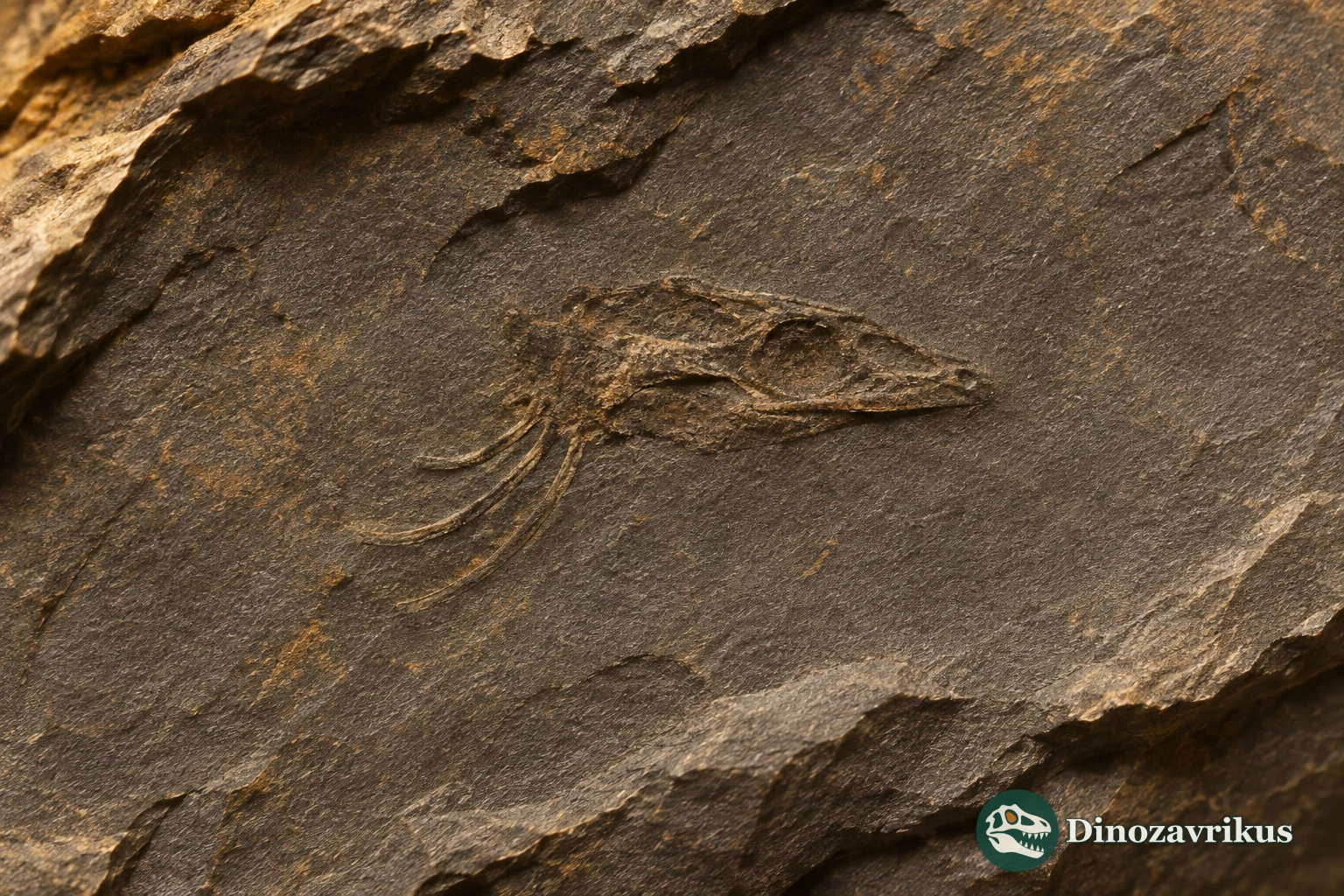
The Bernissart specimen preserves ossified gill arches, separate tail vertebrae and four limbs. Dollo recorded four fingers and five toes.
Retention of the gill apparatus is consistent with a salamander that kept larval traits into adulthood and lived in water.
The fossil does not preserve a clear outline of the soft gills. A similar salamander from Las Hoyas in Spain remains of uncertain affinity.
From the Bernissart mine
Louis Dollo described the Belgian specimen in 1884. It came from the Cretaceous deposits at Bernissart, where work at the coal mine uncovered iguanodons and a rich assemblage of fishes. The salamander is in the collections of the Royal Belgian Institute of Natural Sciences in Brussels. Its species name honours the Prince de Croÿ, who helped run the mining company.
Limb bones, tail and gill arches
Dollo described a long skull that narrows towards the front, very short ribs and at least fifteen tail vertebrae. The forelimbs are shorter than the hind limbs. Three ossified arches remain near the skull. Dollo used their degree of ossification to identify the animal as an adult. Recent comparative work treats Hylaeobatrachus as a probable example of neoteny, the persistence of larval traits in a mature animal.
The freshwater setting
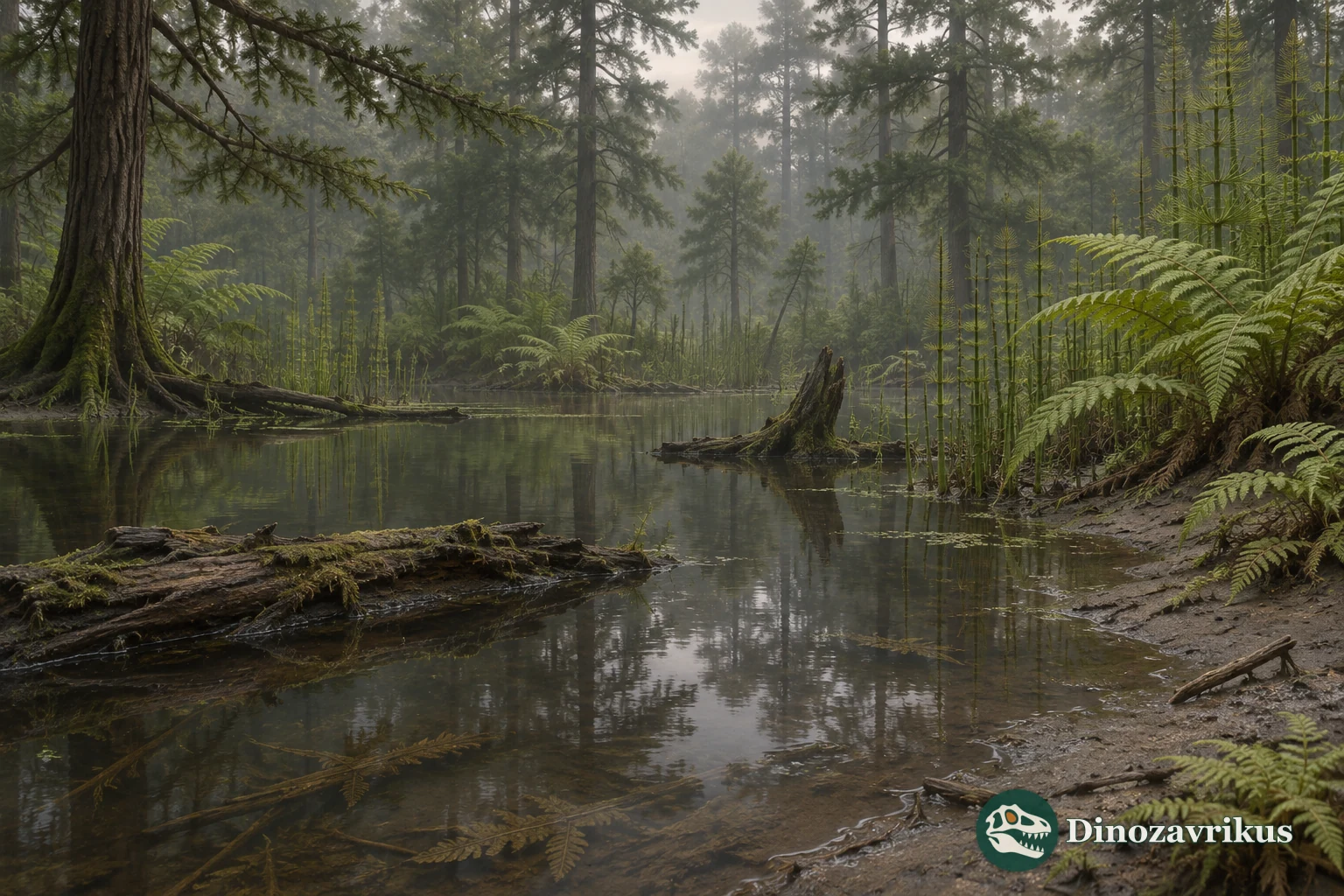
The Sainte-Barbe clays accumulated in a lake. Fossil pollen and studies of the sediment constrain the age of the Bernissart sequence to the late Barremian and the earliest Aptian. The salamander is a small part of a much larger sample of freshwater vertebrates. Its skeleton provides no direct record of what it ate.
How it fits among early salamanders
Dollo compared the combination of gill arches and hind limbs with living proteids. Similar traits can evolve independently in aquatic salamanders. The much earlier Karaurus is also known from an articulated skeleton and represents a separate early lineage. An Early Cretaceous salamander from Las Hoyas in Spain resembles Hylaeobatrachus, but its assignment to the Belgian genus remains uncertain.
Frequently asked questions
How long is the preserved skeleton?
It is about eight centimetres long, including the tail.
What do the gill arches represent?
They are bony supports of the gill apparatus. Dollo identified remnants of three in the specimen.
Did Hylaeobatrachus have hind limbs?
Yes. The original description records five toes on the hind foot and four fingers on the forelimb.
Where is the Belgian fossil held?
It belongs to the collection of the Royal Belgian Institute of Natural Sciences in Brussels.