

Hyolithes is a genus of hyoliths, extinct marine invertebrates with a mineralised conical shell. A useful identification depends on more than a tube-like outline: specialists examine the aperture, longitudinal grooves, operculum and, where present, paired helens.
Eichwald established the name in 1840, and Hyolithes acutus is its type species. A revision of Estonian topotypes places H. acutus in the Middle Ordovician and defines the genus more narrowly than many older lists. See the Ordovician Period guide for the broader geological setting.
Quick facts
| Scientific name | Hyolithes Eichwald, 1840 |
|---|---|
| Type species | Hyolithes acutus Eichwald, 1840 |
| Age | Middle Ordovician type species; narrow genus concept extends into the Early Devonian |
| Hard parts | Conical shell, operculum and paired helens in some hyoliths |
| Type region | Baltic Ordovician strata in the historical literature |
| Diet | Not established for Hyolithes |
| Evidence | Shells and occasional associated elements |
| Limit | Ordinary fossils do not preserve colour or a complete soft body |
What can the fossils tell us?
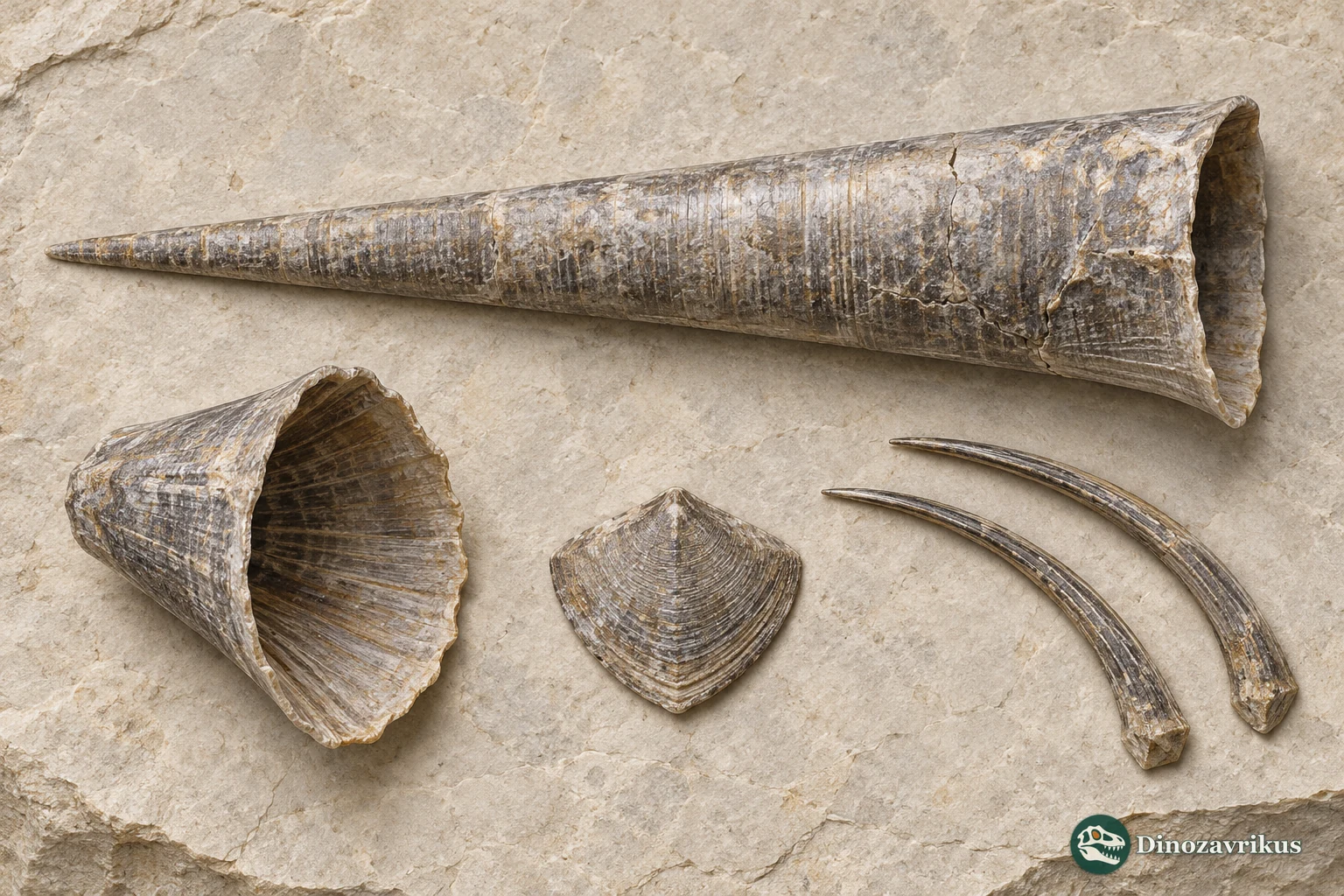
Hyoliths had an elongate conical shell with dorsal and ventral sides. Revisions of Hyolithes sensu stricto emphasise a low dorsum, longitudinal sulci and aperture characters. A crushed or incomplete cone may hide these distinctions.
The operculum closed the shell aperture, but isolated examples may be difficult to assign. Associated specimens offer stronger evidence. Paired curved helens occur in some hyoliths, though their attribution and function must be evaluated taxon by taxon.
The genus dates to Eichwald, with H. acutus as its type species. A revision of Estonian topotypes places that species in the Middle Ordovician and defines Hyolithes more narrowly; later species assigned to the genus extend into the Early Devonian. Old occurrence lists therefore need taxonomic review.
Shells establish shape, and rare associations show how hard parts fit together. A study of exceptional Cambrian Haplophrentis fossils interpreted its tentacle-bearing organ as a lophophore and hyoliths as lophophorates. This group-level evidence does not preserve the soft body of Hyolithes itself.
Name, type species and revised identifications
Eichwald introduced Hyolithes in the nineteenth century. Systematic sources list H. acutus Eichwald, 1840 as the type species. A type species anchors the use of a genus name; it is not a complete description of every species ever assigned to the genus.
Topotypes from Odensholm, Estonia, allowed a later revision to refine the diagnosis. Malinky’s 2006 study places H. acutus in the Middle Ordovician and defines Hyolithes more narrowly. The revised concept first appears in the Middle Ordovician and extends into at least the Early Devonian through two species from the Czech Barrandian region. Re-examination of Walcott and Resser type specimens showed why original material matters: some historical identifications do not match the diagnostic features when compared directly with the types.
Shell and associated hard parts
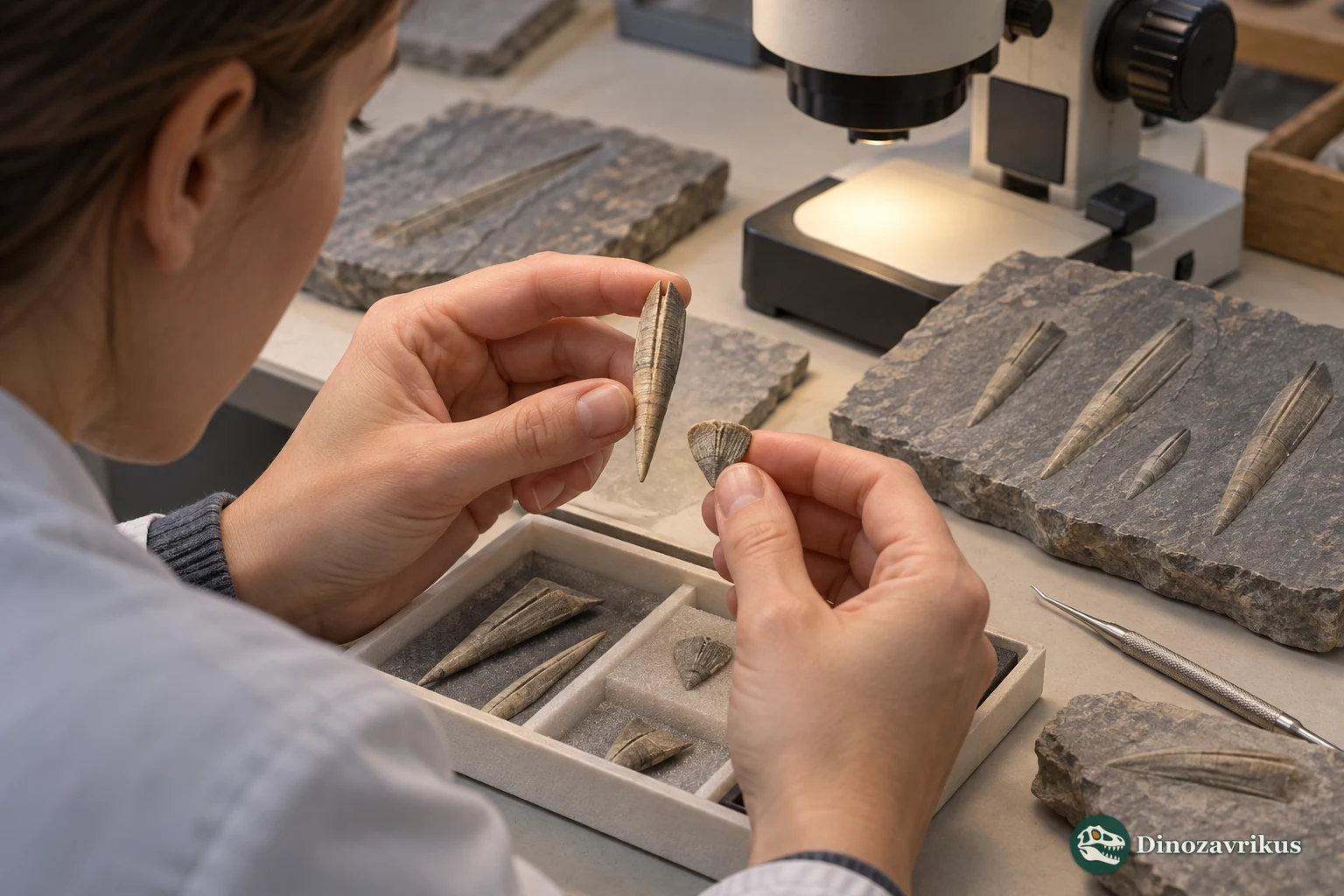
The principal fossil is an elongate conical shell with distinct dorsal and ventral surfaces. Researchers compare the expansion angle, longitudinal sulci, dorsum and aperture. In Hyolithes sensu stricto, a low dorsum and particular aperture characters help distinguish the genus from similar forms. Compression, breakage and erosion can remove the very features needed for diagnosis.
An operculum closed the aperture. Some hyoliths also had paired curved elements called helens. These may have contacted the substrate or affected the animal’s position, but function varies among proposed reconstructions and cannot be transferred automatically between taxa.
Soft anatomy is much less commonly preserved. Moysiuk, Smith and Caron’s 2017 study interpreted a tentacle-bearing organ around the mouth of the Cambrian hyolith Haplophrentis as a lophophore and placed hyoliths among lophophorates, probably near brachiopods. This group-level result does not supply a soft-body reconstruction for Hyolithes.
Age and geological setting
The type species is Middle Ordovician, and the narrowed genus concept extends into the Early Devonian. North American and Scandinavian collections have been revised separately, and some old records no longer retain their original identifications. The age of an individual fossil comes from its bed and associated assemblage, not from a broad database range by itself.
Ordovician seas included shallow carbonate platforms and more offshore settings. A hyolith shell alone does not reveal water depth, salinity or substrate. Sedimentary structures and the associated fossils are needed to make an environmental interpretation.
Diet, movement and growth
The conical shell and operculum are direct evidence. The diet and locomotion of Hyolithes cannot be established from the outline alone. Particle collection, suspension feeding and contact with the seabed have been discussed for different hyoliths, but a specific feeding mode requires corresponding anatomical or trace evidence.
Growth lines and size series can document shell accretion. They do not by themselves establish lifespan or growth rate. A full soft body reconstructed from a related form remains comparative artwork, and colour is not preserved in ordinary specimens.
Reading reconstructions
A cautious illustration can show a conical shell, operculum and paired helens when those structures are appropriate to the chosen form. Soft tissues, colour and exact posture are usually unknown. The image here is an educational reconstruction, not a photograph of a living animal or fossil.
Hyolithes appears in the Cambrian animal catalogue, whose historical title is retained for a collection that also includes later early Palaeozoic entries. This profile and its catalogue card identify the genus as Ordovician.
Frequently asked questions
Was Hyolithes a Cambrian animal?
Not exclusively. The genus and its type species are associated with early Palaeozoic, including Ordovician, records. Older broad species lists need to be checked against later revisions.
What is the type species of Hyolithes?
The type species is Hyolithes acutus Eichwald, 1840. It anchors the genus name but does not describe every species assigned to the genus.
What are helens?
Helens are paired curved hard parts known in some hyoliths. Their function and taxonomic attribution need to be assessed for each form.
Can fossils reveal its colour and diet?
Ordinary shell fossils do not preserve colour, and shell shape alone does not establish a precise diet.