

Hypohippus was a North American Miocene horse with three developed toes. Compared with living horses, it had an elongated face, neck and body, and relatively short legs. Its scientific story began with a few deciduous teeth, however. Only later skeletons allowed researchers to test what kind of animal had worn them.
The genus belongs in the ancient mammal catalogue as a distinct equid branch. Its skeleton and teeth support much more than a name, but the common image of a woodland browser still combines direct anatomy with functional interpretation.
Quick facts
| Scientific name | Hypohippus Leidy, 1858 |
|---|---|
| Group | Equidae, Perissodactyla |
| Age | Miocene, roughly 17–11 million years ago in the museum summary |
| Range | Nebraska, Colorado, Montana and rare Florida finds |
| Initial evidence | Deciduous cheek teeth |
| Later evidence | Skeletons, including material of H. osborni |
| Limbs | Three toes, with variable side-toe strength |
| Diet | Browsing inferred from teeth; exact menu unknown |
What can the fossils tell us?
Joseph Leidy named the genus in 1858 from deciduous molars. These establish a distinctive dental form but cannot reveal neck length, body proportions or the complete foot.
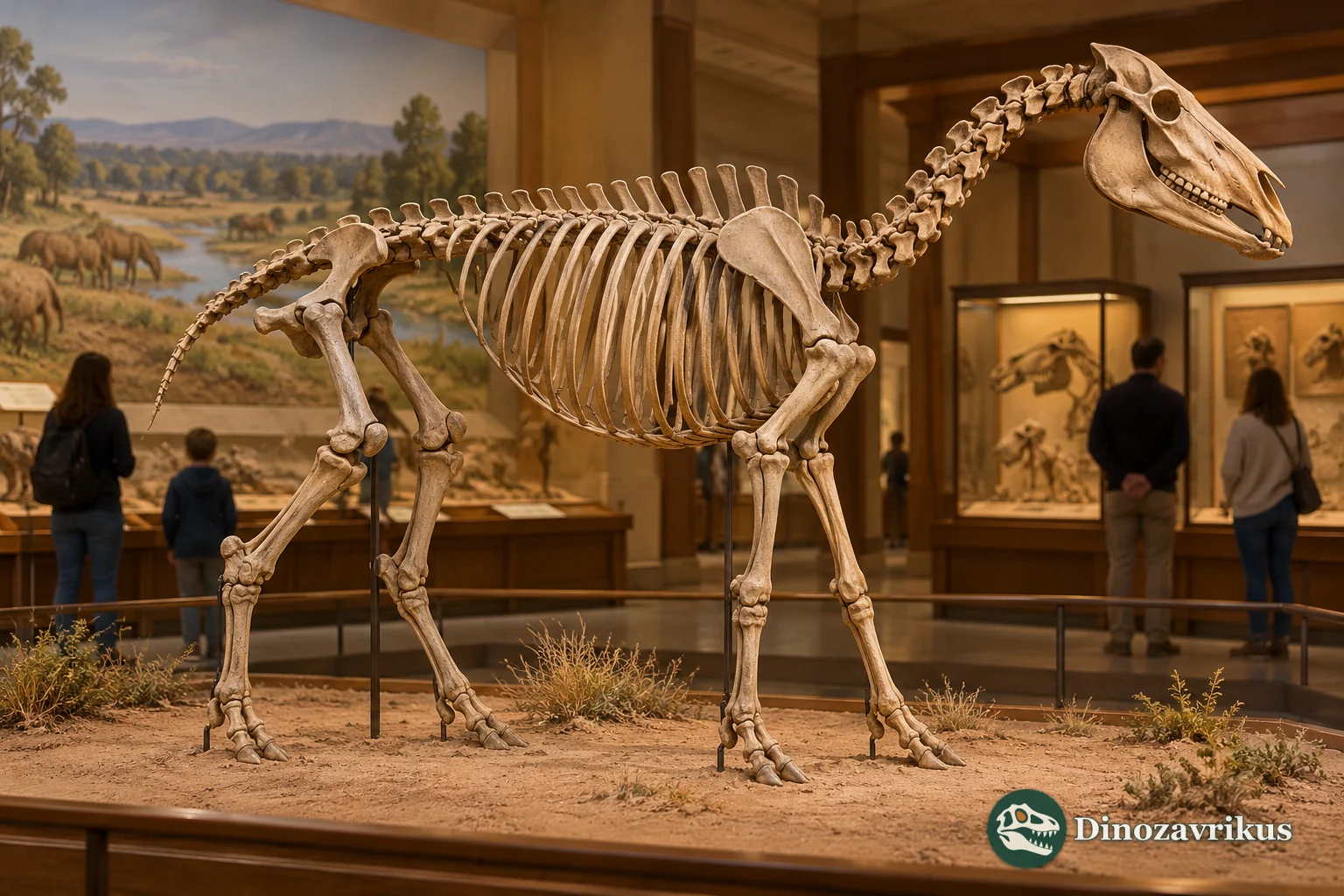
Material including H. osborni shows a long face, neck and trunk with relatively short legs. A museum mount illustrates anatomy but its pose and completed parts must not be confused with direct preservation.
A comparative osteological study included Hypohippus wrist and metacarpal articulations. Its three-toed structure supports functional comparisons but does not measure running speed.
Low-crowned teeth and the form of the three-toed feet fit browsing in relatively soft-ground habitats. Exact plants, seasons and woodland density are not recorded by the skeleton.
A horse named from deciduous molars
Joseph Leidy introduced Hypohippus in 1858 after studying deciduous cheek teeth from a young individual. He noted the low position of a cusp; this dental observation probably shaped the name, often translated as “low horse.” The name was not based on measuring the height of a whole animal.
Almost half a century later, skeletons gave a much broader view. A well-known H. osborni mount illustrates a long muzzle, neck and trunk carried on comparatively short limbs. A mounted skeleton is a powerful teaching aid, but its pose and any restored elements depend partly on preparation. The bones establish proportions more reliably than a particular museum stance establishes motion.
Compare the later Merychippus, whose teeth and limbs record a different adaptation within Equidae. Membership in the same family does not turn one genus into the proven direct ancestor of another.
Three toes, but not one uniform foot
The middle toe became the main axis of support during horse evolution, while side toes varied in size and function among branches. Hypohippus retained three toes. The Florida Museum explains their spreading position as well suited to soft woodland ground. That is a functional inference from anatomy, not a preserved trackway proving exactly where one individual walked.
A 2018 comparative study of equid forelimbs examined wrist and metacarpal anatomy, including Hypohippus. Joint surfaces help establish the identities and arrangement of the side elements. This is more informative than merely saying “three-toed,” because side toes need not carry equal loads in all species. The museum account describes relatively weak side toes in H. osborni compared with some other forms.
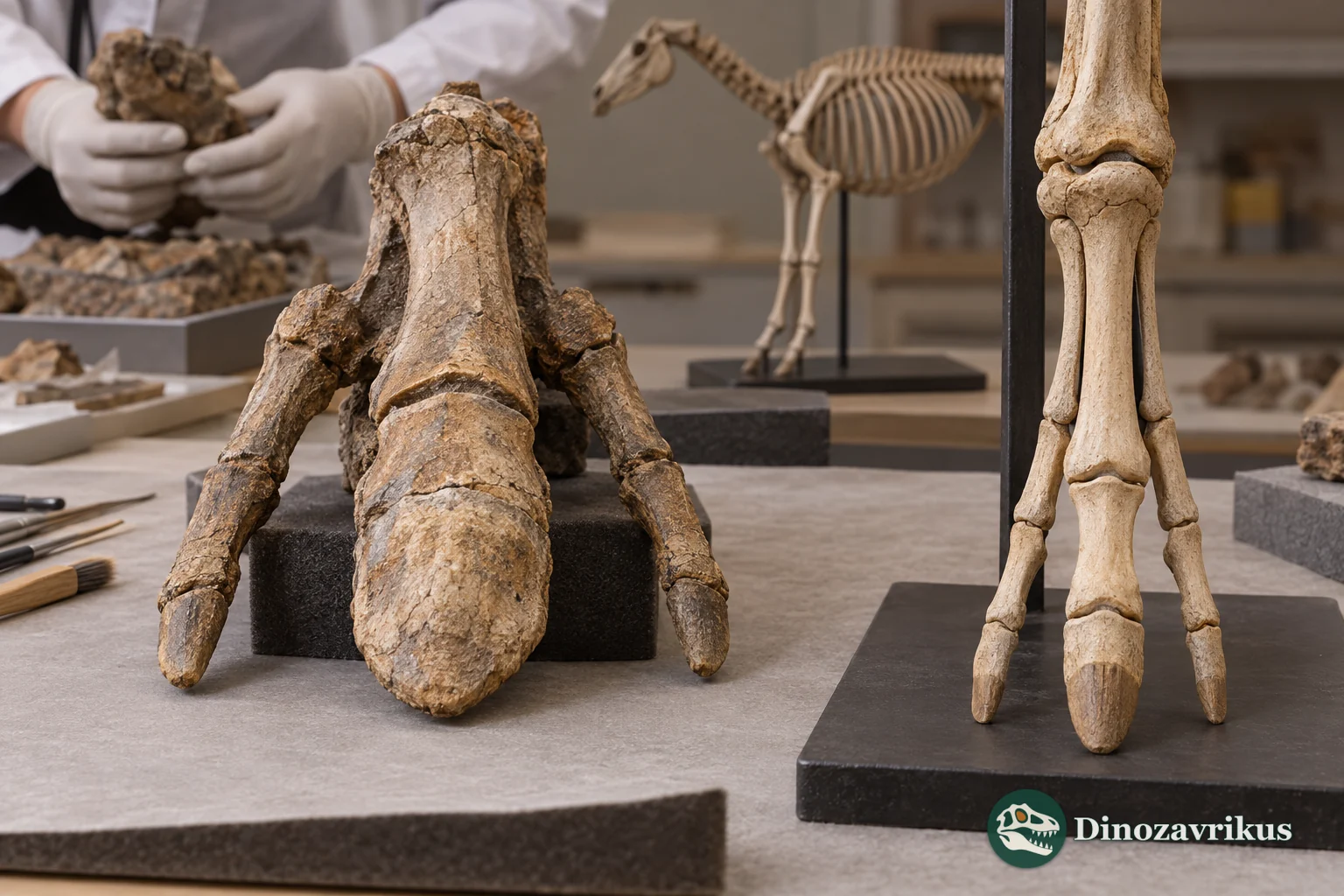
Joint shape permits discussion of support and movement, but it does not supply a running speed or daily travel distance. A living one-toed horse represents another evolutionary outcome, not a simple measure of how successful the older three-toed form was.
When and where it lived
The Florida Museum lists fossils from Nebraska, Colorado and Montana and places species of the genus at roughly 17–11 million years ago. That list is not exhaustive: its type collection includes the central Florida species H. chico, described from Bone Valley, while the Agricola Road site has a single lower tooth cautiously assigned to Hypohippus sp. cf. H. affinis. These Florida records differ in completeness and certainty; one tooth is not equivalent to a skeleton. The approximate age span is genus-wide, not the lifespan of a particular species. The broader Cenozoic history provides context for the changing mammal faunas of this interval.
Low-crowned teeth and the form of the feet support an interpretation of browsing in relatively wooded settings. They do not identify an exact plant menu, seasonal pattern or forest density. An analysis of the particular teeth and environmental deposits would be needed to resolve those questions.

The museum describes Hypohippus as large for its time, approximately comparable to a modern pony. That comparison gives a sense of scale without pretending that one measured mass fits every species. Coat, exact soft-tissue outline and social behaviour remain unknown from the available skeletons.
Frequently asked questions
Was Hypohippus a true horse?
It was an equid, but it belonged to an extinct three-toed branch with different body and limb proportions from living horses.
Why was it called the 'low horse'?
Leidy's name was associated with a low cusp on deciduous molars, not a measurement of a complete skeleton's height.
Did all three toes bear the same weight?
The available anatomy does not support equal loading across every species. H. osborni had relatively weak side toes, and wrist joints offer further clues.
What did Hypohippus eat?
Tooth form supports browsing on soft plant material. The precise plants and seasonal balance are not established.