

Hypotodus is an extinct sand tiger shark relative known mainly from isolated teeth. A 2019 study examined 121 teeth from Alabama, identifying differences among jaw positions. That count does not represent 121 animals or a complete skeleton. The cover depicts a comparative reconstruction.
Quick facts
| Genus | Hypotodus Jaekel, 1895 |
|---|---|
| Type species | Hypotodus verticalis (Agassiz, 1843) |
| Group | Lamniform sand tiger shark relative |
| Alabama material | 121 isolated teeth from the Claiborne Group |
| Illustrated tooth | MSC 37055.1, anterior tooth from Tallahatta Formation |
| Romanian tooth | FES 061, lowermost Bartonian |
| Body length | Not measured from these teeth |
What can the fossils tell us?
The Claiborne Group sample contains isolated teeth from different jaw positions. It does not establish how many individuals shed them.
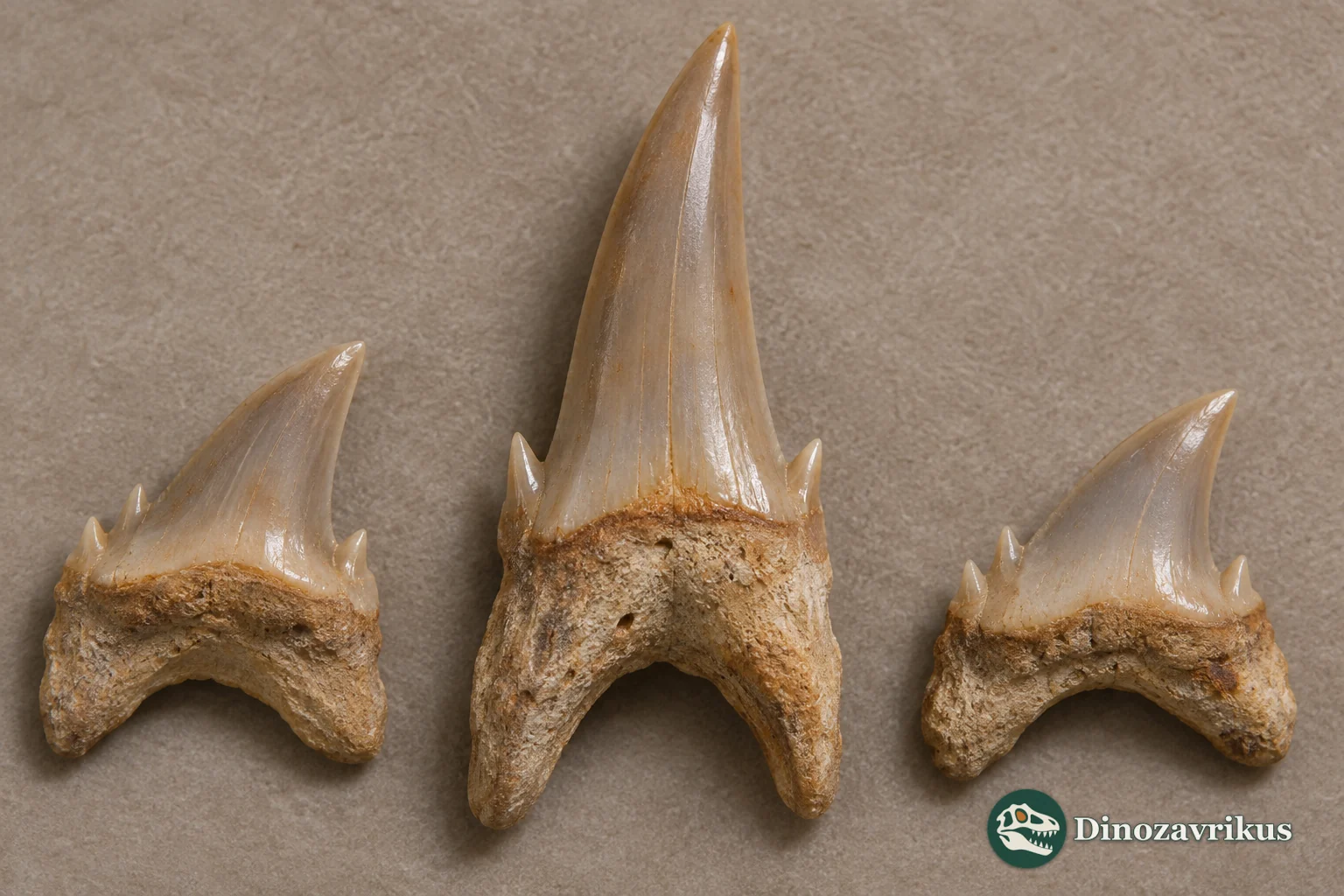
The smooth crowns have one pair of inward-angled side cusplets. Cutting edges stop before reaching those cusplets, separating them from some similar fossil sharks.
FES 061 came from lowermost Bartonian deposits near Luna de Sus. A single tooth establishes a local record, not a body size or population history.
Agassiz named verticalis in 1843. Jaekel introduced Hypotodus in 1895. Later authors differed over hopei and its placement; the 2019 review recognises H. verticalis.
A name with a contested history
Louis Agassiz introduced Lamna verticalis in 1843 from English Eocene material. Karl Jaekel established Hypotodus in 1895. Later researchers differed over whether the teeth belonged with hopei and whether Hypotodus deserved its own genus. The 2019 Alabama review retained H. verticalis as the only species of the genus.
The decision rests on dental anatomy, especially cutting edges that end before the lateral cusplets. In Jaekelotodus, the edge extends farther and enamel reaches onto the upper root lobes. Tooth position and preservation must be considered before comparing isolated specimens.
The Claiborne tooth series
Ebersole, Cicimurri and Stringer examined 121 separate teeth from the Eocene Claiborne Group of Alabama. Figure specimens include anterior tooth MSC 37055.1 from the Meridian Sand Member of the Tallahatta Formation and lateral tooth MSC 37296 from the basal Lisbon Formation. The total counts fossils, not complete jaws or individual sharks.
The crowns have smooth faces, a single pair of small cusplets angled toward the main cusp, and a two-lobed root with a nutritive groove. Anterior teeth tend to be taller and narrower; lateral crowns are shorter and broader. This variation helps identify isolated teeth but does not directly fix whole-body dimensions.
A Romanian occurrence
Trif, Codrea and Arghiuș reported tooth FES 061 from lowermost Bartonian deposits near Luna de Sus in the Transylvanian Basin. Its triangular cusp, smooth faces, single cusplet pair and root groove support the identification. The Romanian and Alabama finds represent distinct marine settings within the Eocene.
The similarly named Palaeohypotodus has its own dental diagnosis. A shared part of a name is not evidence that the animals were identical or lived in one continuous population.
What the fossils leave open
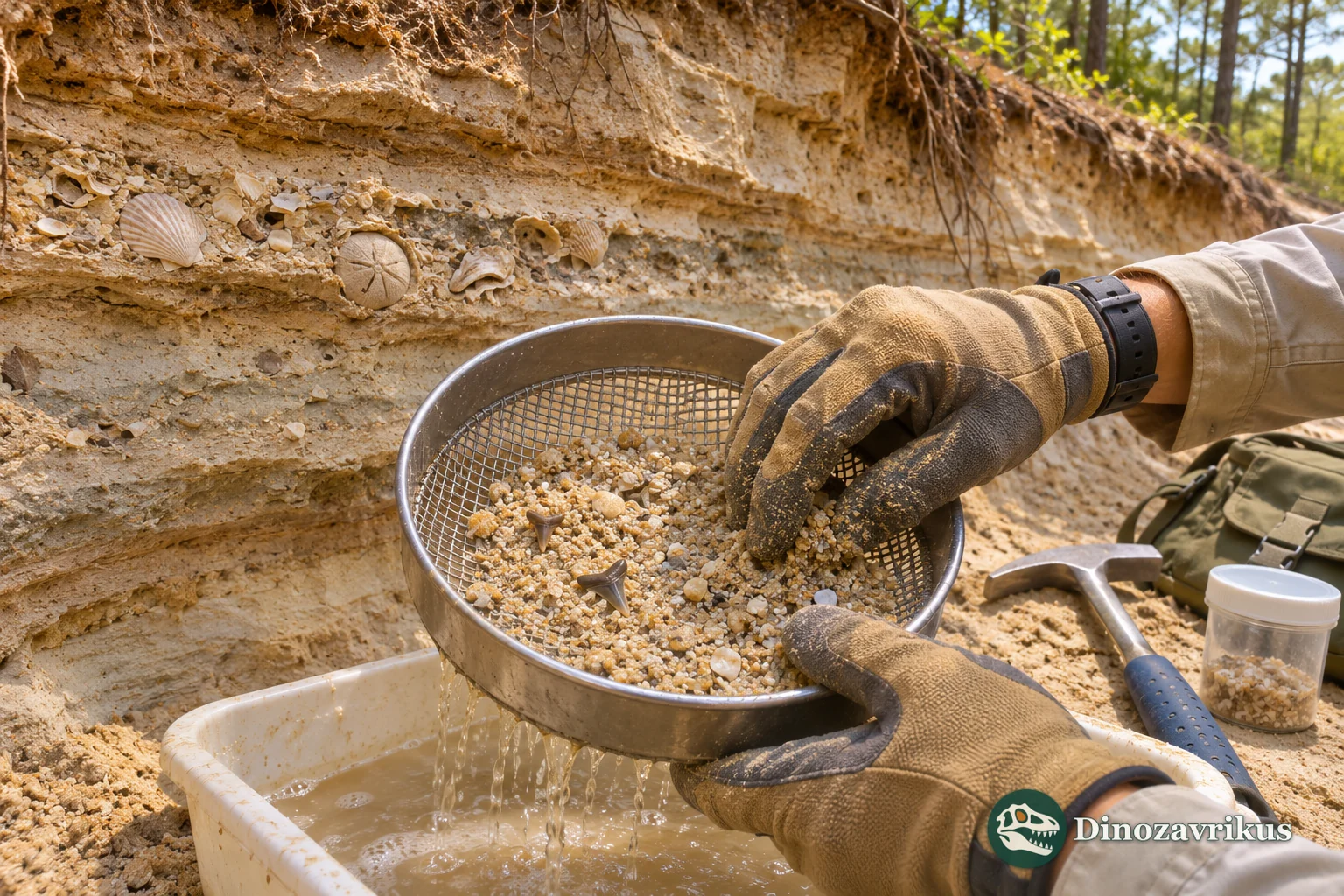
Teeth reveal a portion of the jaws. They do not directly reveal body length, colour, fin shape, particular prey or swimming speed for this fossil form. The field scene is illustrative, and the shark on the cover is a plausible comparison rather than a documented individual.
Frequently asked questions
Do the 121 Alabama teeth represent 121 sharks?
No. They are isolated teeth; the sample cannot determine the number of individuals.
Which species is the type of Hypotodus?
H. verticalis, first named by Agassiz in 1843 under Lamna.
How does its tooth differ from Jaekelotodus?
In Hypotodus the cutting edge stops before the side cusplets; Jaekelotodus has a longer edge and enamel extending onto the upper root lobes.
Can the fossils give a direct body length?
No. The described series provides tooth characters, not a measured complete body.