

Illaenus is a genus of asaphid trilobites from Ordovician seas. Many species have a broad, vaulted shell with subdued furrows, a shape that can make a complete carapace look unusually smooth. The genus is not a single species or one local population: its fossil record includes numerous named forms, and regional classifications have changed as researchers compared more material.
East Baltoscandia has received particular attention, with studies discussing more than twenty species and proposing a framework of subgenera. A separate specimen, the pygidium GIT 437-107, became notable because its internal mould carries thirteen small structures. A recent paper discussed parasite infestation and host pathology as possible causes, while leaving the exact explanation unresolved. The ancient arthropod catalogue provides a place to compare Illaenus with other fossil arthropods without treating every smooth trilobite as the same animal.
Quick facts
| Named | Dalman, 1827 |
|---|---|
| Type species | Illaenus crassicauda |
| Group | Illaenidae; trilobite |
| Age | Ordovician |
| Best-studied region | East Baltoscandia, among others |
| Shell | Broad, vaulted and often weakly furrowed |
| Unusual specimen | GIT 437-107, a pygidium with small structures |
| Open question | Whether those structures reflect parasites or host pathology |
What can the fossils tell us?
The shields and their sutures can be measured and compared. Soft appendages, colour and most internal anatomy are not preserved by an ordinary shell.
A classification proposed for East Baltoscandia is a working taxonomic scheme. It does not settle the genus-wide status of every species from every continent.
Enrollment is directly visible in the fossil. Its exact trigger and frequency in life cannot be read from the posture alone.
The published authors considered parasite infestation and host pathology among the plausible explanations. The structures do not identify a parasite, and the specimen does not establish a genus-wide disease pattern.
A genus founded in the early study of trilobites
Johan Wilhelm Dalman introduced Illaenus in 1827. The genus name is anchored by its type species, Illaenus crassicauda. A type species is a nomenclatural reference point: it fixes how the name is applied, but it does not mean that all fossils historically placed in the genus are equally well understood.
Over nearly two centuries, palaeontologists described Illaenus species from different regions and revised their boundaries. Such changes are normal in a group known largely from durable external skeletons. A broad outline may be shared by related forms, while details of the glabella, facial sutures, pygidium and thoracic axis help separate taxa. Fragmentary material can lack exactly the characters needed for a confident identification.
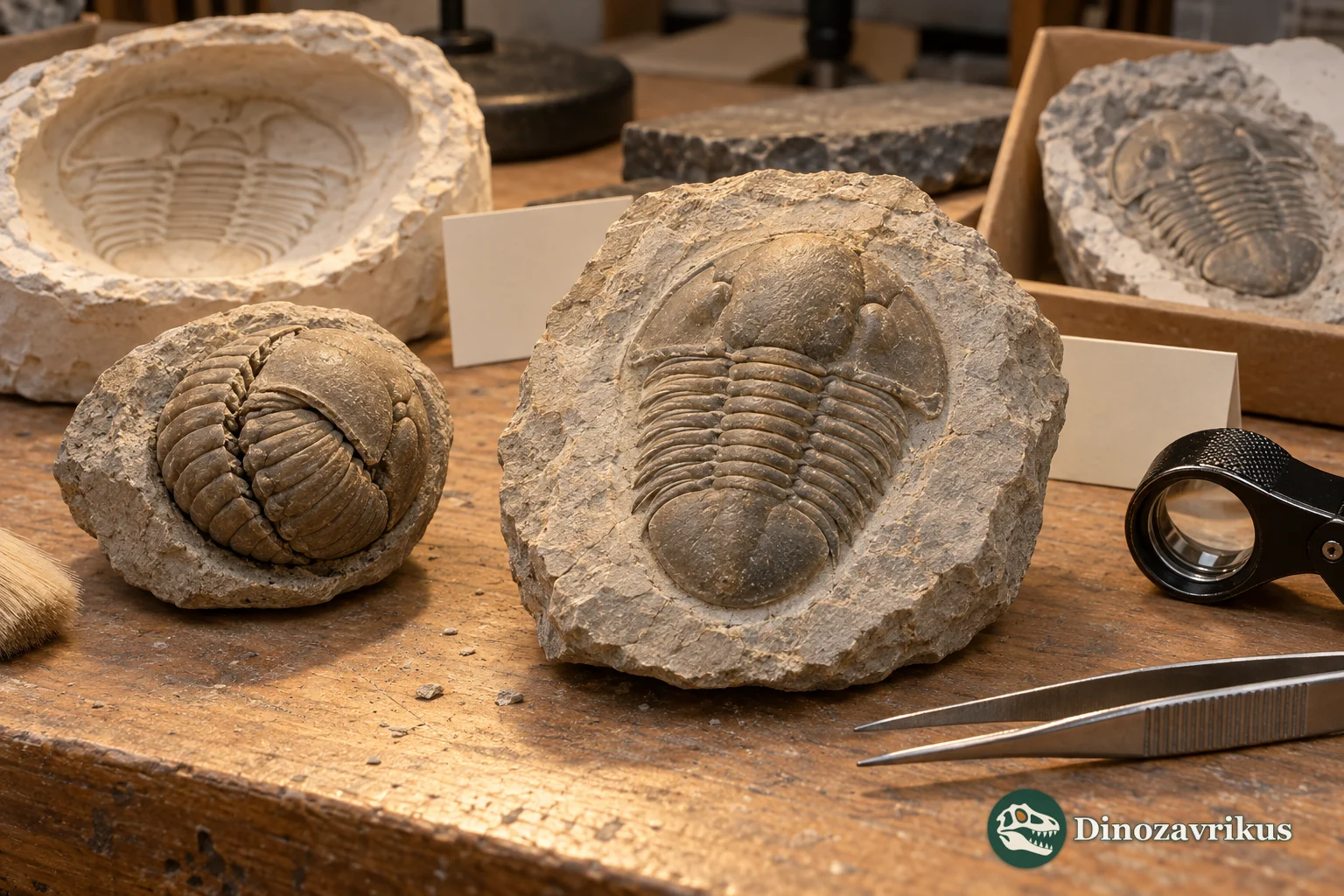
What an illaenid shell preserves
The trilobite body was divided into a head shield, a segmented thorax and a tail shield called the pygidium. In many Illaenus, the head and pygidium are wide and strongly convex, and the thoracic axis is relatively broad. The exact proportions vary among species. The apparently plain surface is still diagnostic: shallow furrows, sutures and the shape of the rear margin remain useful when preservation is good.
Some fossils preserve the animal enrolled, with the head and tail shields brought together around the softer underside. This is direct evidence that the exoskeleton could close into a compact posture. It is reasonable to interpret enrollment as protection, but a single enrolled fossil cannot reveal what threat caused the response or how often individuals used it.
Most specimens preserve the mineralised cuticle rather than the legs, antennae or digestive tract. Those missing parts limit claims about how Illaenus moved sediment or selected food. A rounded shell by itself does not prove a particular diet. Feeding models need to be treated as hypotheses unless supported by gut contents, preserved appendages or a detailed functional comparison.
Species and subgenera in East Baltoscandia
East Baltoscandian material has been the focus of intensive taxonomic work. One modern regional synthesis reviewed twenty-three species and proposed a five-subgenus arrangement. That framework helps organise a diverse local record, but it is a hypothesis built around the sampled species and characters. It should not be mistaken for an unchanging global classification.
Species assignments depend on combinations of features, not a single smooth outline. Researchers compare the cephalon, glabella, facial sutures, thoracic axis and pygidium, and they consider deformation and growth. A worn or compressed fossil can obscure a furrow or change the apparent width of a shield. For that reason, a genus-level identification may be more responsible than naming a species from an incomplete tail alone.
The fossil record is also assembled from different beds and localities. Baltic examples do not represent every species or the whole geographic range. When two forms occur in separate strata, their resemblance does not establish that they lived together or occupied identical habitats. Stratigraphic position and the associated fauna provide the context for each identification.
Thirteen structures on pygidium GIT 437-107
A 2025 study reported a Middle Ordovician Illaenus pygidium from Estonia with thirteen domical to crater-like structures on its internal mould. The specimen is catalogued as GIT 437-107. The published account describes an isolated tail shield, not a complete animal, and the exact collecting locality was not available in the report. Those limits matter: the structures can be described, but the full circumstances of the individual’s life are not known.
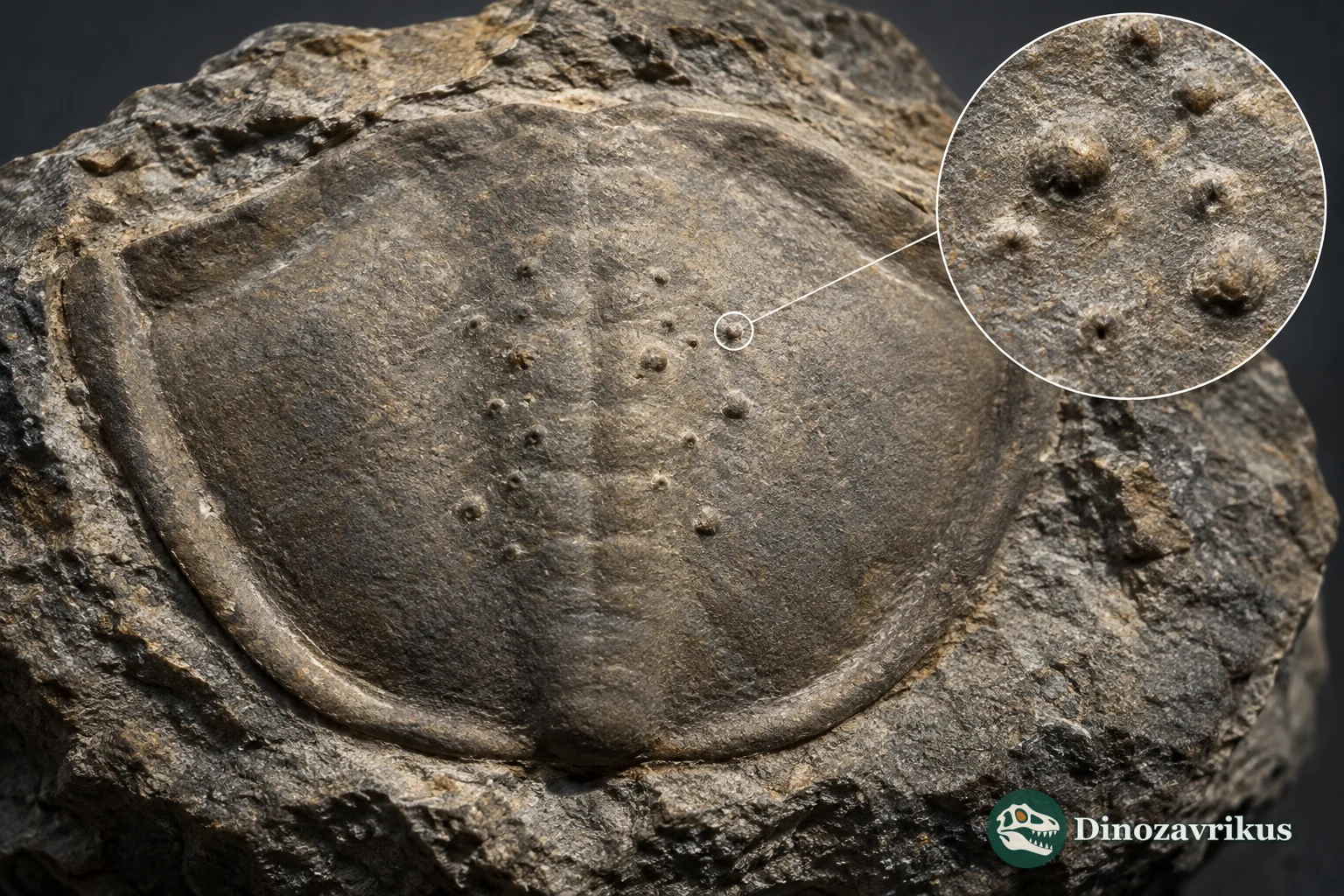
The authors considered parasitic infestation the more likely of the alternatives they discussed, but also examined host pathology. The visible pattern does not preserve a parasite’s body or a diagnostic trace that would name one. A disease process, biological interaction and other explanations must therefore remain distinct possibilities rather than facts. The specimen is evidence of an unusual interaction or growth pattern, not proof that all Illaenus were commonly parasitised.
The case shows why the description of a fossil and its interpretation should be kept separate. The count, shape and position of the structures are observations. Their cause is an inference based on comparison with other fossils and biological processes.
Ordovician seas and the limits of reconstruction
Illaenus lived in marine settings during the Ordovician, a period when shallow shelves covered parts of several continents. East Baltoscandian formations preserve a particularly informative succession, but the genus is not restricted to one bed or one environment. Species distributions have to be assessed at the level of named taxa and dated localities.
Researchers can use trilobite assemblages to compare strata and reconstruct changes in marine communities. Those applications depend on reliable identifications and age control. A genus-level record can be useful, but it should not be given the precision of a species range when its material is incomplete or its taxonomy unsettled.
The cover reconstruction communicates a plausible trilobite body plan, not a photograph from an Ordovician seabed. Colour, exact limb arrangement, feeding behaviour and the precise habitat of GIT 437-107 are not directly known. The evidence supports a distinctive group of shelled marine arthropods and a few unusually informative specimens; many details of their lives remain open.
Frequently asked questions
When did Illaenus live?
Illaenus is an Ordovician trilobite genus. The age and geographic range depend on the species and the dated rock unit where each fossil was found.
What is the type species of Illaenus?
The type species is Illaenus crassicauda. It anchors the use of the genus name, although many other species have been assigned to Illaenus over time.
What are the marks on pygidium GIT 437-107?
A 2025 study described thirteen small domical or crater-like structures on an internal mould. The authors discussed parasite infestation and host pathology, but the exact cause is not established.
What did Illaenus eat?
The available shell evidence does not securely establish a specific diet. Without diagnostic gut contents or preserved feeding anatomy, a precise menu would be speculation.