

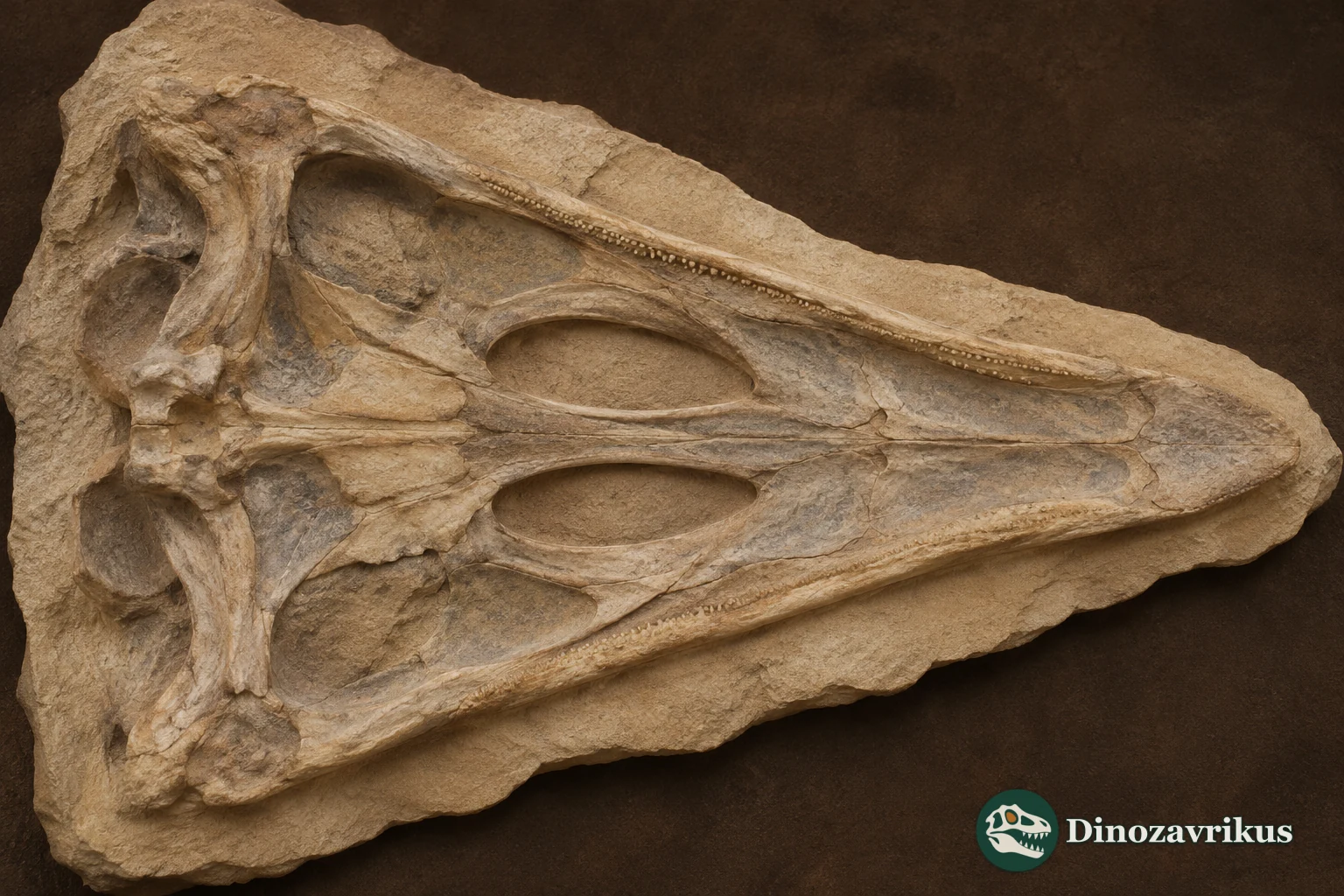
Inflectosaurus amplus was a trematosaurid from Bolshoye Bogdo in what is now southern European Russia. Its largest skulls were estimated at up to 70 centimetres long. Impressions of the skull roof, parts of the palate and a lower jaw fragment allow researchers to compare smaller specimens with the large holotype.
Quick facts
| Group | Temnospondyls, trematosaurids |
|---|---|
| Age | Early Triassic, late Olenekian |
| Region | Europe, Astrakhan Region, Russia |
| Skull length | Up to 70 cm, estimated |
| Type species | Inflectosaurus amplus |
| Scientific name | Inflectosaurus |
| Diet | Exact prey is unknown |
What can the fossils tell us?
The fossils from Bolshoye Bogdo include partial skulls, an impression of the skull roof and a lower jaw fragment. The incomplete type skull is PIN 2242/1.
The smaller skulls have oval orbits. Larger specimens have rounder orbits and a jaw joint farther behind the back of the skull. These differences are consistent with growth.
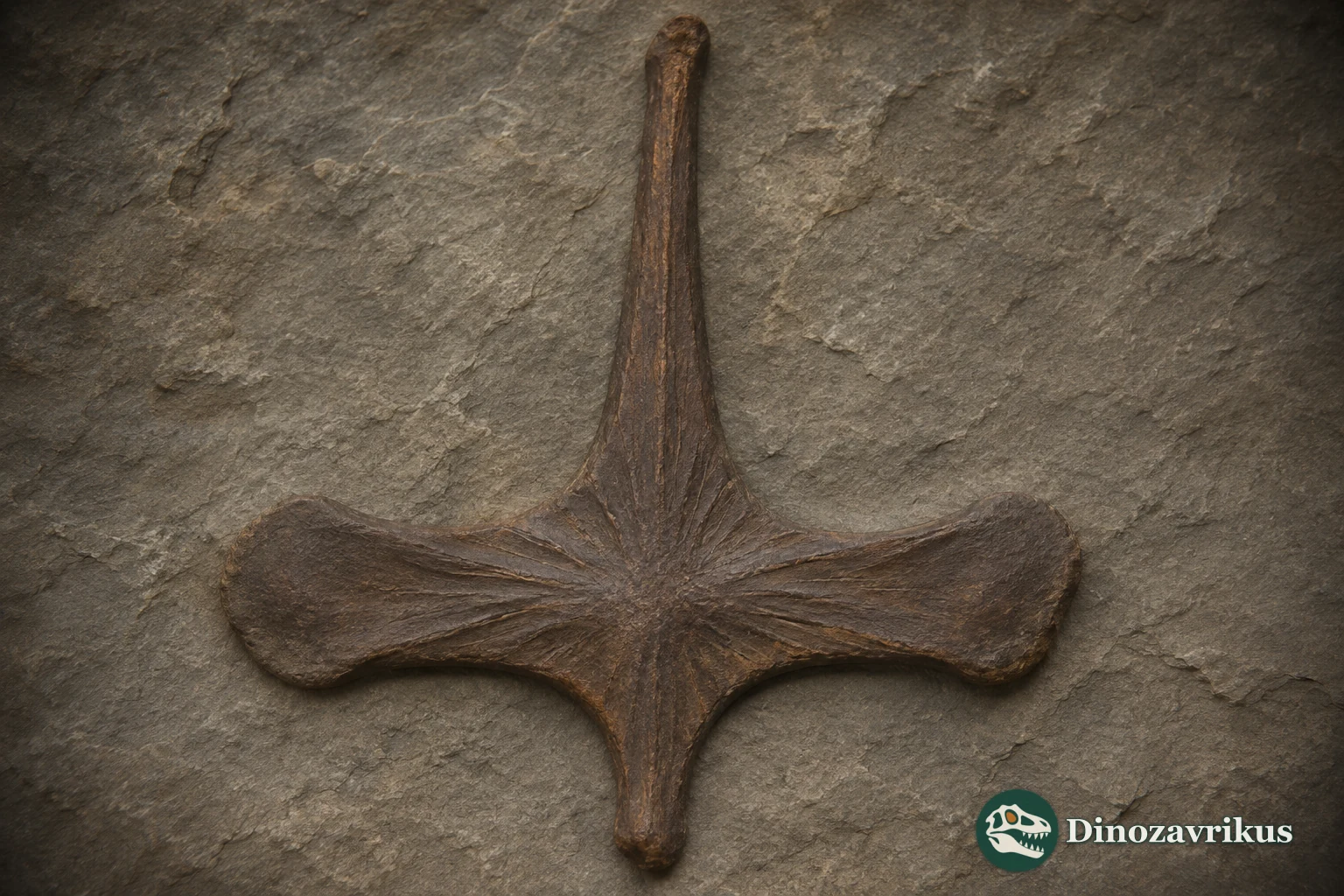
A separate interclavicle may belong to Inflectosaurus. It cannot establish the proportions or length of the whole body.
Material from Bolshoye Bogdo
Mikhail Shishkin named Inflectosaurus in 1960 from an incomplete skull, PIN 2242/1. It was found near the base of the Bogdo Formation in the Astrakhan Region. The fossil-bearing beds are late Olenekian in age. The site also yielded smaller skull remains and a lower jaw that was initially given a different identification.
Changes in skull shape
The skull-roof impression PIN 2247/3 and the fragments PIN 2242/49 are from individuals with skulls estimated to have been about 20 centimetres long. Their orbits are oval, whereas those of the large holotype are rounder and relatively smaller. In the bigger specimens the jaw articulation sits well behind the points where the skull meets the neck. The skull roof and palate also carry characters that permit comparison with Angusaurus, an earlier trematosaurid from Eastern Europe.
A possible shoulder bone
The same locality yielded a cross-shaped interclavicle, PIN 2242/48, measuring 9.3 centimetres long and 5 centimetres wide. This bone would have lain between the clavicles in the shoulder girdle. Its resemblance to other trematosaurid interclavicles supports the referral. The bone was found separately, and its identification to genus remains tentative.
The coastal setting
Some Early Triassic deposits at Bolshoye Bogdo formed near a marine shore. Grooves on the skull mark lateral-line canals, part of a system that sensed water movement. They support an aquatic interpretation. The fossils leave open whether Inflectosaurus spent its entire life in marine water or used a range of aquatic habitats. Its prey is unknown.
Frequently asked questions
How long was its skull?
The amended diagnosis gives a maximum of about 70 centimetres. Two smaller skulls from the same locality are estimated at roughly 20 centimetres long.
How old are the fossils?
The specimens from Bolshoye Bogdo are from the later part of the Olenekian, in the Early Triassic.
What did the grooves on the skull do?
They mark canals for a lateral-line system that detected water movement.
Is anything known of the shoulder girdle?
A separate shoulder bone called an interclavicle was provisionally referred to Inflectosaurus based on similarities to other trematosaurids.