

Isoteloides is an Ordovician genus of asaphid trilobites with broad cephalic and pygidial borders and relatively subdued axial features. A smooth, wide outline alone is not enough to identify it: researchers compare the head, facial sutures and the proportions of the pygidial axis. Its species are part of the ancient arthropod catalogue, where each name is tied to described fossil material.
Quick facts
| Scientific name | Isoteloides Raymond, 1910 |
|---|---|
| Type species | Isoteloides canalis (Whitfield, 1886) |
| Group | Arthropoda, Trilobita, Asaphidae, Isotelinae |
| Age | Ordovician; the best-described series is Lower Ordovician |
| Type formation | Fort Cassin Formation, Vermont |
| Typical material | Cranidia, pygidia, free cheeks, hypostomes and articulated shells |
| Species distinction | Relative length of the pygidial axis and border |
| Size and diet | No single genus-wide length or direct diet evidence |
What can the fossils tell us?
Raymond established Isoteloides in 1910 with Asaphus canalis Whitfield, 1886 as its type species. Brett and Westrop later examined the Whitfield material and selected a lectotype from the Fort Cassin Formation.
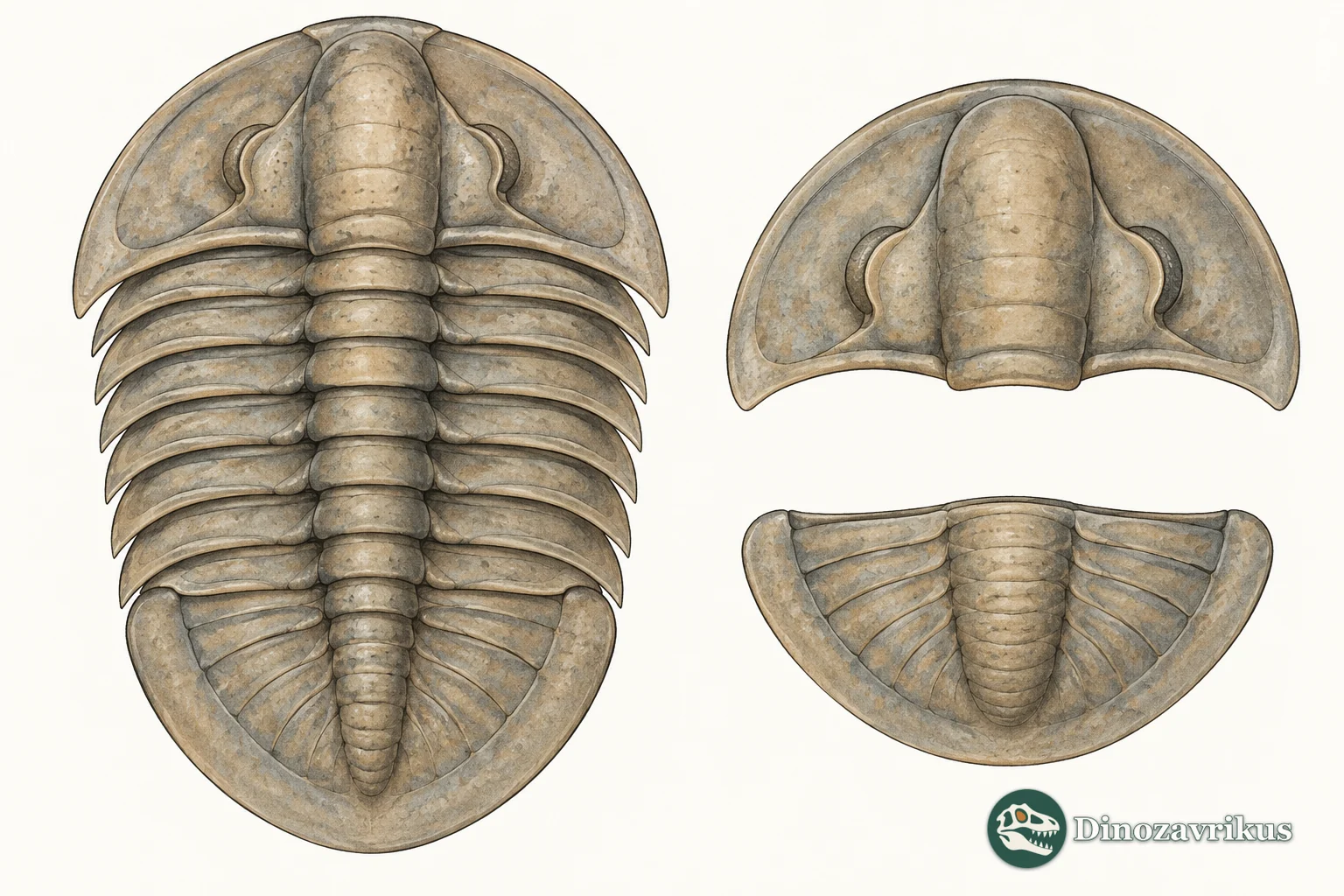
In the Fort Cassin sample, the pygidial axis of I. canalis occupies about 70–80 percent of shield length, leaving a broader border. In I. peri it occupies about 85–90 percent. Cranidial characters provide an additional comparison.
Brett and Westrop described 40 cranidia, 149 pygidia and numerous free cheeks and hypostomes from several collecting levels. These are skeletal pieces, not a count of complete trilobites.
The Fort Cassin Formation represents a shallow subtidal carbonate environment affected by storms. The fossils do not show exact diet, habitual depth, swimming speed or soft-body anatomy.
From Asaphus canalis to Isoteloides
Robert P. Whitfield described Asaphus canalis in 1886 from material associated with the Fort Cassin Formation in Vermont. Percy Raymond erected Isoteloides in 1910 and designated A. canalis as its type species. Raymond also applied the name I. whitfieldi to material that later authors treated as a junior objective synonym of I. canalis.
Kevin Brett and Stephen Westrop revisited the genus in their 1996 study of the Fort Cassin Formation. They examined Whitfield's specimens and a broader sample from Vermont and New York, and designated a lectotype from the American Museum of Natural History collection. Their study showed that two pygidial forms previously lumped together represented two species.
The formal history matters because each old label is not automatically a modern identification. The authors reassigned some figured specimens published by Fortey as I. latimarginatus to I. canalis, while another figure belonged to I. peri. The name attached to a specimen therefore depends on its observable characters and the revision being followed.
How I. canalis differs from I. peri
The most useful distinction in the Fort Cassin material is the relationship between the axis and border of the pygidium. In I. canalis, the axial lobe occupies roughly 70–80 percent of the shield's length, leaving a relatively broad border. In I. peri, described by Richard Fortey in 1979, the axis is longer, occupying about 85–90 percent, and the border is narrower.
The comparison does not depend on a single tail shield. Brett and Westrop compared pygidia with cranidia, including the width of the frontal area and the course of the anterior facial sutures. Their sample included 40 cranidia, 149 pygidia and numerous free cheeks and hypostomes. Those are fossil parts, not 189 whole animals.
The two species can occur together in the Fort Cassin Formation. Their differences matter for stratigraphic correlation: if a broad-bordered pygidium is assigned to I. peri without checking the head or the rest of the diagnosis, a faunal list can blur distinct records.
A storm-influenced carbonate shelf
The Fort Cassin Formation consists mainly of carbonates deposited in a shallow subtidal setting affected by storms. Brett and Westrop described a low-diversity trilobite fauna in which Isoteloides was especially abundant at some sampled levels. That abundance belongs to the documented collections, not to every Ordovician sea or every species in the genus.
Sections in Vermont and New York were compared with the Catoche Formation of western Newfoundland. Shared trilobites helped correlate regional strata, but fossils from separate localities do not represent one population. Sediment type, storm transport and preservation all influence which parts of an animal enter a collection.
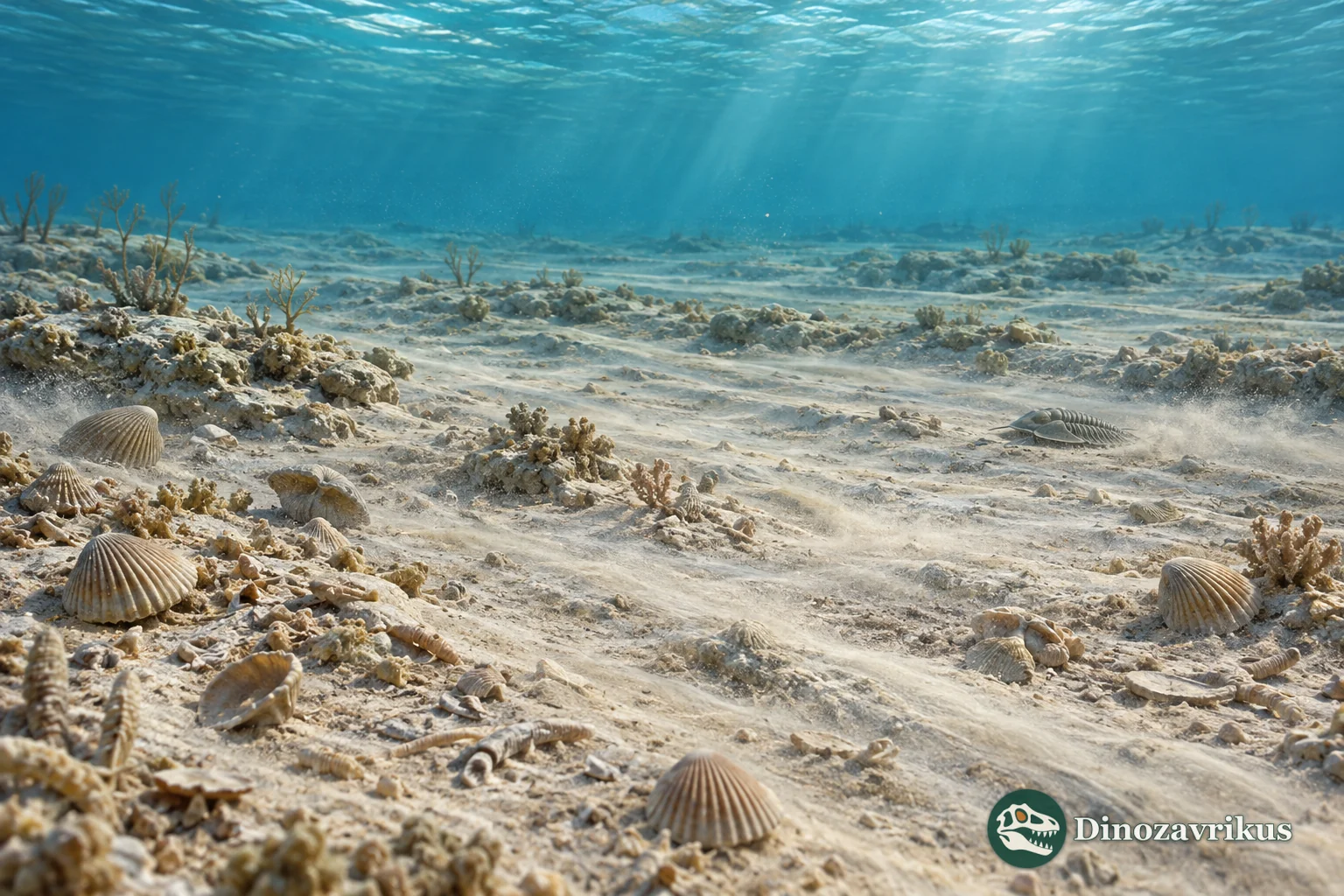
The broader setting belongs to the changing seas of the Ordovician Period. A genus-level occurrence helps describe a fossil assemblage, but it cannot by itself determine water depth, food or movement.
Anatomy and body size
The trilobite body was divided into a cephalon, an articulated thorax and a pygidium. Isotelines are often broad and smooth in outline, but diagnostic features include the course of facial sutures, the definition of the axial furrows and the relative length of the pygidial axis. Some species have genal spines; that feature should not be applied to every member of the genus without species-level evidence.
A single total length cannot be given for Isoteloides. Published material includes isolated shields, and measurements in systematic papers refer to particular specimens or parts. Restoring a complete length from a cranidium or pygidium alone requires a justified comparison with a complete close relative, which the Fort Cassin sample does not provide as a universal genus-wide estimate.
The fossils preserve the dorsal exoskeleton better than appendages, gut contents or other soft tissues. A marine benthic setting is supported by the host rocks, but exact feeding mode, habitual depth, swimming speed and reproductive behaviour remain unestablished for the genus.
Evidence and reconstruction
The type specimens, measured shields and their stratigraphic positions are direct evidence. Species diagnoses, synonymies and correlations are conclusions from comparative work and can be revised when new material is studied. The colour, soft anatomy and precise posture in artwork are interpretive.
Frequently asked questions
When did Isoteloides live?
The genus is known from Ordovician rocks. The best-described sample from the Fort Cassin Formation is Lower Ordovician; other species and regions have their own stratigraphic records.
What is the type species?
Isoteloides canalis, described by Whitfield in 1886 as Asaphus canalis. Raymond established Isoteloides in 1910.
How do I. canalis and I. peri differ?
The pygidial axis is shorter relative to the shield in I. canalis, leaving a broader border. In I. peri the axis occupies more of the pygidium; cranidial characters also help distinguish them.
Why can Isoteloides be confused with Isotelus?
Both are broad-bodied asaphid trilobites with smooth shields. Their genera are distinguished by a combination of facial sutures, axial furrows and shield proportions, not by the overall silhouette alone.