

A carbonate shell may preserve a chemical signal from the water in which it grew. In the laboratory, researchers measure the relative abundance of light and heavy isotopes of oxygen or carbon and compare the result with an agreed reference. The value can help constrain temperature, water composition or carbon-cycle change, but it is not a climate reading until the formation process is understood.
Isotopes are atoms of the same element with the same number of protons but different numbers of neutrons. Oxygen-16 is lighter than oxygen-18; carbon-12 is lighter than carbon-13. Evaporation, rainfall, ice growth and mineral formation distribute these isotopes slightly differently. Their ratios give geochemists a way to investigate ancient environments, alongside the rock sequence and other evidence used to reconstruct Earth’s geological history.
What an isotope value means
Mass spectrometry measures isotope ratios in a prepared sample. Results are often reported in delta notation: the difference between a sample’s heavy-to-light isotope ratio and a reference, expressed in parts per thousand. A value in per mil is not a temperature. Connecting it to climate requires a model of how the mineral formed and exchanged with water or air.
Oxygen-18 values in marine carbonate depend on at least two variables: the temperature at which the organism built its shell and the isotope composition of seawater. When large ice sheets grow, proportionally more light oxygen is stored in continental ice, changing the ocean’s composition. The same shift in a shell can therefore reflect temperature, ice volume or both.
Shells record temperature and ice volume together
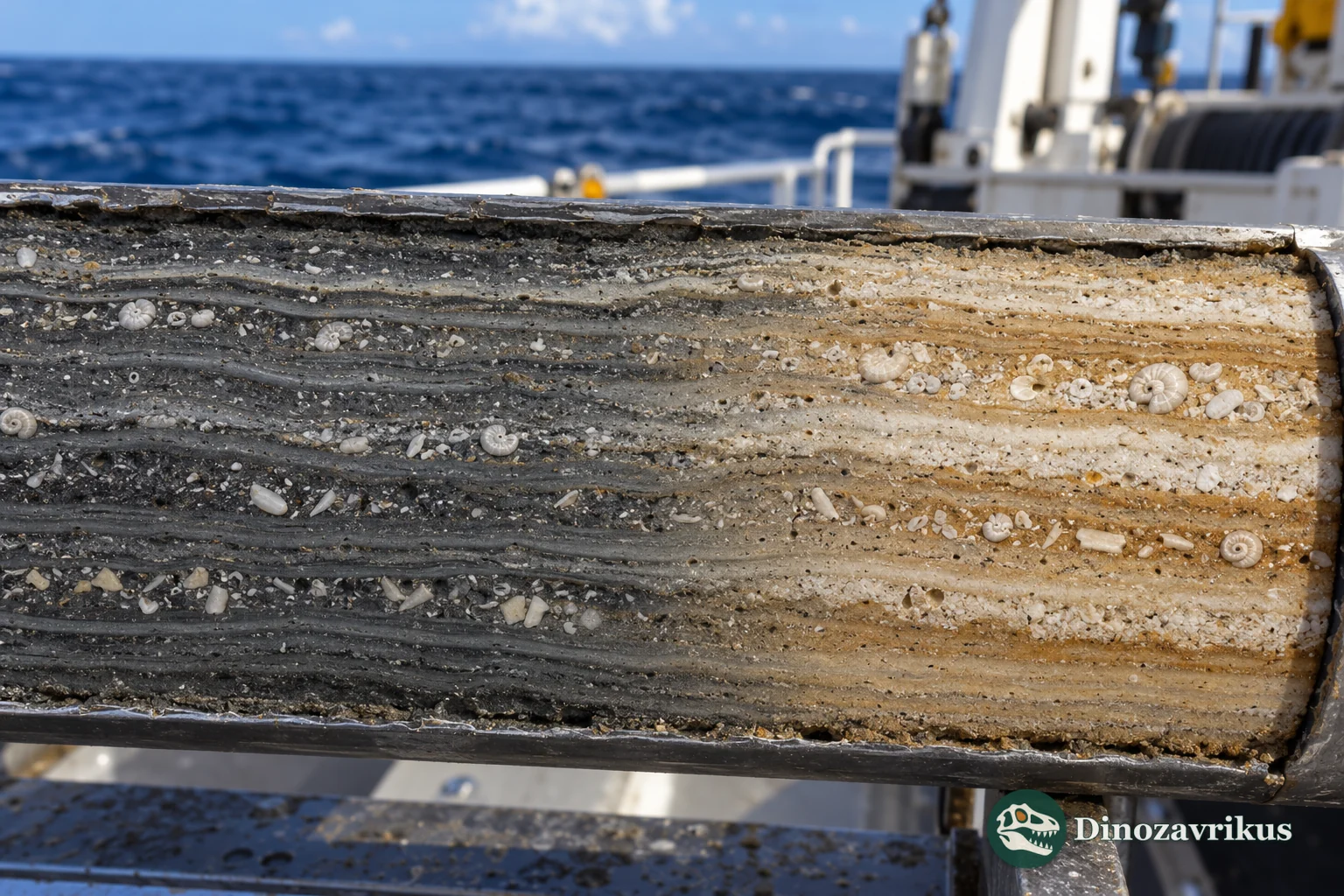
Foraminifera and other marine microfossils provide carbonate that can be analysed in sequences through a sediment core. But conventional oxygen-isotope measurements mix the temperature of shell growth with the composition of seawater. Scientists separate the signals by combining independent temperature proxies, estimates of ice volume and records from different archives.
Carbonate clumped-isotope thermometry measures how often heavy carbon and oxygen isotopes occur bonded within the same carbonate group. That ordering depends on the temperature at which the mineral formed, allowing researchers to estimate formation temperature independently of the parent water’s isotope composition. Combined with the carbonate’s oxygen-isotope value, the temperature estimate can then help constrain the water from which the shell or mineral grew.
The method needs enough suitable material, careful calibration and a preservation check. It does not work automatically on every shell or fossil bone. Groundwater can alter carbonate after burial or replace it with new minerals, so the measured chemistry may reflect later history rather than the environment in which the organism lived.
Carbon isotopes answer a different question
Carbon-13 relative to carbon-12, reported as δ13C, helps track carbon moving among the ocean, atmosphere, organisms and sediments. Plant values can differ with photosynthetic pathway; marine carbonate can record changes in dissolved carbon and the broader carbon cycle. But δ13C is not a direct thermometer.
A carbon-isotope shift may coincide with climate change because temperature, weathering, productivity and organic-carbon burial interact. Coincidence does not establish the cause. Researchers also examine carbon burial, circulation, sediment context and other geochemical proxies. Isotope measurements in an animal’s teeth may reveal details of its diet or habitat, but that is a different question from reconstructing regional climate.
What can alter the signal
The isotope record is shaped by more than climate. Species, season, habitat depth, shell-growth rate and local water chemistry can affect the signal. Organisms may also fractionate isotopes through physiology. Researchers test these effects by comparing taxa, modern samples and independently measured environmental data.
Before analysis, a sample is examined for recrystallisation and other signs of alteration. If carbonate exchanged with groundwater after burial, a precise laboratory value may describe the later fluid rather than the original ocean. Mineralogical and geochemical checks help assess preservation, though no single test can guarantee that every original signal survived.
Stable-isotope proxies should also be distinguished from radiometric dating. Climate studies use naturally occurring stable ratios that respond to physical and chemical processes. Radiometric methods use radioactive decay to estimate when an event occurred, such as zircon crystallisation in volcanic ash. Both involve isotopes, but they answer different questions. Good reconstructions combine geochemistry with stratigraphy, independent dating and other climate proxies; they are one part of how palaeontologists study fossil evidence.
Frequently asked questions
Can oxygen isotopes in a shell give ocean temperature directly?
No. The value depends on both shell-growth temperature and seawater composition, which can change when continental ice grows. Researchers separate these effects with independent evidence and models.
What do clumped isotopes measure?
They measure how often heavy carbon and oxygen isotopes are bonded within the same carbonate group. That ordering depends on mineral-formation temperature and can constrain it independently of the parent water’s composition.
Does carbon-13 reveal climate temperature?
Not on its own. Carbon-isotope values help trace carbon sources and cycling, including photosynthesis and organic-carbon burial. Their climate meaning depends on context and comparison with other evidence.
How are climate isotope proxies different from radiometric dating?
Climate proxies use stable-isotope ratios to investigate environmental processes. Radiometric dating uses radioactive decay to estimate the age of a geological event.