

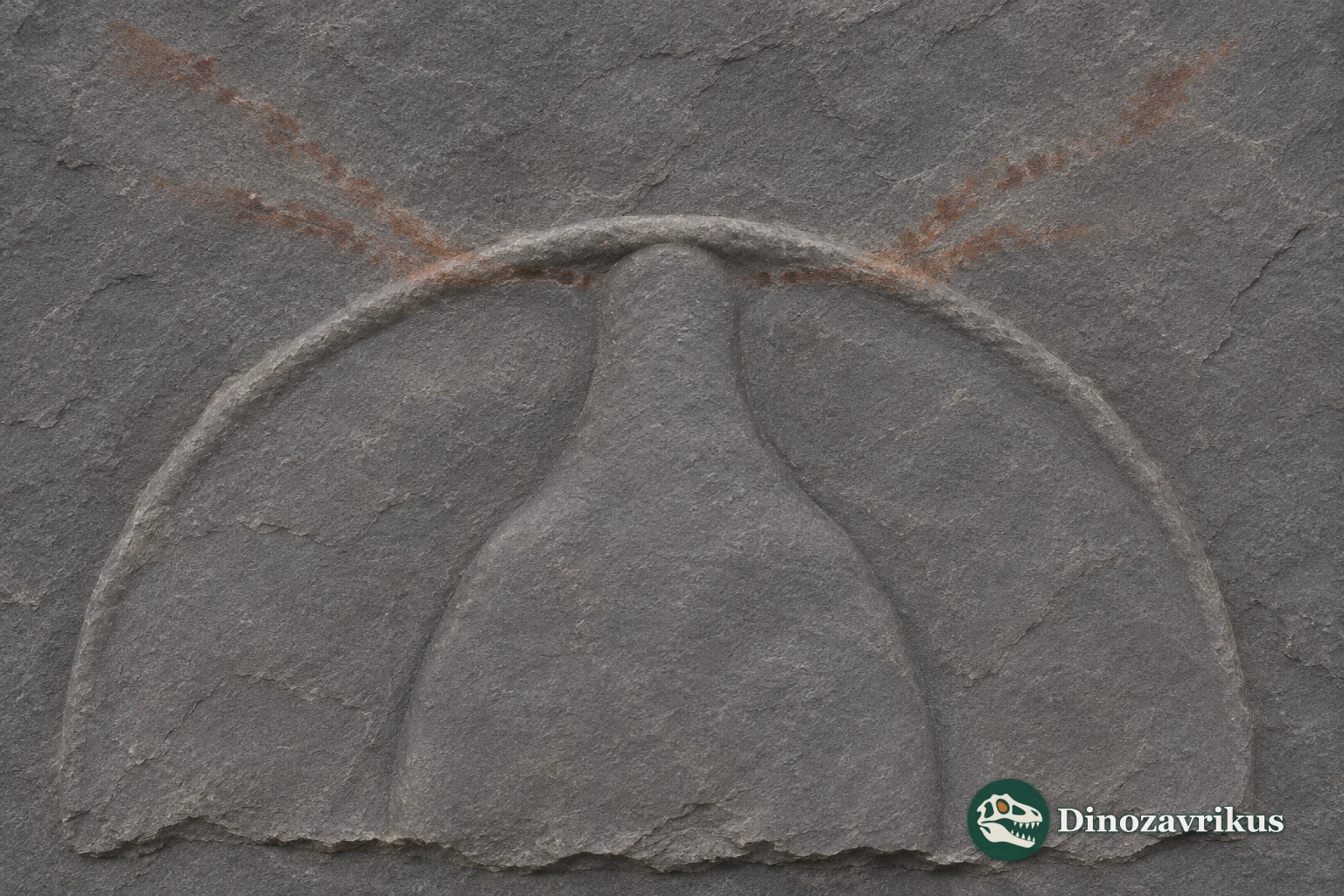
Itagnostus had two short thoracic segments between its rounded head and tail shields. A nearly complete specimen from Utah preserves thin rusty marks extending from under the head. Those marks offer rare evidence about the softer parts of an agnostid.
Quick facts
| Group | Agnostida |
|---|---|
| Age | Middle Cambrian |
| Named by | Armin Öpik, 1979 |
| Type species | Itagnostus elkedraensis |
| Utah specimen | UU18056.36, nearly complete shell |
| Idaho shields | Up to 3.5 mm long |
What can the fossils tell us?
The position of the frontmost left trace suggests an antenna. The fossil does not establish the full number of limb pairs.
Researchers compared the rear lobe with the first lobe of the tail axis across specimens of different sizes.
Lectotype AMF 9138 anchors the Australian species. The assignment of some other species varies among revisions.
From subgenus to genus
Armin Öpik introduced Itagnostus in 1979 as a subgenus of Peronopsis. Its type species, Agnostus elkedraensis, was described by Robert Etheridge Jr. in 1902 from the Northern Territory of Australia. John Laurie elevated Itagnostus to genus rank in 2004 and figured lectotype AMF 9138.
Charles White described the species known from Utah in 1874. It has also appeared as Peronopsis interstricta. There is still variation among revisions in which species they include. Gerd Geyer and John Peel used a concept of Itagnostus that included the American species.

What the Wheeler shale preserved
Specimen UU18056.36 came from Naraoia Quarry in the Wheeler Formation of the House Range. Parts of the front of the head and the back of the tail have broken away. Short iron oxide streaks project from both sides of the head. The frontmost on the left emerges ahead of the glabella, where a single-branched antenna could have been attached.
Other streaks are harder to place. The two on the right could be from separate appendages or from two branches of one. The joined shields make a reconstruction of the shell possible, but the marks leave the full number of appendages and their functions unresolved.
How the tail proportions vary
In the Lakeview Limestone near Lake Pend Oreille, the head and tail shields of I. idahoensis reach 3.5 mm in length. The holotype, USNM 724035, is a tail shield with a long raised axis and tiny marginal spines. In small tail shields the rear axial lobe is about 80% as wide as the front lobe. In larger specimens the two are roughly equal in width.
Comparing shields of similar sizes helps separate species differences from changes during growth. The Idaho species has a more expanded rear lobe and smaller tail spines than the Australian type species.
Frequently asked questions
Where was the specimen with traces of appendages found?
In the Wheeler Formation at Naraoia Quarry, Utah.
Why is one of the traces interpreted as an antenna?
It emerges from beneath the front of the head, ahead of the glabella, in a position consistent with an antenna.
Where did the type species come from?
It was found in the Elkedra area of Australia’s Northern Territory.
What is the holotype of the Idaho species?
USNM 724035, a tail shield from the Lakeview Limestone.