

Johnlongia was a Cretaceous lamniform shark named from isolated teeth. Fossils attributed to the genus occur in Western Australia, Russia and North America, but no associated skeleton shows its full proportions. The teeth preserve a useful taxonomic signal; they leave body size, colour and behaviour uncertain.
Quick facts
| Group | Cretaceous lamniform shark; family-level placement rests mainly on teeth |
|---|---|
| Type species | Johnlongia allocotodon, named by Mikael Siverson in 1996 |
| Known material | Isolated teeth; no associated body skeleton is known |
| Age | Cretaceous records range from Albian to Coniacian in published assignments |
| Geography | Western Australia, Russia and North America |
| Body length | Unknown; tooth height cannot provide a reliable total-length estimate |
| Diet | Specific prey are unknown; the teeth are not a crushing pavement |
What can the fossils tell us?
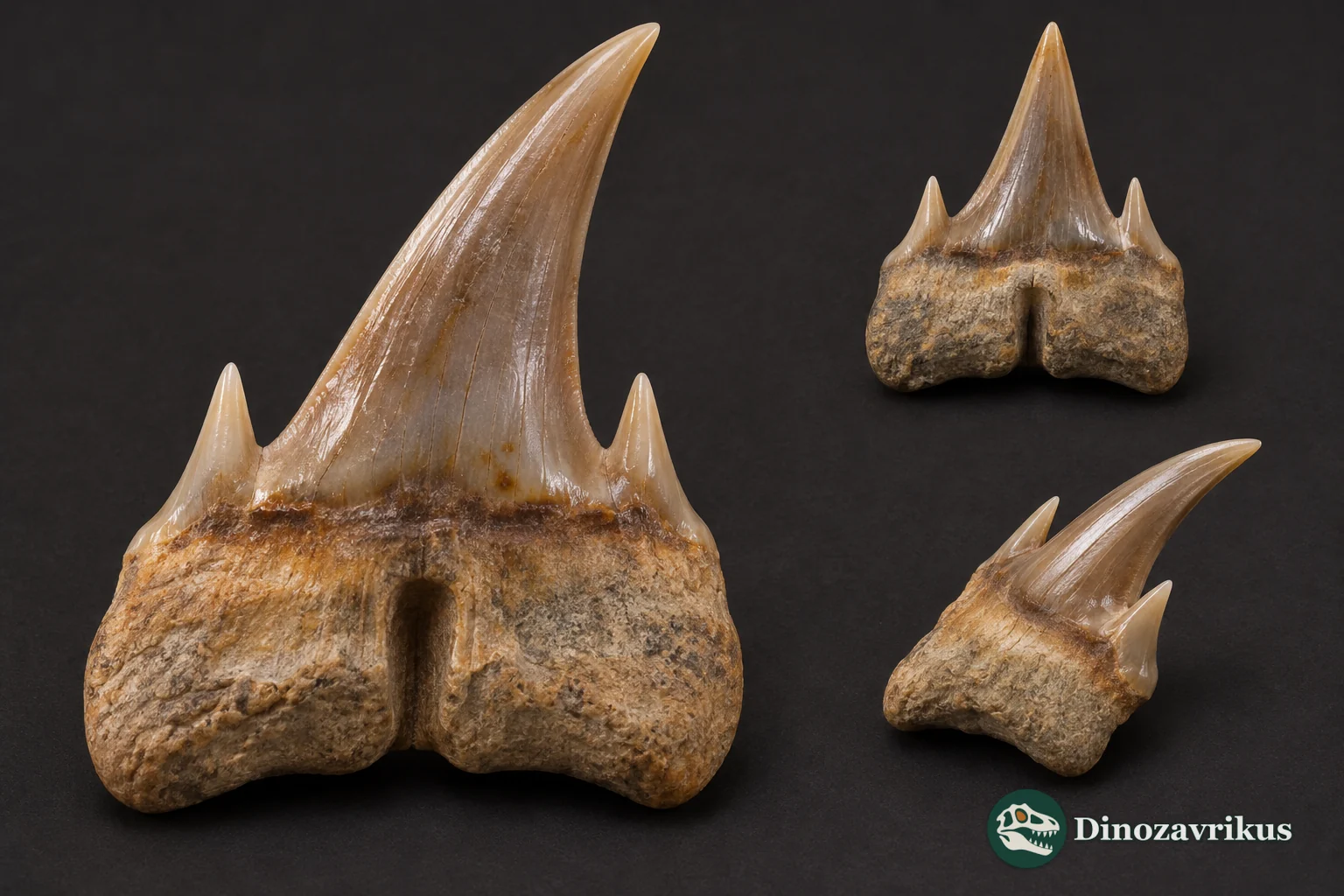
Described teeth have a narrow, often backward-inclined main cusp, smaller lateral cusplets and a deep groove across a prominent root boss. Those features help distinguish teeth, but do not directly record total body length or a specific diet.
The type species comes from mid-Cretaceous deposits in Western Australia; other teeth have been assigned to the genus in Russia and North America. These separate occurrences do not establish a continuous range or a migration route.
A 2015 study grouped Johnlongia with Pseudomegachasma in Johnlonginae, while noting the lack of associated tooth rows and skeletons. The classification is a reasoned proposal, not a result confirmed by a complete skeleton.
A new genus from Western Australia
Mikael Siverson described Johnlongia in 1996 in a survey of lamniform sharks from the Alinga Formation and Beedagong Claystone in Western Australia. The sampled beds yielded 15 lamniform species, including one new genus and three new species. Johnlongia allocotodon was the new genus’s type species, the name-bearing species that anchors the genus name.
The work also used shark teeth to correlate marine rock layers across distant regions. Siverson placed the uppermost Alinga Formation provisionally in the early Cenomanian and the basal Beedagong Claystone in the early or middle Cenomanian. Those ages apply to the studied beds, not automatically to every tooth later assigned to the genus.
What the teeth show
The teeth attributed to Johnlongia have a tall, narrow main cusp. In many specimens it curves slightly and leans toward the back of the mouth. One or more smaller cusplets sit at the sides of the crown. The root is broad and robust, with a large projection on its lingual side divided by a deep nutritive groove. In lateral teeth of J. parvidens, the front root lobe can be longer than the rear one.
Palaeontologists compare the crown outline, cusp angle, cutting edges, side cusplets and root lobes together. This combination helps separate the teeth from those of other Cretaceous lamniform sharks, including Cretalamna and Cretodus. It does not identify the position of every loose tooth in a jaw or reveal the full dentition.
Two named species and scattered records
The genus includes the type species J. allocotodon and J. parvidens, which was named earlier and later reassigned to Johnlongia after comparison of its teeth. Upper Cenomanian teeth of J. allocotodon have also been reported from the Melovatka Formation in Russia. These finds broaden the known record of the type species, but they remain isolated teeth from separate collections and localities.
The North American record of J. parvidens spans several marine formations. Hamm and Cicimurri described four teeth from the basal Atco Formation in Texas and summarised other records from Cenomanian rocks in Colorado, Turonian rocks in South Dakota and New Mexico, and a tooth from the upper Coniacian Niobrara Chalk in Kansas. A single tooth reported from western Kansas illustrates how even one find can extend a known geographic record while leaving the animal’s anatomy largely unknown.
Classification and the Johnlonginae proposal
Tooth morphology places Johnlongia among lamniform sharks. Its precise family-level position is less certain because tooth-based fossil groups can be difficult to compare with living sharks, which are known from complete anatomy and genetic data. In 2015, Kenshu Shimada and colleagues proposed Johnlonginae for Johnlongia and the related genus Pseudomegachasma.
The authors chose a subfamily-level group in part because associated tooth rows and skeletal remains were missing. Their paper also discussed a possible evolutionary sequence within this tooth-based group. That proposal is a hypothesis about relationships, not evidence that one named species was the direct parent of another. The distinction matters when fossils preserve isolated dental elements rather than connected skeletons.
Body size, prey and environment
The tooth crowns can be measured, but the body length of Johnlongia is unknown. A tooth’s size varies with its position in the jaw and with the animal’s growth, so a measurement cannot be converted into metres without a reliable model linking that tooth position to body size. No such complete tooth row or associated skeleton is available for this genus.
The pointed crowns and lateral cusplets are consistent with grasping or holding prey, but no stomach contents or prey fossil has been reported in direct association with Johnlongia. A study of an early Turonian high-latitude assemblage from Alberta noted that J. parvidens had not been reported from known southern sites and suggested a possible link with cooler northern waters. That is a biogeographic interpretation, not a measured temperature preference.
What a reconstruction can and cannot show
A living shark image can help readers picture a lamniform body plan, but it is not a portrait recovered from the rocks. The slender body, fin shapes, surface colour and swimming posture in an illustration are informed by comparisons with other sharks. The fossils of Johnlongia directly document teeth, and the limits of the reconstruction follow from that difference.
The most secure story is therefore dental and geological: researchers described the genus in a Cretaceous shark fauna, compared its tooth structure across localities and proposed a cautious place in lamniform relationships. Many details about the animal’s daily life remain open because the evidence consists chiefly of detached teeth.
Frequently asked questions
Was Johnlongia a sand tiger shark?
It is classified among lamniform sharks and has often been placed within the broad sand-tiger-shark family concept. Its exact family-level relationships remain tentative because the genus is known from teeth rather than a complete skeleton.
How large was Johnlongia?
Its total body length is unknown. Isolated teeth vary by position in the jaw and cannot be converted into a reliable body-length estimate without a complete or associated skeleton.
What did Johnlongia eat?
The teeth are pointed rather than arranged as a broad crushing pavement, but no specific prey is known. A precise menu or hunting method would go beyond the fossil evidence.
Why are two species assigned to the genus?
Researchers compare crown shape, cusplets and root anatomy in the teeth assigned to J. allocotodon and J. parvidens. The distinction is based on dental characters because associated skeletons and complete tooth rows are not known.