

Juncitarsus was already walking on remarkably slender legs in the Eocene. One lower leg bone from Wyoming is 182 mm long and only 3.8 mm wide at its narrowest. A German species preserves a long, almost straight bill. The two finds offer different clues to what early relatives of flamingos and grebes may have looked like.
Quick facts
| Group | Possible early relative of flamingos and grebes |
|---|---|
| Age | Eocene |
| Localities | Bridger, USA, and Messel, Germany |
| Holotype of J. gracillimus | USNM 244318 |
| Type bone length | 182 mm |
What can the fossils tell us?
The nearly complete left tarsometatarsus from Wyoming preserves both its full length and the narrowest part of its shaft.
A micro-CT scan of the German holotype shows a long, nearly straight bill. The Wyoming species has no known skull.
Several bones from Wyoming have poorly ossified or unfused ends, so juveniles were present. The description records no nests or eggs.
The slender bone from Wyoming
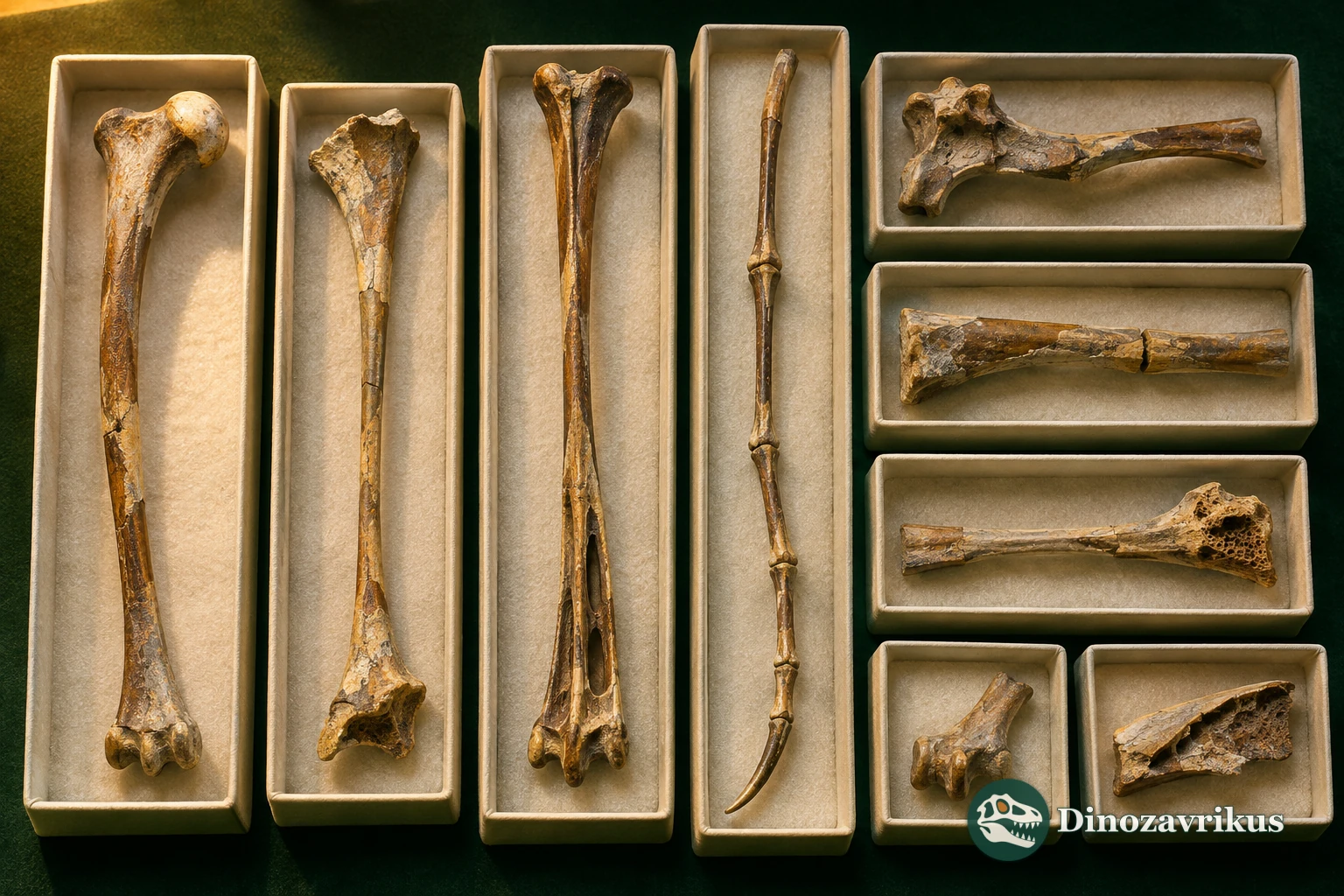
C. Lewis Gazin collected the fossil used to name Juncitarsus gracillimus in Sweetwater County on 8 September 1947. Storrs Olson and Alan Feduccia published the description in 1980. The holotype, USNM 244318, is a near-complete left tarsometatarsus from low in the Bridger Formation. The bone runs from the ankle joint to the toes. It measures 182 mm long and only 3.8 mm across at the narrowest part of the shaft.
Isolated wing and leg bones and vertebrae came from the same bed. Some have weakly ossified or unfused ends, while others represent older individuals. The describers suggested the birds might have bred nearby. They had no nest or egg evidence to confirm it.
A bill preserved at Messel
Dieter Peters named Juncitarsus merkeli in 1987 from a skeleton preserved in the deposits of the Eocene lake at Messel. Its holotype, SMF-ME 12000, includes the head. Gerald Mayr's micro-CT work shows a long, almost straight bill. The absence of a skull from the Wyoming material leaves the bill of J. gracillimus unknown.
The later Palaelodus, a close fossil relative of flamingos, also had a straight bill. Both fossils help place the highly curved feeding apparatus of living flamingos on a narrower branch of their evolutionary tree.

Wading and a possible place on the family tree
Long slender legs would suit feeding along a wet shore or wading in shallow water. The long bill could reach food ahead of the bird. The fossils do not reveal which foods it took.
Olson and Feduccia noted that the slim shaft resembled a stilt's and that the ankle end showed features shared with flamingos. Mayr later proposed that Juncitarsus branched next to the lineage uniting flamingos and grebes. A primitive wing phalanx in later comparisons is consistent with this placement. Many other traits remain unscorable in the available material.
Frequently asked questions
How slender was its leg bone?
The Wyoming holotype tarsometatarsus is 182 mm long and about 3.8 mm wide at the narrowest part of the shaft.
Which species preserves the bill?
The Messel skeleton of Juncitarsus merkeli shows a long, nearly straight bill. A skull is still unknown for the Wyoming species.
Did modern flamingos descend from Juncitarsus?
One hypothesis places it on an early branch beside the common lineage of flamingos and grebes. Its fossils do not establish direct ancestry.
Why did the describers consider breeding at the Wyoming site?
Juvenile bones occur alongside more mature ones. This suggests breeding may have taken place nearby, but no eggs or nests were found.