

One limestone bed in Oman yielded the type teeth of two species of Khuffia. Both had a continuous edge running across the crown, but they differ in the height of the main cusp and the spacing of the smaller points beside it. The isolated teeth record part of the feeding apparatus of this Permian cartilaginous fish.
Quick facts
| Group | Elasmobranchs |
|---|---|
| Family in the original description | Sphenacanthidae |
| Type species | Khuffia lenis |
| Type specimen | Tooth MPUM 10882 |
| Locality | Haushi Cliff, Oman |
| Age | Wordian, Middle Permian |
| Fossils | Complete and fragmentary teeth |
What can the fossils tell us?
Sample AO40 came from the top of a shell-rich storm layer. A storm deposit may mix remains from more than one local habitat.
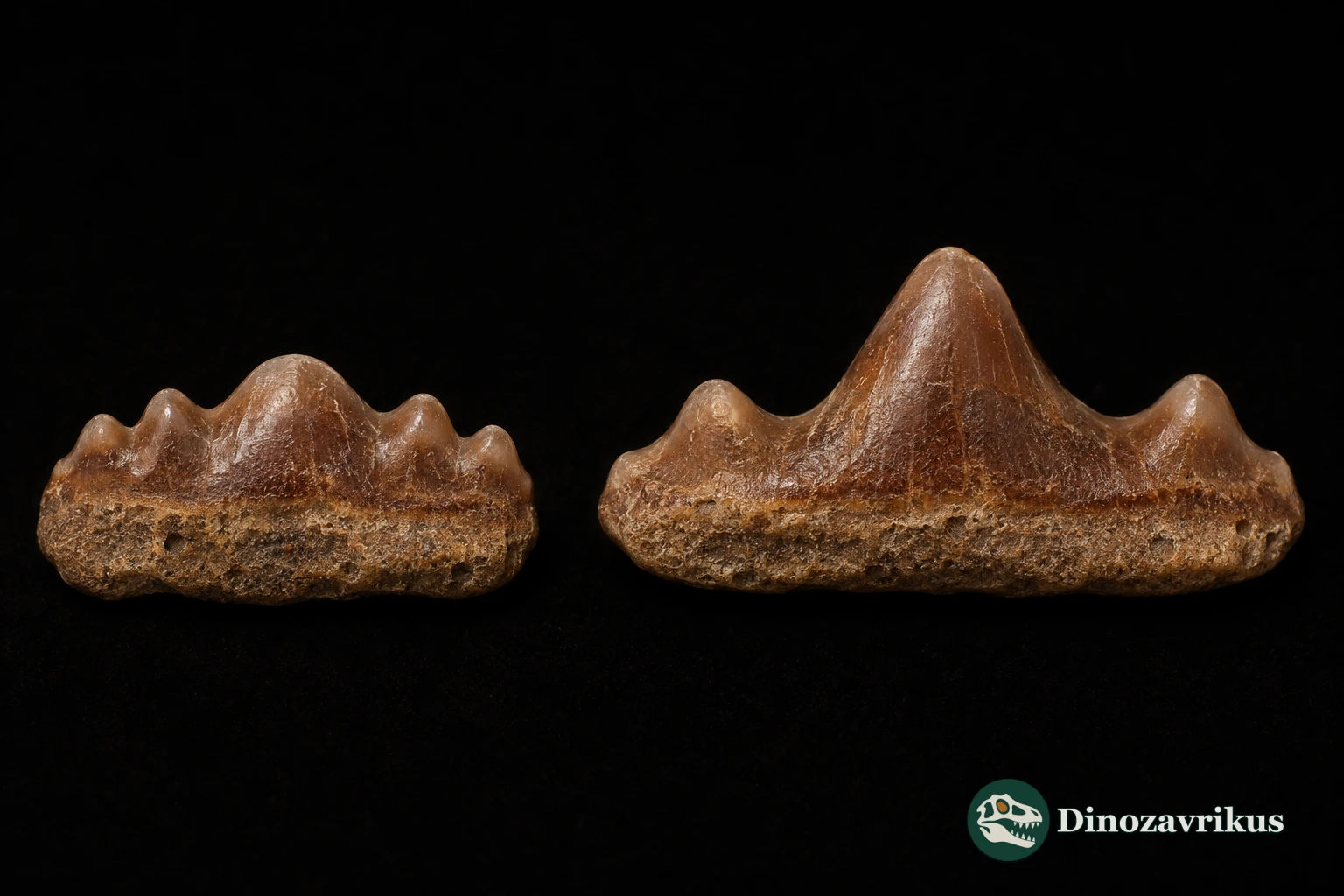
The lower-crowned form has a small projection on its inner face. The taller form lacks it and has more widely separated side cusplets.
The original study compared the number and size of openings in the roots with those of sphenacanthids. No associated skeleton is available to test the placement.
A shell-rich layer at Haushi Cliff
Martha Koot, Gilles Cuny, Andrea Tintori and Richard Twitchett described Khuffia in a journal issue dated 2013. Its name comes from the Khuff Formation. Both type teeth came from sample AO40 at Haushi Cliff, in central eastern Oman. That sample represents the upper part of a storm bed rich in brachiopod shells.
The researchers used buffered acetic acid to free the small fossils from the limestone. The type specimens are held at the Palaeontological Museum of the University of Milan. The wider Khuff assemblage also includes the tall, triangular teeth of Glikmanius. The two genera illustrate how different the teeth of cartilaginous fishes in the same basin could be.
How the two species differ
The sample of Khuffia lenis contains 79 complete and broken teeth. The teeth measure 1.0–1.2 millimetres along the row and 0.5–0.6 millimetres in height. Teeth identified as front teeth usually have two pairs of blunt side cusplets, while lateral teeth carry three. A small projection lies on the inner face below the main cusp. The name lenis refers to a surface that is nearly smooth, although weak vertical ridges can be present.
The authors assigned 27 complete and broken teeth to Khuffia prolixa. At 1.3–1.6 millimetres along the row and 0.7–0.8 millimetres high, its teeth are longer and taller. They have one or two pairs of side cusplets with wider gaps between those cusplets and the main point. The inner projection seen in the type species is absent.
What the roots contribute to classification
The base of a Khuffia tooth extends towards the inside of the mouth and has openings of unequal size. The authors found similarities to Sphenacanthus, while noting that Khuffia has weaker crown ornament, more distinct cusplets and fewer but larger openings in the base. They assigned the genus to Sphenacanthidae and left its order open.
The loose teeth give no secure body length, fin shape or complete tooth arrangement. Shell fragments in the storm bed record invertebrates in the basin. They do not show what Khuffia ate.
Frequently asked questions
Where did the name Khuffia come from?
It was named for Oman’s Khuff Formation.
Where is the type of the second species kept?
Tooth MPUM 10892 is held at the Palaeontological Museum of the University of Milan.
How old is the type bed?
It is Wordian, part of the Middle Permian.
Do all teeth of the type species have the same number of cusplets?
Front teeth were described with two pairs. Lateral teeth commonly carry three.