

Kiyacursor longipes lived in Western Siberia during the Early Cretaceous. Its long foot had a stout third metatarsal beside a much thinner second metatarsal. This arrangement resembles that of several Jurassic ceratosaurs and helps explain how this group developed adaptations for running.
Quick facts
| Group | Theropods (Ceratosauria, Noasauridae) |
|---|---|
| Age | Early Cretaceous (Aptian) |
| Region | Asia (Western Siberia, Kemerovo Oblast, Russia) |
| Diet | No direct evidence |
| Type species | Kiyacursor longipes |
| Holotype | KOKM 5542, a partial skeleton |
| Locality | Shestakovo 1, Ilek Formation |
| Estimated holotype length | About 2.5 m for the growing individual |
What can the fossils tell us?
The fused ankle element, metatarsals and toe bones remain in association. This made it possible to compare the lengths and widths of individual bones.
Sections through the femur and tibia show growth marks and developing bone tissue near their outer surfaces. The animal had yet to reach skeletal maturity.
The Aptian fossils extended the known record of ceratosaurs in Asia beyond the Late Jurassic. The assemblage also preserves other vertebrates of the local ecosystem.
A skeleton in two blocks of rock
Alexander Averianov, Pavel Skutschas and colleagues described the dinosaur in 2024. The genus name combines the Kiya River and the Latin word for runner. The species name refers to the long foot. The Kuzbass State Museum of Local Lore holds the holotype, KOKM 5542.
The blocks contain articulated bones of the hind limbs, vertebrae, cervical ribs, upper arm bones and a scapulocoracoid. The researchers used CT scans to examine parts still concealed in rock. An incomplete neck vertebra, PIN 329/16, was found in the same part of the section and may belong to the same individual.
An elongated, narrow foot
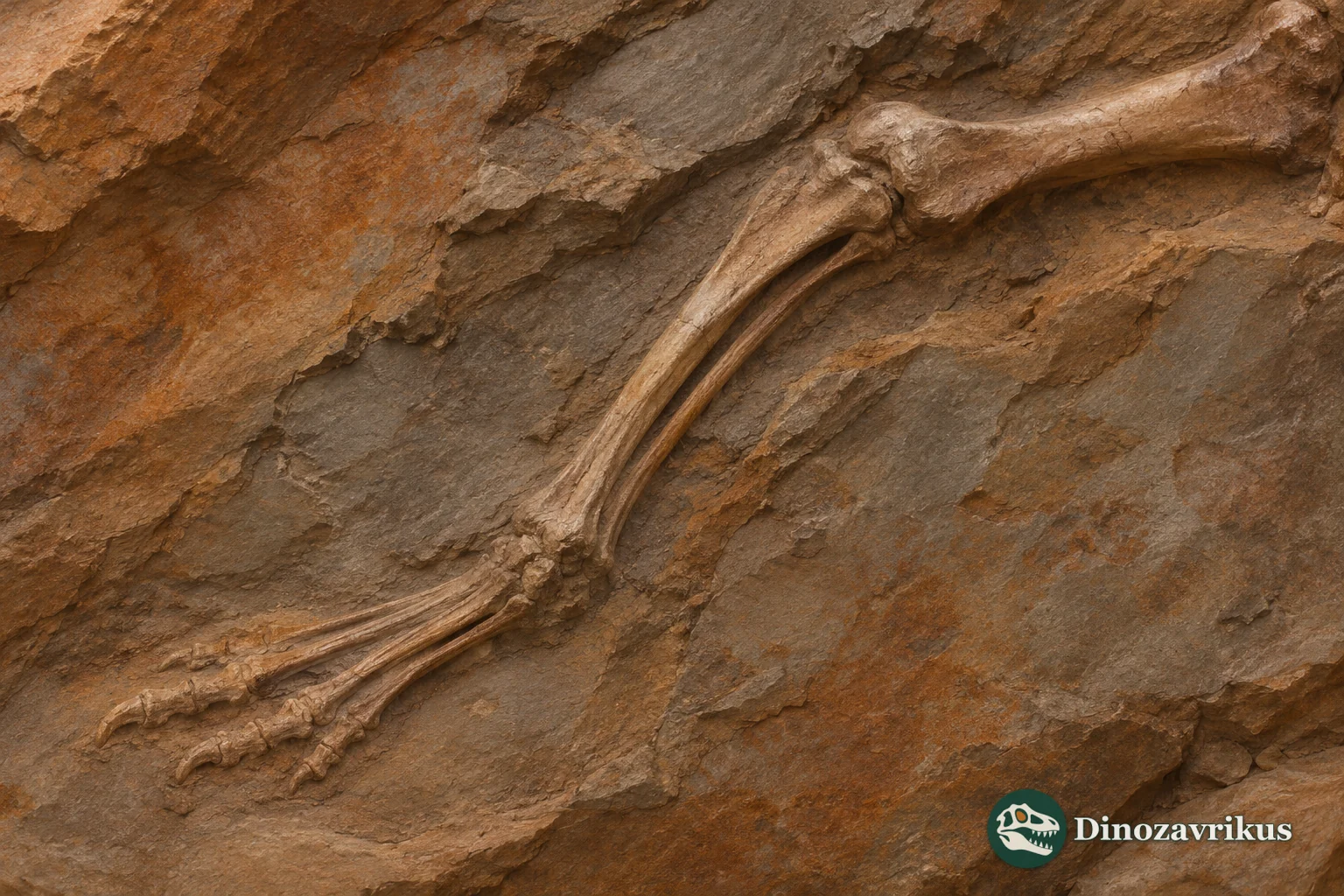
The metatarsus with its fused ankle bone measures 188 mm, about 73% of the femur length. The third metatarsal projects farther than the second or fourth. The shaft of the second metatarsal narrows to a splint and broadens again at its toe joint.
Elaphrosaurus and Limusaurus have comparable foot proportions. The authors interpreted this arrangement as an adaptation for running. Estimating maximum speed would also require reliable assumptions about stride, body mass and the muscles moving the limb.
An individual that was still growing
The authors estimated a length of about 2.5 m for the type individual. Bone sections preserve several episodes of slower growth. The authors concluded that the animal was more than three years old and was still growing at the time of death.
The remains come from Aptian deposits of the Ilek Formation. The same area yielded the Siberian psittacosaur and other dinosaurs from Shestakovo. The known Kiyacursor specimens preserve no skull or teeth, leaving its diet open.
Frequently asked questions
How did Kiyacursor get its name?
It is named for the Kiya River and the Latin word cursor, meaning runner.
How long is the preserved foot?
The metatarsus and its fused distal ankle bone together measure 188 mm in the type specimen.
Does 2.5 m describe an adult Kiyacursor?
The estimate applies to the type specimen. Its bone tissue shows that the individual was still growing.
What kind of dinosaur was Kiyacursor?
The original description placed it in Noasauridae, a family of ceratosaurian theropods.