

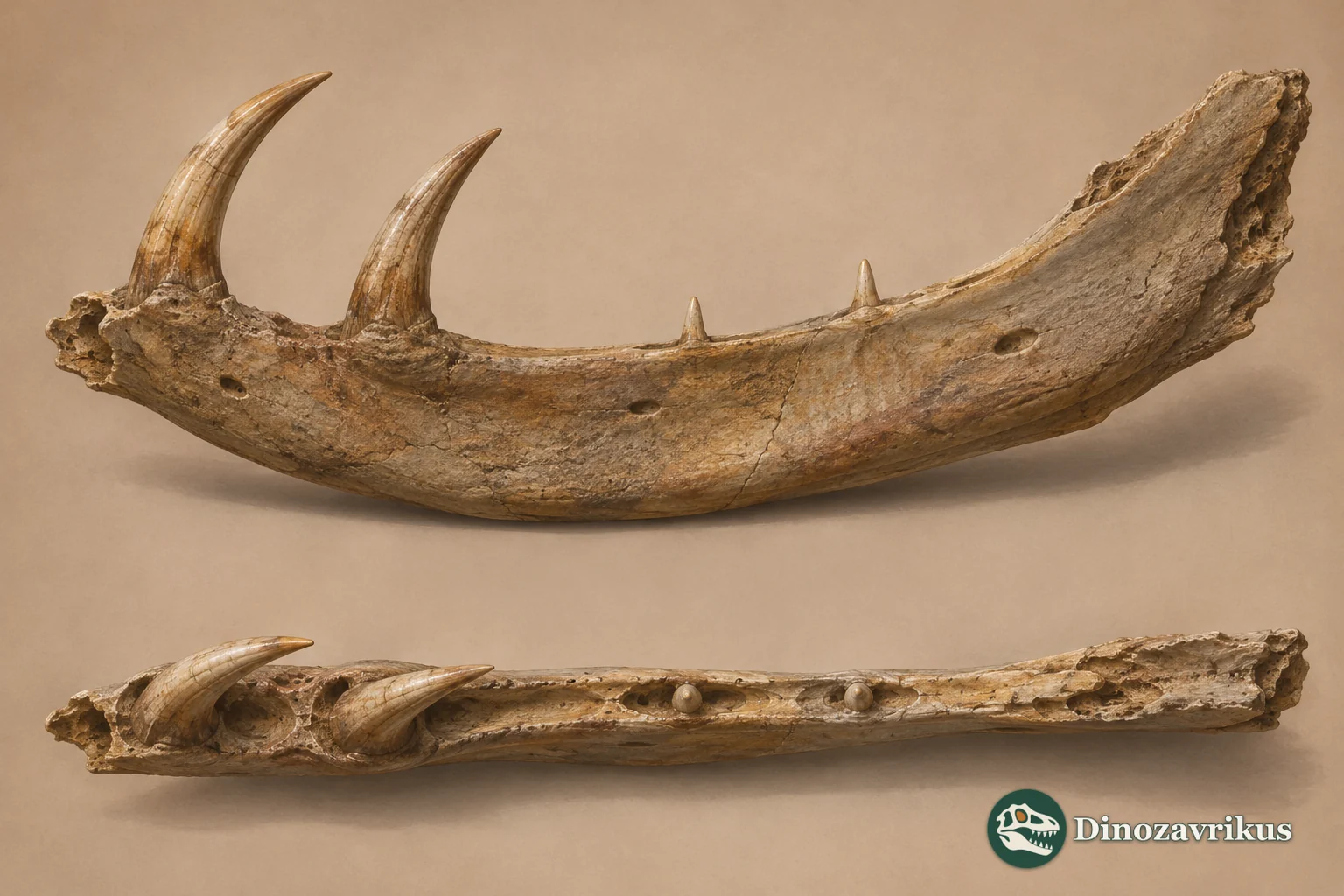
Klobiodon rochei was named in 2018 from a partial lower jaw found in the historic Stonesfield quarries of England. Two large recurved front teeth contrast with two much shorter teeth farther back. Although the fossil had been known for many years under other labels, the new diagnosis applies to this jaw, not to every pterosaur bone once associated with those names. No complete skull or wing is securely linked to the holotype.
Quick facts
| Scientific name | Klobiodon rochei, O'Sullivan and Martill, 2018 |
|---|---|
| Holotype | NHMUK PV OR 47991, a partial right lower jaw with four preserved teeth |
| Locality | Stonesfield, Oxfordshire, England |
| Rock and age | Stonesfield Slate Member, Taynton Limestone Formation; Bathonian |
| Jaw | 140 mm preserved; around 180 mm total length estimated |
| Teeth | Two large recurved front teeth and two shorter medial teeth |
| Wingspan | Around 2 m by comparison, not a measured wing |
What can the fossils tell us?
NHMUK PV OR 47991 preserves 140 mm of the right lower jaw. No associated upper skull, wing or tail establishes the whole body outline.
The front teeth are about 26 and 18.7 mm high, whereas the next two are about 7.9 and 10.8 mm. These measurements are from the fossil.
Older authors applied other pterosaur names to the jaw. The 2018 diagnosis recognized its distinct combination of features; those old assignments do not unite all other material.
An approximately 2 m wingspan was inferred by comparing the jaw with other pterosaurs. No full wing of Klobiodon provides a direct value.
An old fossil from Stonesfield
Holotype NHMUK PV OR 47991 is kept at London's Natural History Museum. It came from Stonesfield in Oxfordshire, where layered limestone was quarried for roofing material. The named rock unit is the Stonesfield Slate Member of the Taynton Limestone Formation, dated to the Bathonian stage of the Middle Jurassic.
The preserved right lower jaw is 140 mm long. Comparison suggests an original length of about 180 mm, but its missing rear end was not measured. The species name honours comic artist Nick Roche. Historical identifications included Pterodactylus raptor and association with Rhamphocephalus; these were taxonomic interpretations of incomplete fossils.
A jaw that carries the diagnosis
Its two large anterior teeth curve backward and measure about 26 and 18.7 mm. Two following teeth are far shorter, about 7.9 and 10.8 mm. The contrast, together with the form of the jaw and tooth sockets, distinguished Klobiodon in the 2018 study.
Another jaw fragment, OUM J.28410, has been tentatively referred to the genus, but its missing teeth limit a secure assignment. No skull, wings or tail are attached to the type jaw. Dorygnathus is a useful comparison for Jurassic tooth-bearing pterosaurs, not a template that fills these gaps.
Estimates and feeding proposals
An approximately 2 m wingspan is a comparison with other pterosaurs, not a direct measurement from Klobiodon. Its placement among long-tailed forms is based on available anatomical comparisons, and details of its full body remain unknown.
The long front teeth could have helped seize prey, and fish catching has been proposed. No gut contents or prey remnants accompany this jaw. The image of the living animal therefore adds an inferred body plan, colour and behaviour beyond the fossil evidence.

What the old quarry scene can show
An illustration of limestone working evokes the regional history. It does not document the people, date or exact slab involved in discovery of NHMUK PV OR 47991.
Frequently asked questions
Where was Klobiodon found?
Its type jaw came from the Stonesfield Slate Member near Stonesfield, Oxfordshire, England.
Why was it named only in 2018?
The older jaw had been assigned to other pterosaurs before a new comparison found a distinctive combination of jaw and tooth features.
Is the total jaw length known?
Only 140 mm survive; about 180 mm is a comparative estimate of the missing complete length.
Did it definitely catch fish?
No direct food evidence survives. Fish catching is a feeding interpretation based on the teeth.