

Knoetschkesuchus was a small Late Jurassic crocodyliform with a short snout, large eye sockets and two distinct kinds of teeth. Two skulls from Langenberg Quarry in Germany capture different stages of growth. Related material from a Portuguese coal mine provides a second species and a comparison with Theriosuchus.
Quick facts
| Type species | Knoetschkesuchus langenbergensis |
|---|---|
| Group | Small neosuchians, described as an atoposaurid |
| Age | Late Jurassic, Kimmeridgian |
| Localities | Langenberg, Germany, and Guimarota, Portugal |
| Holotype | DFMMh/FV 200, partial skeleton with skull |
| Second species | Knoetschkesuchus guimarotae |
What can the fossils tell us?
The snout makes up 37 percent of the length of the young skull and 47 percent of the larger one. The original description attributed the difference to growth.
Conical teeth at the front give way to lance-shaped crowns farther back. The type species of Theriosuchus has a third, low leaf-shaped crown type.
Slight disarticulation and the preservation of fragile bones indicate limited transport. The bed records the place of burial. The animal probably came from a nearby island.
A partial skeleton and a juvenile skull
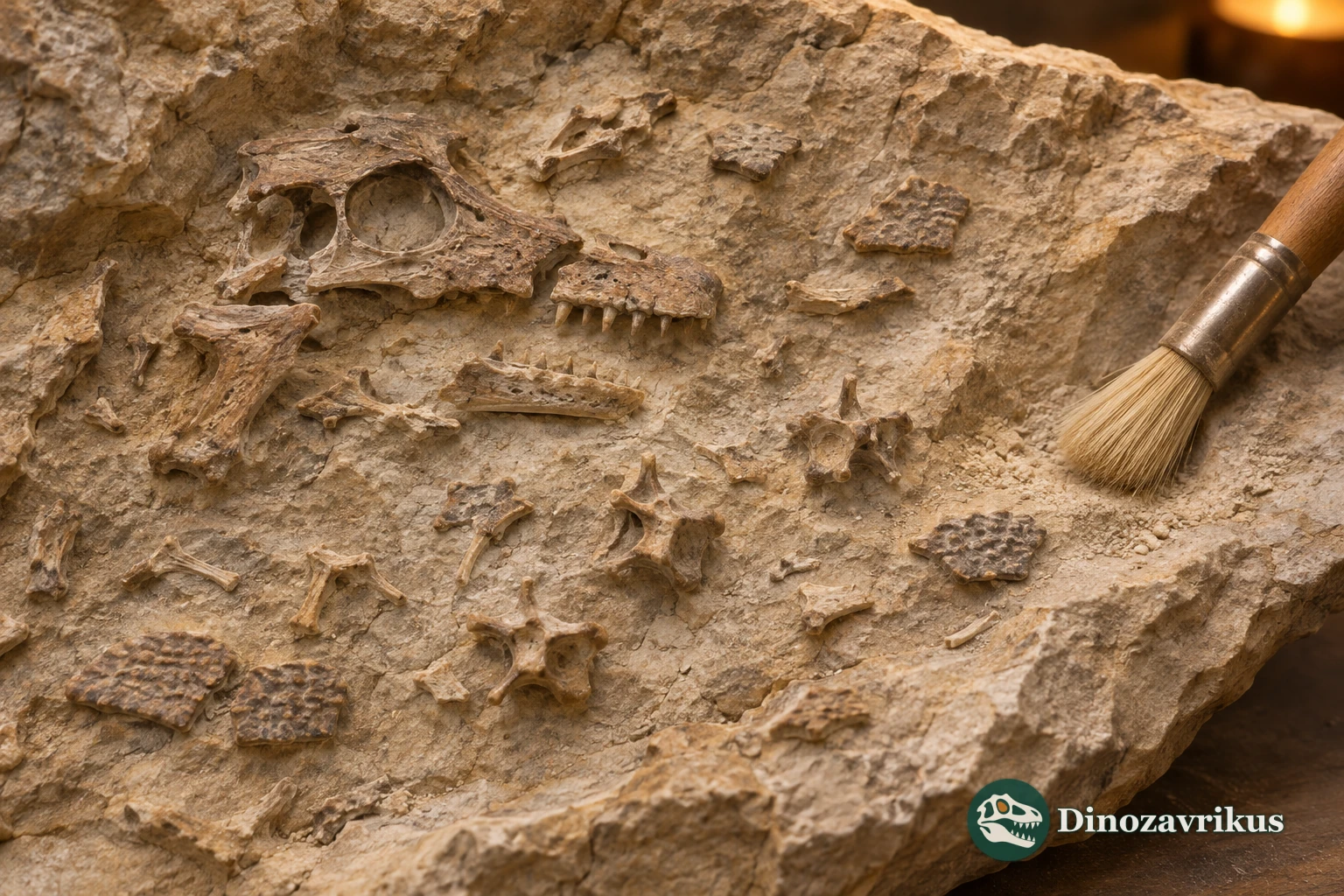
Daniela Schwarz, Maik Raddatz and Oliver Wings described the German species in 2017. They named the genus after Nils Knötschke, who collected, prepared and curated fossils from Langenberg. Its holotype, DFMMh/FV 200, preserves a skull and jaw, vertebrae, limb bones and osteoderms from one individual.
The skull DFMMh/FV 605 represents a juvenile. Micro-CT exposed details concealed by sediment or adjacent bones. The snout accounts for 37 percent of the length of this skull and 47 percent in the larger type specimen. The roof of the larger skull also has more distinct pitting. The authors interpreted these differences as changes with growth.
Teeth and the bony skin covering
Knoetschkesuchus had conical teeth towards the front and lance-shaped teeth farther back. A third kind of crown, a low and strongly flattened leaf shape, occurs in the type species of Theriosuchus. It has not been recognised in Knoetschkesuchus. Its teeth and small body are consistent with prey such as insects and small vertebrates.
Four rectangular osteoderms near the spine remain in the Langenberg type specimen. Each has a pitted surface and a smooth area at the front, which may have overlapped the plate in front of it. That portion of the armour reveals how some plates may have fitted together. It does not give the full pattern of scales and scutes over the body.
The Guimarota species and the family tree
In 2005 Daniela Schwarz and Steven Salisbury described the Guimarota material as Theriosuchus guimarotae. The 2017 study transferred it to Knoetschkesuchus. The two species have similar teeth and skull features. The joint between the halves of the lower jaw reaches the sixth tooth in the Portuguese species and the eighth in the German one.
The authors who named Knoetschkesuchus placed it in Atoposauridae. An earlier analysis, completed before the German material was described, retained the Portuguese species in Theriosuchus and placed it outside a more narrowly defined Atoposauridae. The comparison shows how much the classification depends on which specimens and characters are available.
Where the bones were buried
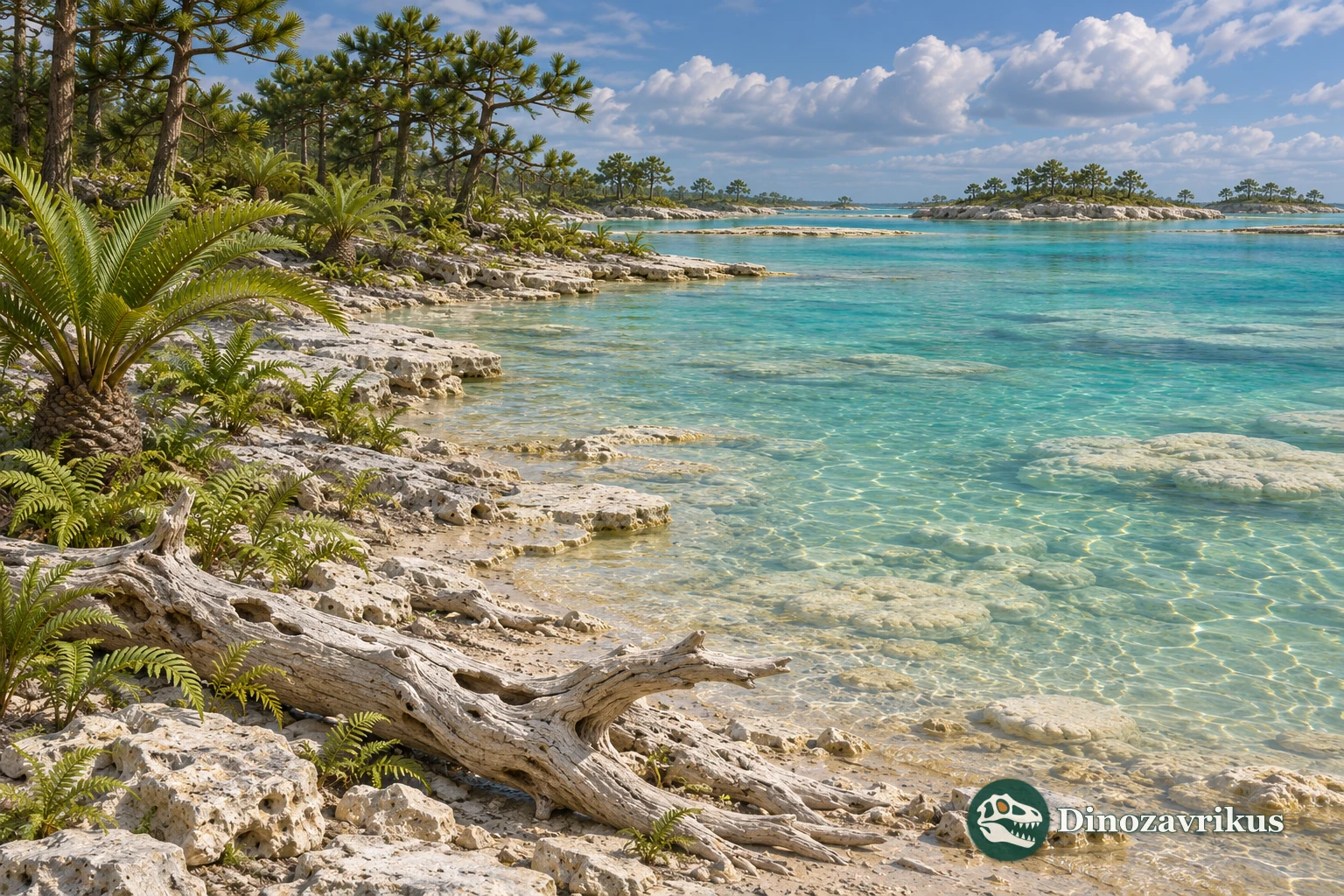
The Langenberg specimens are attributed to bed 83 of the Süntel Formation near Goslar, which also yielded the sauropod Europasaurus. Some bones are still associated and others moved apart. The preservation suggests limited transport into shallow marine water from nearby land. The Guimarota coal beds record a lagoonal setting influenced by fresh and salt water.
Frequently asked questions
Who was Nils Knötschke?
He collected and prepared fossils from Langenberg and helped care for the collection. The genus name honours him.
Why assign the juvenile and larger skull to one species?
They share the diagnostic features. Differences in snout proportions and surface sculpturing fit the growth changes the authors identified.
How many tooth shapes does it have?
Two. The anterior teeth are conical, with lance-shaped teeth farther back in the jaws.
Was Knoetschkesuchus a marine reptile?
The German fossils were buried in marine sediment. Their preservation and the land animals in the same bed support transport from nearby land.