

Koldinioidia was a Late Cambrian trilobite. Early growth stages survive for one species, K. choii. Two small domed shields from South Korea show how different young individuals looked from later stages.
Quick facts
| Group | Trilobites, family Shumardiidae |
|---|---|
| Age | Late Cambrian, Furongian |
| Region | Asia: South Korea, China and Thailand |
| Type species | Koldinioidia typicalis |
| Diet | Unknown |
What can the fossils tell us?
The Hwajeol Formation yielded two K. choii early shields 0.48 and 0.61 mm long. Both are convex and similar in outline.
The shape of the single early shield differs from later cranidia. A series of specimens records the shift.
The two early shields differ in size but have nearly identical outlines. The sample leaves the number of stages represented uncertain.
The type species and its head shield
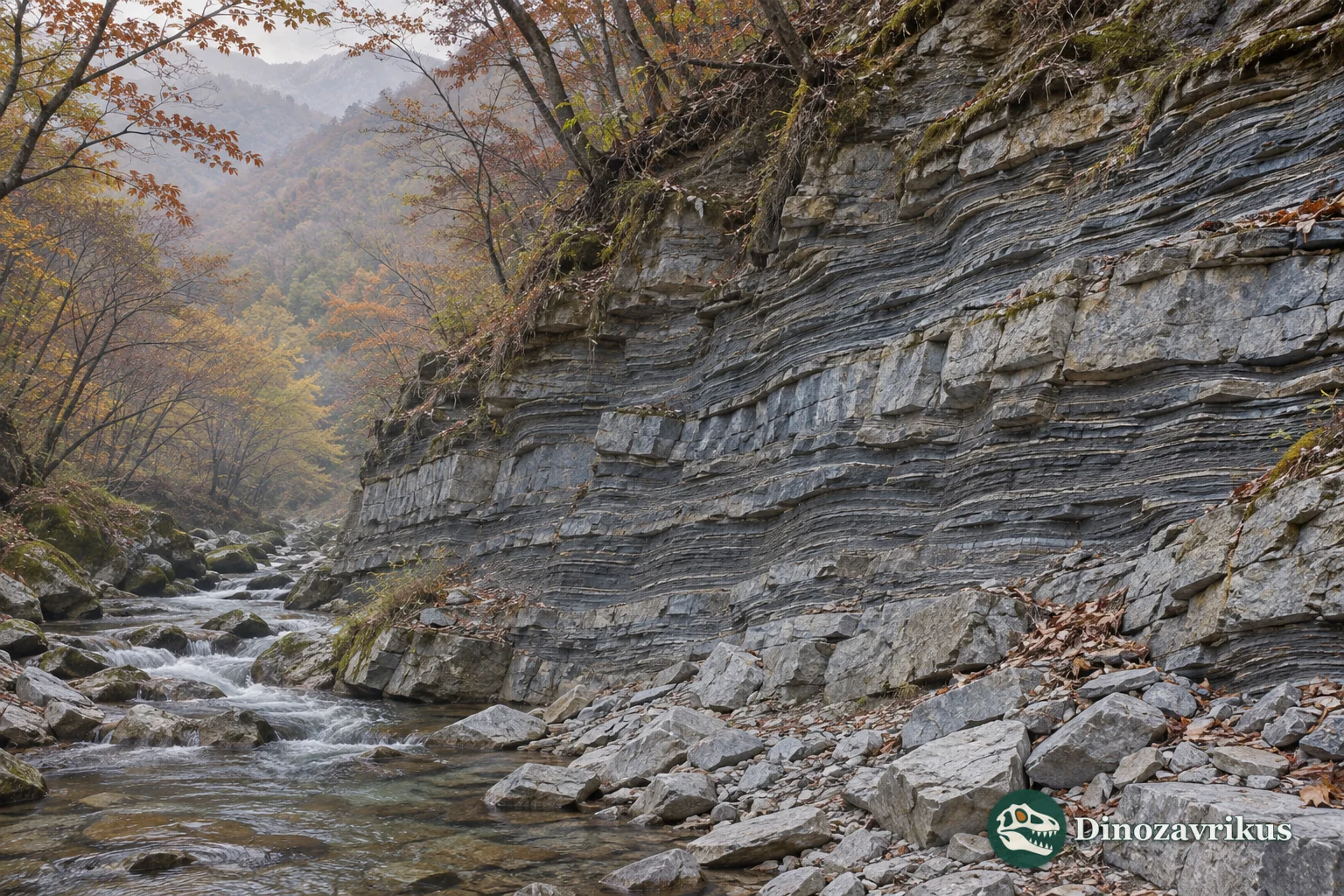
Teiichi Kobayashi established Koldinioidia in 1931. One syntype of K. typicalis is held at the University Museum of the University of Tokyo. This species occurs in uppermost Cambrian rocks of South Korea’s Dongjeom Formation.
In the revised diagnosis of the genus, the furrow in front of the glabella, the raised midline portion of the head, is shallow or almost invisible. Lobes near the front corners are weakly marked or absent. Fine features needed for species identification can be difficult to see in an isolated mould.
Growing out of a single shield
Small shields of K. choii from the Hwajeol Formation measure 0.48 and 0.61 mm long. Both are oval and convex. They belong to the protaspid phase, when the early mineralized exoskeleton still formed one shield.
The early shields differ in shape from later cranidia. Bulbous protaspides of this kind have been interpreted as a possible stage spent in the water column. The fossils establish shape and size. They leave locomotion and diet uncertain.
Records in China and Thailand
Moulds from Guangxi allowed researchers to revise Shumardia orientalis. They placed the species in Koldinioidia and treated Eoshumardia, for which it was the type, as a junior synonym. Peichiashania is another Late Cambrian genus used to make sense of rock sequences in China.
A single cranidium from the Ao Mo Lae Formation on Thailand’s Tarutao Island was identified as Koldinioidia. Its broad glabellar base resembles that of K. choii, but the Thai internal mould lacks a furrow expected in that species. That distinction limits how far the species range can be extended.
Frequently asked questions
What is a protaspid shield?
It is the single mineralized shield of an early trilobite growth phase.
How big were the early K. choii shields?
The two measured fossils are 0.48 and 0.61 mm long.
Which species anchors Koldinioidia?
The type species is Koldinioidia typicalis, described by Teiichi Kobayashi in 1931.
Why is the Thai fossil identified only to genus?
The single cranidium has some features shared with other Koldinioidia, but lacks characters that would support a confident assignment to species.