

Kritimys is an extinct murid rodent from Pleistocene Crete. Its record consists chiefly of jaws and molars, including material assigned to K. kiridus and the larger-toothed K. catreus. 'Giant mouse' describes a relative size among island murids; the published millimetres refer to tooth crowns, not a deer-sized animal or a known body mass.
A jaw from Koutalas cave in western Crete places K. catreus in a fossil assemblage that also contains larger island mammals. The endemic deer Candiacervus is relevant to Cretan faunal history, though its fossils should not be assumed to come from the same layer as every Kritimys tooth.
Quick facts
| Group | Muridae, rodents |
|---|---|
| Island | Crete, Greece |
| Discussed species | Kritimys kiridus and K. catreus |
| Main evidence | Jaws and cheek teeth |
| Illustrative site | Koutalas cave in western Crete |
| Age | Pleistocene; direct dating remains limited |
What can the fossils tell us?
Koutalas K. catreus first lower molars measure 3.85–3.95 mm in crown length. That comparison aids identification but is not a measured body length or weight.
The upper Koutalas horizon contains K. catreus along with dwarf hippo remains and an elephantid tooth. A biozone gives relative context, not an independent date for each fossil.
K. kiridus and larger K. catreus have been proposed as successive forms. The age of the early type locality at Cape Maleka remains too weakly constrained to make tooth size a precise evolutionary clock.
From Rattus to an island genus
Dorothea Bate named material from Crete Rattus kiridus in 1942. Kuss and Misonne later placed the island fossils in Kritimys. The change reflects a taxonomic reassessment of jaw and dental traits, not the sudden appearance of a new animal at the moment of renaming. K. catreus entered comparisons as another Cretan form with larger first lower molars.
Mayhew proposed a lineage increasing in size from K. kiridus toward K. catreus. That remains a hypothesis because Cape Maleka, the key early locality, lacks a secure independent absolute date. Sorting teeth by size and then using that same size to prove their age would be circular. The exact time of arrival of the lineage on Crete is not fixed by these fossils alone.
What the Koutalas jaw measures
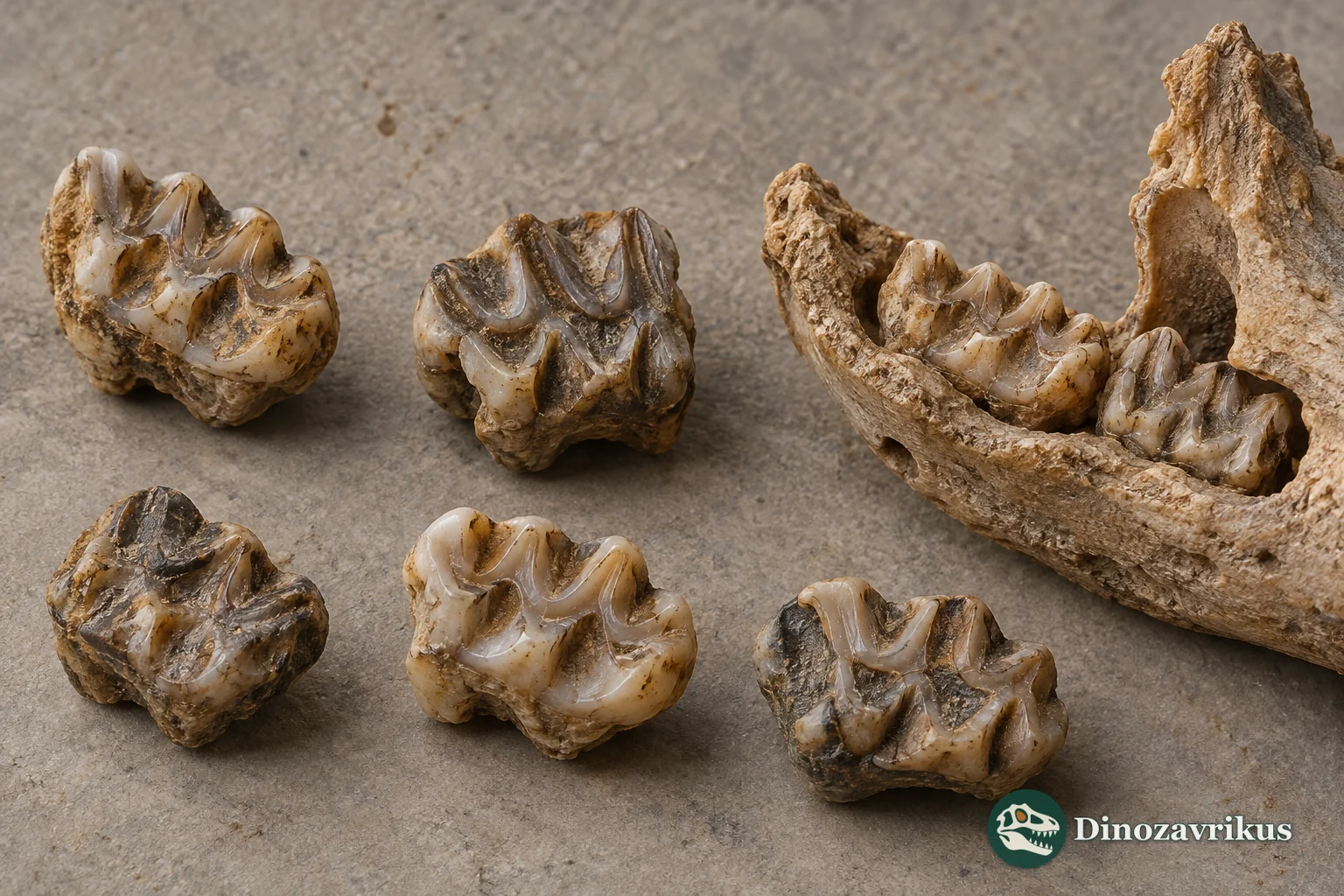
In Koutalas cave at Cape Drepano, the upper fossil-bearing level yielded a partial lower jaw of K. catreus with the first and second molars. The first lower molars studied there have crown lengths of 3.85–3.95 millimetres and width near 2.32 millimetres. The paper compares those teeth with reported ranges of 2.89–3.30 millimetres for K. kiridus and 3.55–4.72 millimetres for K. catreus. These are tooth measurements from samples, not a reconstructed length of the living rodent.
The upper level also contained a dwarf hippopotamus and an elephantid deciduous tooth. Co-occurrence indicates a shared deposit, not that each individual died on the same day. Researchers associated the level with the K. catreus biozone and a late Middle Pleistocene interpretation. The paper's title refers to a late Pleistocene locality, making it especially important to separate its stated biozone interpretation from an independently measured date. The illustrated fossils below are not the actual Koutalas specimens.
An island setting with clear unknowns
Crete supported an unusual sequence of mammals under long island isolation. The history of its elephants is also discussed through Palaeoloxodon and other proboscideans, but a single deciduous tooth at Koutalas cannot be assigned to that genus solely because it came from Crete. Faunal zones describe changes in assemblages; they are not a single event experienced by all endemic species at once.
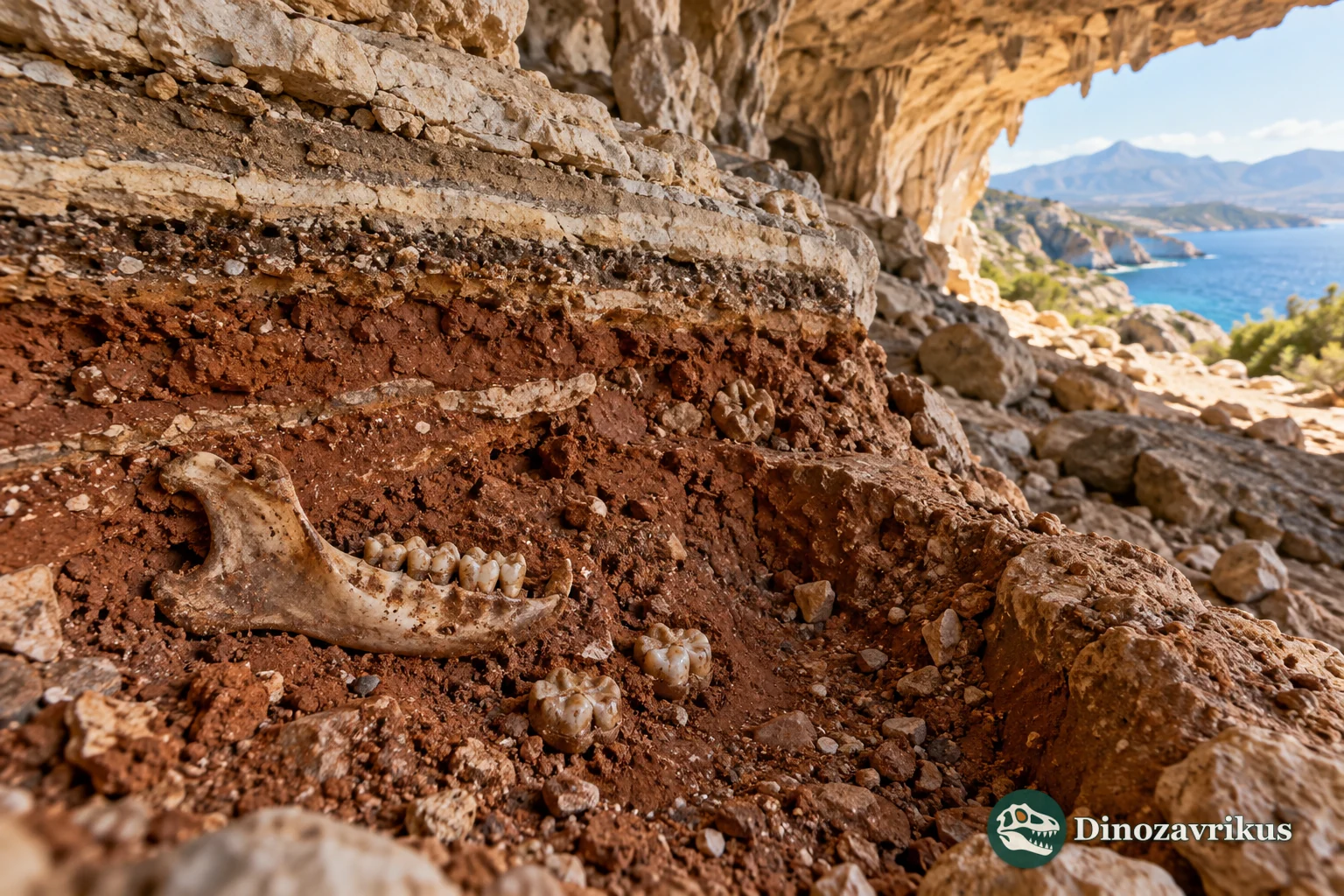
The jaw and molars identify a murid and permit dental comparisons. They do not establish the exact food, fur colour, litter size or cause of extinction of Kritimys. The cover is a plausible mouse-like reconstruction in a Cretan landscape. The cave illustration explains sediment context without depicting the actual Koutalas exposure or its exact stratigraphic section.
Frequently asked questions
Was Kritimys a modern house mouse?
No. It was an extinct murid lineage endemic to Crete, known mostly from jaws and teeth.
How do K. catreus and K. kiridus differ?
Published comparisons show larger first lower molars in K. catreus; tooth form and locality also matter.
Can a molar reveal Kritimys body weight?
A measured crown length is not a direct body-weight measurement. No precise mass follows from the cited Koutalas teeth alone.
Is the Koutalas jaw directly dated?
Its layer is assigned by fauna to a K. catreus biozone; that is a relative correlation rather than a direct absolute date on the jaw.