

Kumimanu biceae was a very large penguin that lived in what is now New Zealand during the late Paleocene. Its associated bones come from a boulder found near Hampden, North Otago. The extinct bird catalogue places it among early penguins whose size is striking, while keeping estimates and taxonomic disputes tied to their evidence.
Quick facts
| Type species | Kumimanu biceae Mayr, Scofield, De Pietri & Tennyson, 2017 |
|---|---|
| Group | Sphenisciformes; family placement of early penguins is unsettled |
| Age | Late Paleocene, about 55–60 million years |
| Locality | Hampden Beach, North Otago, New Zealand |
| Holotype | NMNZ S.45877, associated partial skeleton |
| Estimated size | About 1.65 m and 100 kg in one reconstruction |
| Taxonomic question | Validity of K. fordycei is disputed |
| Catalogue | Extinct birds |
What can the fossils tell us?
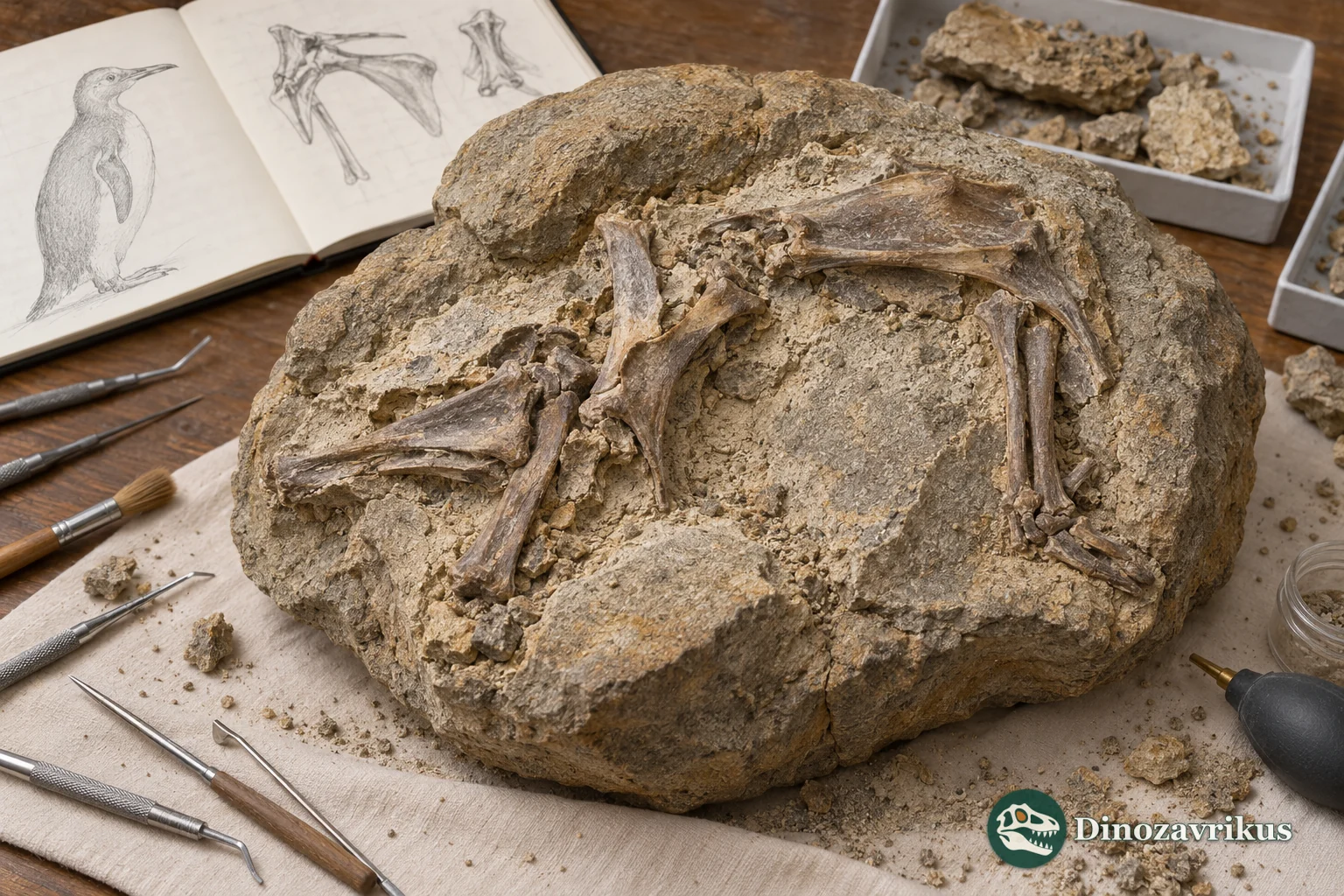
NMNZ S.45877 includes parts of the shoulder girdle, sternum, wing, femur, lower leg and vertebral column. It is not a complete skeleton, but multiple regions support the large-body estimate.
The specimen comes from the late Paleocene Moeraki Formation. Its published age interval is roughly 55.5–59.5 million years; that is a geological estimate, not a direct date for each bone.
Estimates near 1.65 m and 100 kg derive from skeletal proportions and comparisons with living penguins. They depend on reconstructed body proportions and are not direct measurements.
K. fordycei was described in 2023 from a larger partial skeleton. A 2025 review argued that the diagnostic differences are insufficient and proposed synonymy with K. biceae; other researchers retain two species.
A fossil found inside a boulder
The first bone of the holotype was found in 2004 in a boulder on a beach near Hampden in North Otago. The bones were enclosed in hard rock. Preparation completed in 2015 by Al Mannering exposed enough anatomy to identify the specimen as a penguin. Gerald Mayr, Richard Scofield, Vanessa De Pietri and Alan Tennyson named Kumimanu biceae in 2017.
Holotype NMNZ S.45877 is held by the Museum of New Zealand Te Papa Tongarewa. It includes several vertebrae and part of the sacral region, portions of the scapula and coracoid, sternum, humerus and ulna, femur and part of the tibiotarsus. It is incomplete, but associated material from several body regions gives a stronger size signal than one isolated bone.
Age and estimated size
The fossil came from the late Paleocene Moeraki Formation. Stratigraphic position and microfossils place it at roughly 55.5–59.5 million years old. This constrains the age of the deposit rather than measuring the moment of the bird’s death.
Published reconstructions estimate K. biceae at about 1.65 metres tall and around 100 kilograms. Those figures are calculated from bone proportions and comparisons with living penguins. The femur is 161 millimetres long, and large wing bones reinforce that the animal was exceptionally robust. Height and mass remain model outputs, not measurements made on a living bird.
Other giant penguins are known from younger Eocene rocks. Kumimanu matters because very large size had already evolved near the beginning of penguin history. It does not represent a single uninterrupted trend toward ever larger birds.
A penguin in a warmer sea
Late Paleocene New Zealand was not covered by modern glaciers. The penguin lived in a marine setting warmer than present-day Otago. Penguins are not restricted to icy water: living Galápagos penguins range close to the equator, and fossil penguins occur in deposits from warm climates.
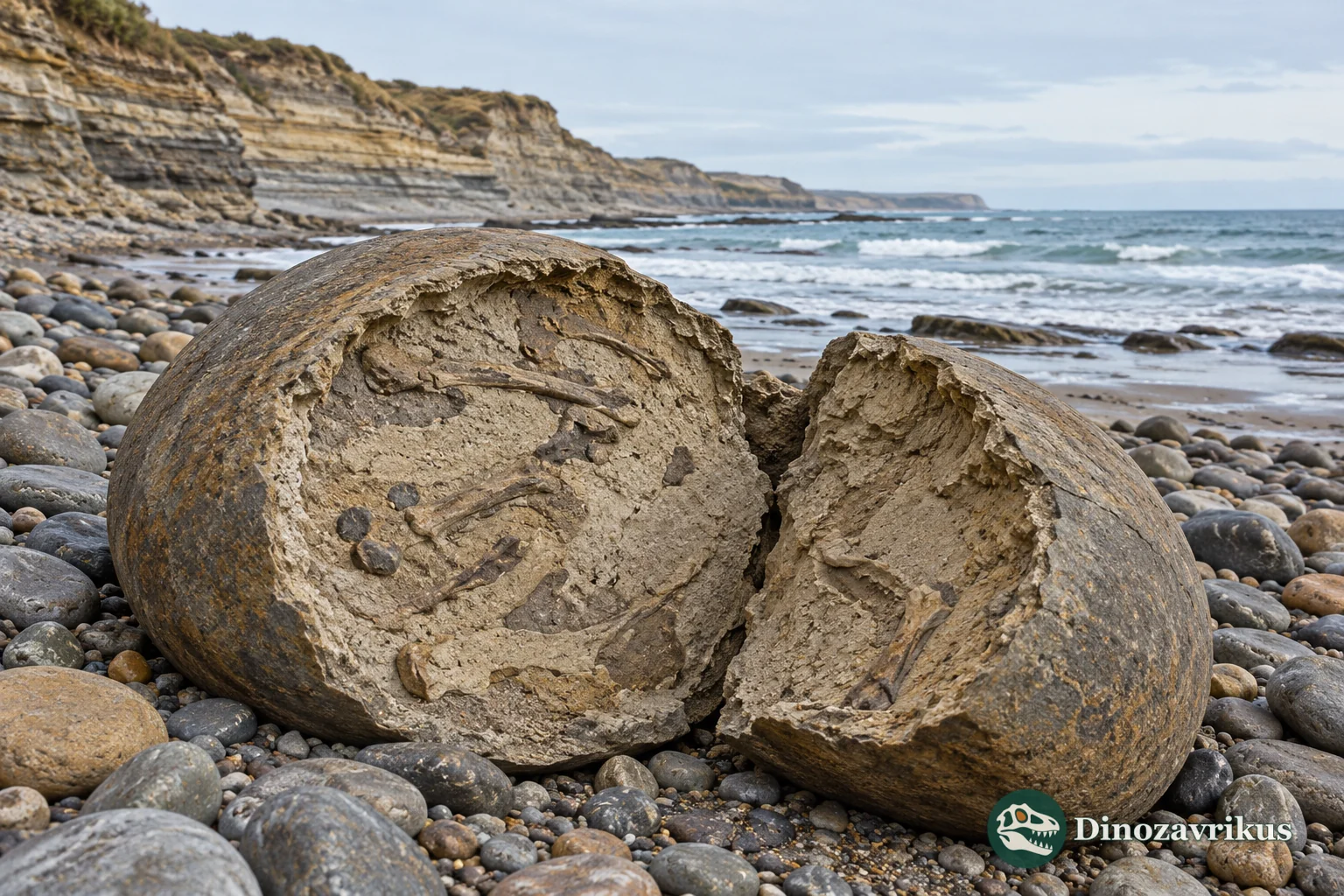
The fossil’s marine depositional context is consistent with the bird dying at sea and sinking before burial, but that sequence was not observed directly. No stomach contents or feeding trace identify its prey. Fish and other marine animals are plausible food for a penguin, yet the precise diet and diving behaviour of Kumimanu are unknown.
Early penguin relationships
The 2017 description compared Kumimanu with Waimanu, an older New Zealand penguin genus. This is a relationship inferred from skeletal characters, not evidence that one genus directly descended from the other. Early penguins already varied in size and body proportions, and their family-level relationships continue to be tested as new fossils appear.
Kumimanu fordycei was named in 2023 from another partial skeleton and estimated at roughly 148–160 kilograms. A 2025 revision argued that the proposed diagnostic differences do not reliably separate it from K. biceae, and treated the later name as a likely junior synonym. Other researchers retain two species and emphasize size and skeletal differences. The status of K. fordycei is therefore a live taxonomic disagreement, not a settled synonymy.
What the bones support
The strongest conclusions are that the holotype is a late Paleocene penguin from Otago and that K. biceae was very large. Its exact external appearance, feather colour and bill soft tissues were not preserved. The cover and coastal scene are reconstructions, not portraits of an observed animal.
Kumimanu shows that large-bodied penguins appeared early and lived in seas that were warmer than modern southern New Zealand. Comparisons with later forms such as Kairuku help place it in a longer history, but do not prove identical ecology.
Frequently asked questions
When did Kumimanu biceae live?
In the late Paleocene, approximately 55.5–59.5 million years ago based on the Moeraki Formation and associated microfossils.
How large was it?
A commonly cited reconstruction is about 1.65 metres tall and 100 kilograms, but both values are modelled from bones.
Where was Kumimanu found?
Its associated partial skeleton was recovered from a boulder found on a beach near Hampden, North Otago, New Zealand.
Is Kumimanu fordycei a separate species?
That is disputed. It was named in 2023, while a 2025 review proposed synonymy with K. biceae because the diagnostic differences may be insufficient.