

Kuruleufenia xenopoides is a Late Cretaceous pipid frog from Patagonia. Its name rests chiefly on a nearly complete sphenethmoid, a bone from the central braincase, while additional finds from the Allen Formation include pieces of the ear region, vertebral column and limbs.
The genus belongs in the ancient amphibian catalogue. Its anatomy helps trace the early history of pipid frogs, but the scattered remains do not preserve a complete animal or establish a direct ancestor-descendant link with living frogs.
Quick facts
| Scientific name | Kuruleufenia xenopoides |
|---|---|
| Group | Pipidae; anuran amphibian |
| Age | Late Campanian to early Maastrichtian |
| Formation | Allen Formation, Río Negro, Argentina |
| Holotype | MACN-PV RN 1064, a nearly complete sphenethmoid |
| Other evidence | Ear capsules, vertebrae, humeri, sacro-urostyle and ilia |
| Body size | No reliable complete-body estimate |
What can the fossils tell us?
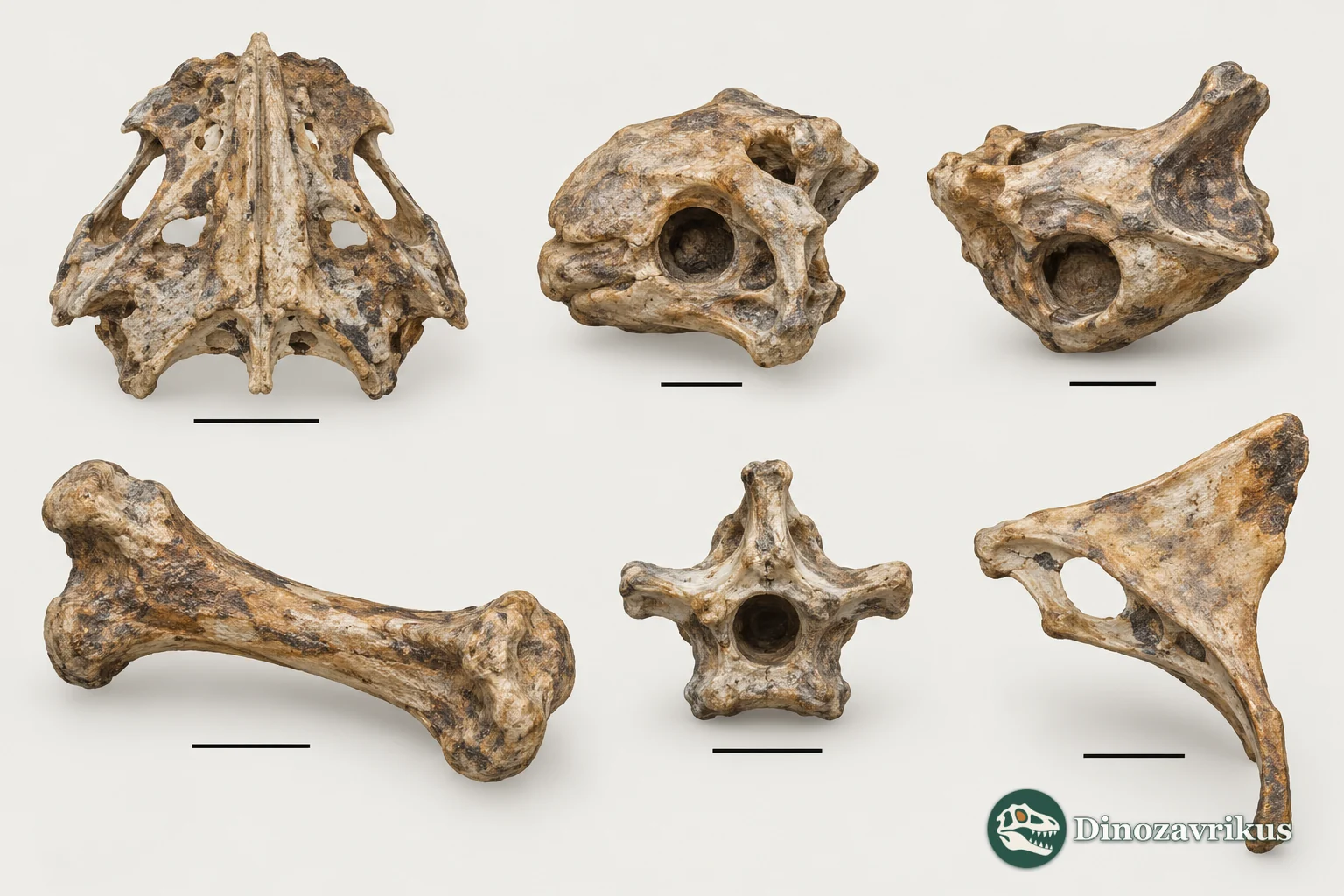
MACN-PV RN 1064 preserves the central braincase bone in unusually good detail for this record. It helps diagnose the genus and compare pipid anatomy; it is not a complete skull or skeleton.
Sphenethmoids, otic capsules, vertebrae, humeri, a sacro-urostyle and ilia have been reported from Allen Formation localities. Referrals of isolated material depend on diagnostic features and should not be mistaken for one articulated individual.
Phylogenetic analyses recover Kuruleufenia within crown Pipidae, often near the xenopodine branch. This is a relationship inferred from coded anatomical characters, not evidence that it was a direct ancestor of Xenopus.
A complete articulated skeleton is unknown. Overall proportions, exact size, colour, diet and behaviour therefore remain uncertain; illustrations show a plausible animal, not a measured specimen.
A braincase from the Allen Formation
Raúl O. Gómez named Kuruleufenia xenopoides in 2016 from material collected in Río Negro Province, Argentina. The holotype, MACN-PV RN 1064, is a nearly complete sphenethmoid. Rather than a whole skull, it is the central braincase element whose shape and internal features can be compared with other frogs.
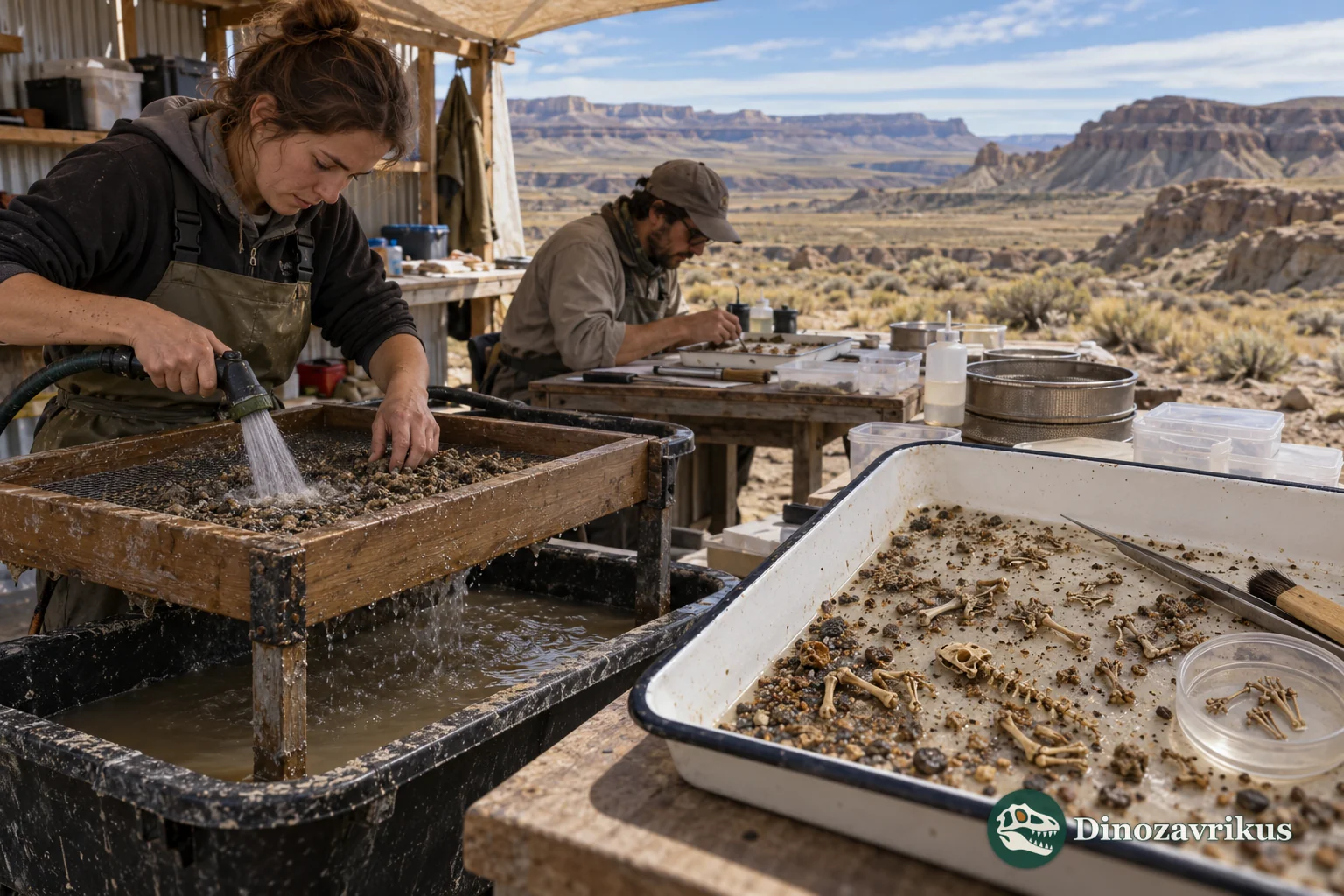
The fossil comes from fine-grained deposits of the Allen Formation, dated broadly to the Late Campanian–early Maastrichtian. The type locality lies near Trapalco and Santa Rosa, around 120 kilometres southwest of Lamarque. Small amphibian remains were recovered through screen washing, a method that can separate tiny bones from sediment that would otherwise be difficult to inspect by eye.
What the additional remains contribute
Other Allen Formation localities have yielded additional sphenethmoids and paired otic capsules, as well as humeri, presacral vertebrae, a sacro-urostyle and ilia. These elements broaden the anatomical picture beyond the holotype. Because most are isolated, each referral depends on features that can distinguish the genus from other frogs in the same deposits.
A later study referred some humeri from the Allen, Los Alamitos and Dorotea assemblages to Kuruleufenia using diagnostic morphology. These records extend the material considered for the genus, but they do not turn separate bones from different sites into one individual. Fragmentary remains make such qualifications important.
A pipid, not a known ancestor of modern frogs
Comparative and phylogenetic analyses place Kuruleufenia within crown-group Pipidae, the family that includes living African clawed frogs and South American pipas. Some analyses recover it near xenopodines. The position depends on the anatomical characters included and how they are scored, so it is best described as a proposed evolutionary relationship.
Similarity to a living branch does not make the fossil a direct ancestor of Xenopus. The known material supports a place on the pipid family tree, not an unbroken lineage to any living species. Its age and South American setting add a useful point to the history of a family whose modern members are distributed across Africa and South America.
What remains unknown
No complete skeleton provides a dependable body length or mass. Nor do the bones directly reveal skin colour, calls, reproduction, prey or a particular behaviour. As a frog, it would have had the basic anuran body plan, but the exact proportions shown in reconstructions remain artistic choices where the fossils are silent.
The Allen Formation preserves a diverse Late Cretaceous ecosystem. Kuruleufenia contributes evidence for frogs in that setting through a distinctive braincase and a wider set of referred bones. Its scientific value lies in those specific anatomical clues, not in a complete view of its life.
Frequently asked questions
What is the holotype of Kuruleufenia?
MACN-PV RN 1064 is a nearly complete sphenethmoid, a central braincase bone. It is not a complete skull or skeleton.
Where did Kuruleufenia live?
Its fossils come from the Allen Formation in Río Negro Province, Patagonia, Argentina.
Was Kuruleufenia an ancestor of Xenopus?
No direct ancestry is established. Analyses place it among crown pipids, sometimes near xenopodines, based on anatomical characters.
How large was Kuruleufenia?
A reliable body length or mass has not been established because no complete articulated skeleton is known.