

Laevisuchus indicus was a small theropod in central India towards the end of the Cretaceous. Its relationships are reconstructed from isolated vertebrae. Two bones from the same formation once gave a second dinosaur its name and are now referred to Laevisuchus.
Quick facts
| Group | Theropods (Ceratosauria, Noasauridae) |
|---|---|
| Age | Late Cretaceous (Maastrichtian) |
| Region | Asia (Madhya Pradesh, India) |
| Diet | No direct evidence |
| Type species | Laevisuchus indicus |
| Lectotype | GSI K27/696, a cervical vertebra |
| Locality | Bara Simla, Jabalpur, Lameta Formation |
| Length of the lectotype centrum | About 45 mm |
What can the fossils tell us?
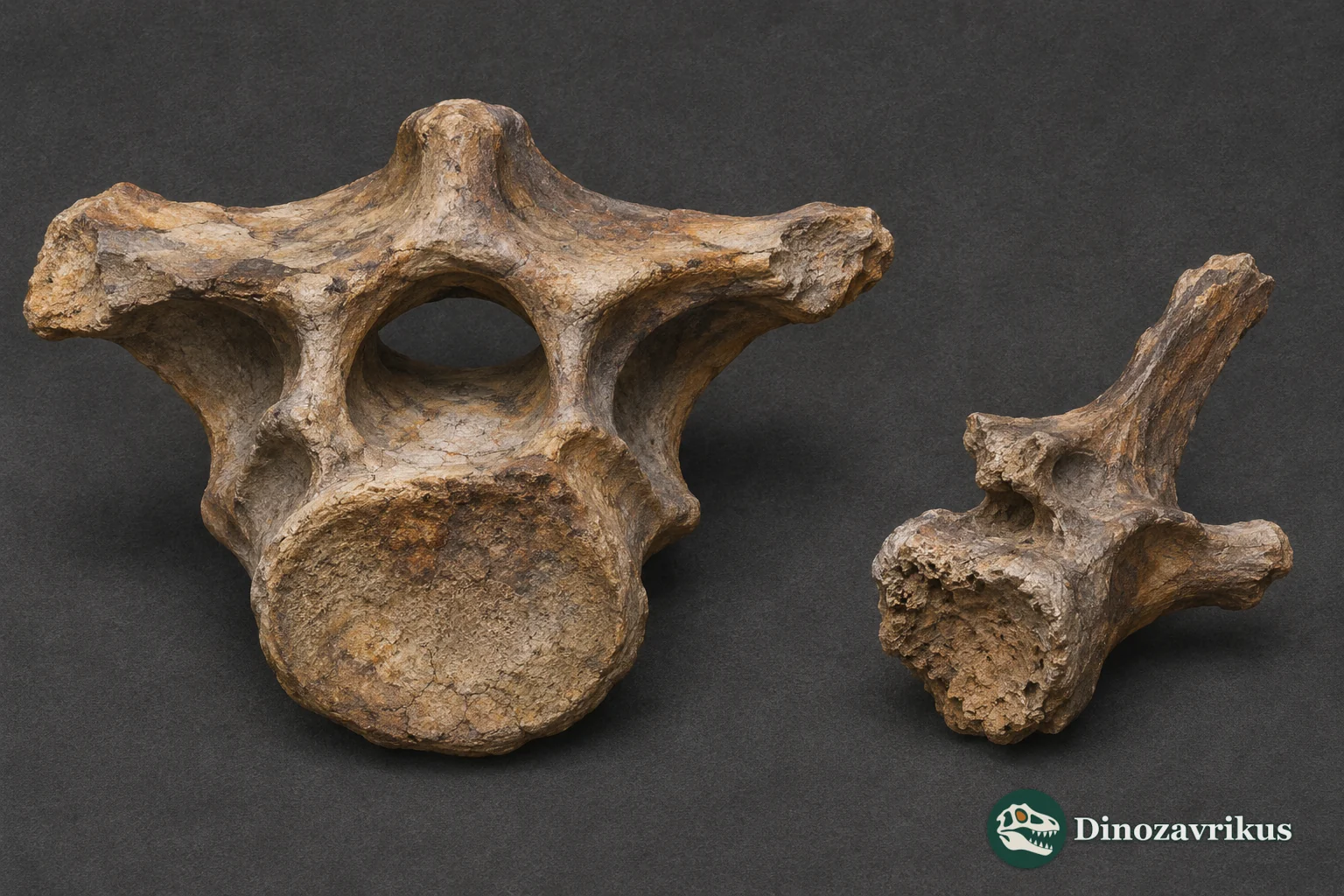
The lectotype preserves the arch, projections and surfaces of the centrum. They provide more anatomical information than the other bones in the original series.
They are consistent in size and shape with the referral to Laevisuchus. The isolated bones may come from different individuals.
The stratigraphic relationship to the overlying basalts places the deposit near the end of the Cretaceous.
Four vertebrae from Bara Simla
Charles Matley and Durgansankar Bhattacharji excavated near Jabalpur between 1917 and 1919. Friedrich von Huene and Matley described Laevisuchus in 1933 from three neck vertebrae and one back vertebra. They came from a small deposit between beds traditionally called the Green Sand and the Main Limestone.
In their 2024 review, Dhananjay Mohabey and colleagues selected the most complete cervical vertebra as the lectotype. Parts of a second cervical vertebra had turned up in different boxes in the Geological Survey of India collections and were fitted together. Part of the dorsal vertebra was also recovered, while a third cervical remains missing.
Reassigning the tail vertebrae
The centrum of the lectotype from the middle of the neck is about 45 mm long. Features of the cervical vertebrae support referral to Noasauridae. Some resemble the neck of the Madagascan Masiakasaurus. The 2024 analysis nevertheless placed Laevisuchus outside the pairing of Masiakasaurus and the South American Noasaurus.
The two bones named Jubbulpuria tenuis were originally identified as back vertebrae. Their recognition as tail vertebrae explained some of the differences once used to separate them. The 2024 review assigned them to Laevisuchus based on their proportions, thin-walled centra and proximity within the same bed. This leaves open how many individuals the bones represent.
A noasaurid jaw found at Pisdura offers a comparison for the broader group. Its species remains open because it was found without vertebrae comparable to those of Laevisuchus. The jaw therefore supplies no direct dietary evidence for this dinosaur.
Frequently asked questions
Why does Laevisuchus have a lectotype?
The original description named the species from four bones without singling out a type specimen. The 2024 review designated the most complete neck vertebra, GSI K27/696, as the lectotype.
When did Laevisuchus live?
It lived during the Maastrichtian, towards the end of the Cretaceous. The geological position of the Lameta deposits supplies the age evidence.
What happened to the name Jubbulpuria?
The 2024 review treated it as a younger synonym. Its two tail vertebrae were referred to Laevisuchus.
Has the skull of Laevisuchus been found?
The bones securely assigned to Laevisuchus come from the spine. A skull and teeth remain unknown.