

Lepidotes is a genus of ray-finned fishes best supported in Early Jurassic marine deposits of Central Europe. Its deep body and rows of thick rhomboid ganoid scales make it recognisable, but the genus was once used for a much wider assortment of Mesozoic fishes. A 2012 phylogenetic revision restricted the name to forms close to its type species, L. gigas, and moved many former members elsewhere. Articulated fossils and rare stomach contents place this changing genus within the ancient fish catalogue on firmer evidence than scale resemblance alone.
Quick facts
| Established | Lepidotes Agassiz, 1832 |
|---|---|
| Type species | L. gigas Agassiz, 1832 |
| Group | Ray-finned fishes; assigned to Lepisosteiformes in the 2012 revision |
| Best-supported interval | Early Jurassic, especially the Toarcian |
| Key region | Posidonia Shale localities in southern Germany |
| Fossil evidence | Articulated skeletons, skulls, jaws, ganoid scales and stomach contents |
| Measured example | BSPG 1940-I-8 has a standard length of 60.5 cm; this is not a genus maximum |
| Diet evidence | Two Early Jurassic specimens preserve fragments of small crustacean cuticle |
What the fossils establish
The genus and its type species remain insufficiently defined, so this specimen does not settle every diagnostic boundary.
Fossil scales reveal shape and arrangement, not the living fish's exact colour, flexibility or swimming speed.
The specimens record particular meals and do not establish the complete diet of all species historically assigned to the genus.
A name from the Posidonia Shale
Louis Agassiz introduced Lepidotes in 1832 for fishes from the Posidonienschiefer, now known as the Posidonia Shale Formation. The early account drew on fossils from a private collection assembled by Eberhard Gottlob Friedrich von Hartmann, a physician and collector based in Göppingen. Agassiz reported the material from Ohmden near Holzmaden in southern Germany. The provenance of some nineteenth-century figured specimens is difficult to match to surviving museum pieces, which complicates later comparisons.
The type species is L. gigas. Its original concept was not sharply defined: Agassiz compared material from Germany, France and England, and later writers brought it close to L. elvensis. Adriana López-Arbarello's 2012 revision distinguished these species by cranial shape and the architecture of several skull bones. It also made clear that the familiar historical outline of the genus had included more than one lineage.
Why the genus became narrower
Older literature applied Lepidotes to many Mesozoic fishes from Europe, Africa, Asia and South America. Some were known from isolated scales or teeth; others had partial skeletons. A similar armoured appearance did not prove that all these species shared a recent common ancestor.
The 2012 phylogenetic analysis divided the former assemblage using combinations of cranial and postcranial characters. Several strongly crushing forms were transferred to Scheenstia; other species received separate generic assignments or remained uncertain. López-Arbarello also placed the restricted genus within Lepisosteiformes, the ginglymodian lineage that includes living gars, rather than among traditional semionotiforms. That placement is a phylogenetic result based on anatomical comparison, not a consequence of the fish's scales alone.
A 2024 study still described the type species as insufficiently known and in need of revision. It treated one newly prepared skeleton as L. gigas only provisionally. Thus a fossil fish with rhomboid scales should not automatically be called Lepidotes unless diagnostic anatomy supports the assignment.
The Dotternhausen skeleton
Detlev Thies described specimen FWD_1098 from the Fossilienmuseum im Werkforum at Dotternhausen. It came from a working cement quarry in the Posidonia Shale Formation and belongs to the Lower Toarcian, within the lower falciferum Zone. The calcareous nodule split into two parts, and both sides were separately transfer-prepared so that the fish's anatomy could be examined in greater detail.
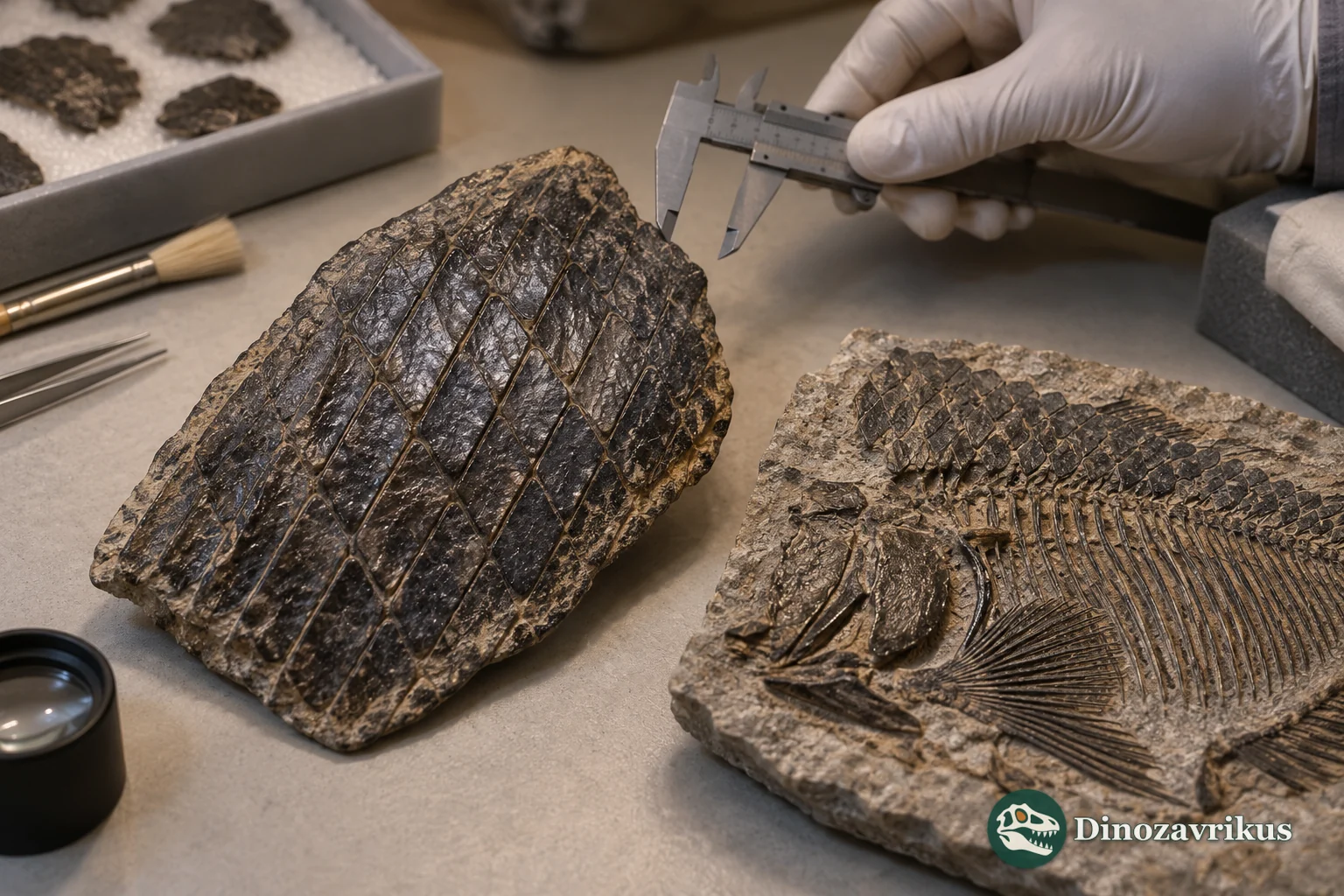
The specimen is nearly complete but lacks the caudal fin. It preserves the skull and pectoral girdle in enough detail to show a large slot-like opening in the maxilla and two tooth-bearing, serrated clavicular elements. Their function is unknown. Similarities with bones in the living bowfin Amia are useful for comparison, but do not demonstrate identical function.
Armour and body form
Articulated fossils show a deep body covered by thick rhomboid ganoid scales arranged in close rows. The scale rows provide direct evidence for a robust external armour. They do not reveal the exact living colours or how much the covering flexed while the fish swam.
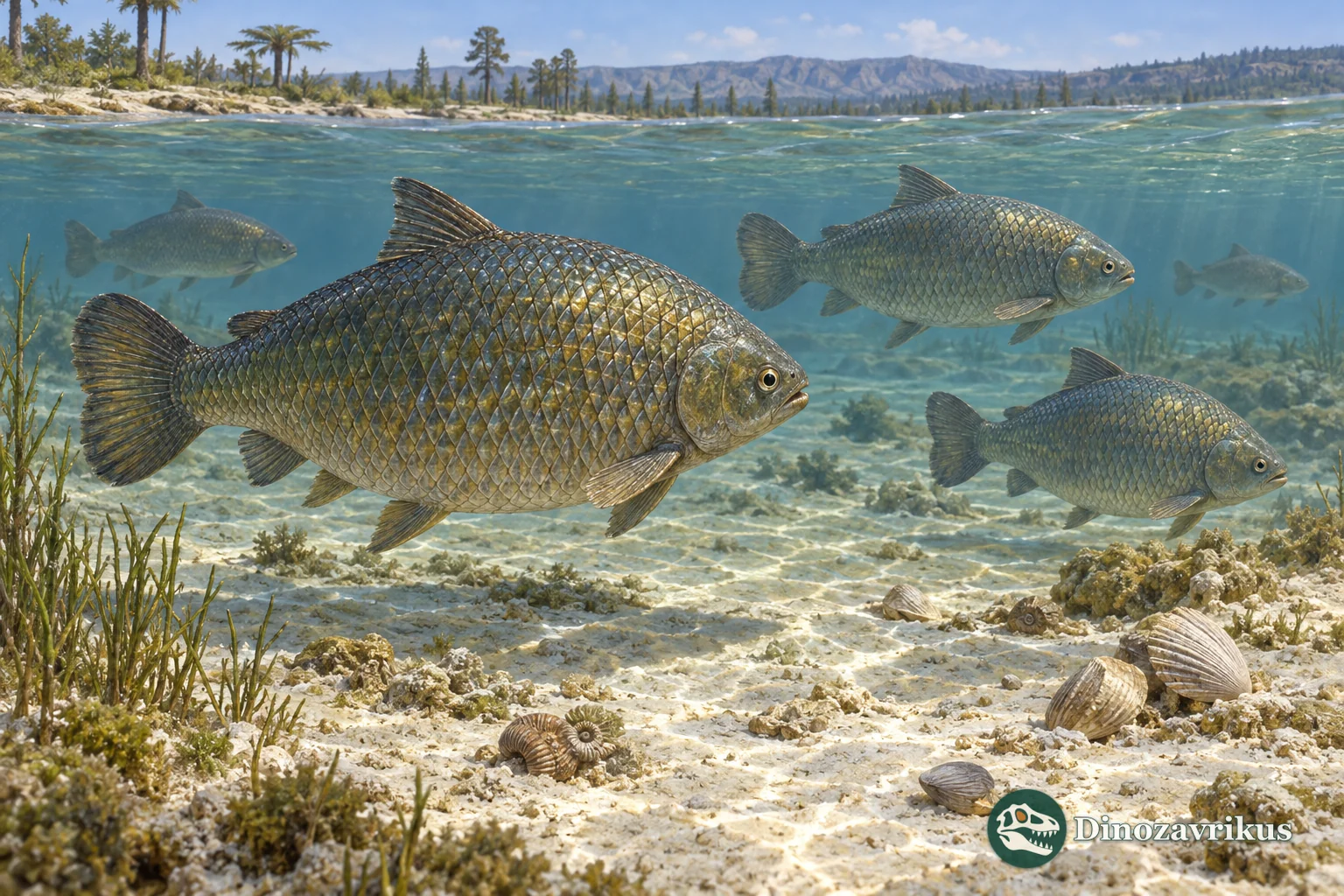
Preserved body proportions and fins support a reconstruction of a manoeuvrable fish in shallow marine water. Quantitative swimming speeds have not been measured. Even where a skeleton is unusually complete, the tail fin and soft tissues may be absent, so a painted body is a comparative restoration rather than a photograph of a whole fossil.
What stomach contents reveal
Thies, Kevin Stevens and Sebastian Stumpf reported two Early Jurassic Lepidotes specimens with stomach contents. Both contained fragments of small crustacean cuticle interpreted as belonging to shrimp-like animals. This is direct evidence of individual meals and complements what can be inferred from the fish's teeth and body form.
The dentition and a sturdy body are consistent with taking relatively small bottom-dwelling or free-living invertebrates. The authors suggested that other moderately slow, soft-shelled or unprotected animals may also have been available. Those additional prey are ecological possibilities, not remains identified in the stomach samples.
The stomach fossils do not define one universal diet for every species formerly placed in Lepidotes. They come from Early Jurassic specimens and record a few feeding events. That limited but direct evidence is more informative than a long prey list inferred only from body shape.
Size and the limits of measurement
The 2012 phylogenetic paper lists a standard length of 60.5 centimetres for specimen BSPG 1940-I-8. Standard length ends at the base of the caudal fin and is not total length. The value describes one museum specimen, not the maximum size of the genus.
FWD_1098 preserves nearly the entire skeleton apart from the tail fin, but its provisional species identification and the genus's incomplete diagnosis prevent it from defining an upper size limit. Measurements from one individual should not be applied to all fishes historically called Lepidotes.
Depositional setting and fossil preservation
The Posidonia Shale formed in an Early Jurassic marine basin. Fine-grained rocks and calcareous concretions preserve fishes alongside ammonites, belemnites, bivalves and marine reptiles. Oxygen-poor bottom conditions in parts of the basin and rapid burial helped retain articulated skeletons, though conditions varied through the succession.
A fish buried in a marine formation records its preservation in that marine system, not every habitat it used in life. Researchers therefore use different evidence for different questions: stomach contents for particular meals, skull bones for taxonomy, and articulated body proportions for cautious restoration. The broader history of the name belongs among the evidence-led profiles in the ancient fish catalogue.
Frequently asked questions
When did Lepidotes live?
The restricted genus is best supported in Early Jurassic deposits, especially the Toarcian of Central Europe. Many older or younger species historically assigned to Lepidotes have since been revised or moved to other genera.
Why was Lepidotes once such a broad genus?
Many fossil fishes shared rhomboid scales, but scale armour alone does not prove close relationship. The 2012 revision used skull and skeletal characters to separate the former catch-all assemblage.
What did Lepidotes eat?
Two Early Jurassic specimens preserve fragments of small crustacean cuticle in their stomach contents. These are direct records of particular meals, not a complete diet for every species.
How large was Lepidotes?
Specimen BSPG 1940-I-8 has a reported standard length of 60.5 cm. A reliable maximum for the restricted genus has not been established, and standard length excludes the caudal fin.