

Leptostomia begaaensis was named from two small, separate jaw fragments in Cretaceous rocks of Morocco. Both are exceptionally narrow, flattened and toothless. Their form prompted a proposal that the pterosaur probed soft sediment for small animals, but neither jaw tip, a wing skeleton nor direct food remains are known. The two fossils are assigned to the same species by anatomical comparison; they need not come from the same individual.
Quick facts
| Scientific name | Leptostomia begaaensis, Smith and colleagues, 2020 |
|---|---|
| Holotype | FSAC-KK 5075, 48 mm of anterior upper jaw |
| Paratype | FSAC-KK 5076, 67 mm of lower jaw symphysis |
| Locality | Aferdou N'Chaft near Hassi El Begaa, Morocco |
| Rock unit | Upper Ifezouane Formation, Kem Kem Group |
| Age | Probably Albian to early Cenomanian |
| Body size | Unknown; no wing or body bones assigned |
What can the fossils tell us?
FSAC-KK 5075 preserves part of a narrow upper rostrum without its tip. It is flattened, toothless and only gradually tapers.
FSAC-KK 5076 is a mandibular symphysis assigned by size and form. Separate discovery cannot establish that it came from the holotype individual.
CT imaging revealed substantial bone walls and a small central space. Surface foramina are present, but soft-tissue sensory receptors are not preserved.
Comparison with living birds suggests probing for small invertebrates. No prey, gut contents, complete beak tip or feeding trace confirms it.
Two separate fossils from the Kem Kem Group
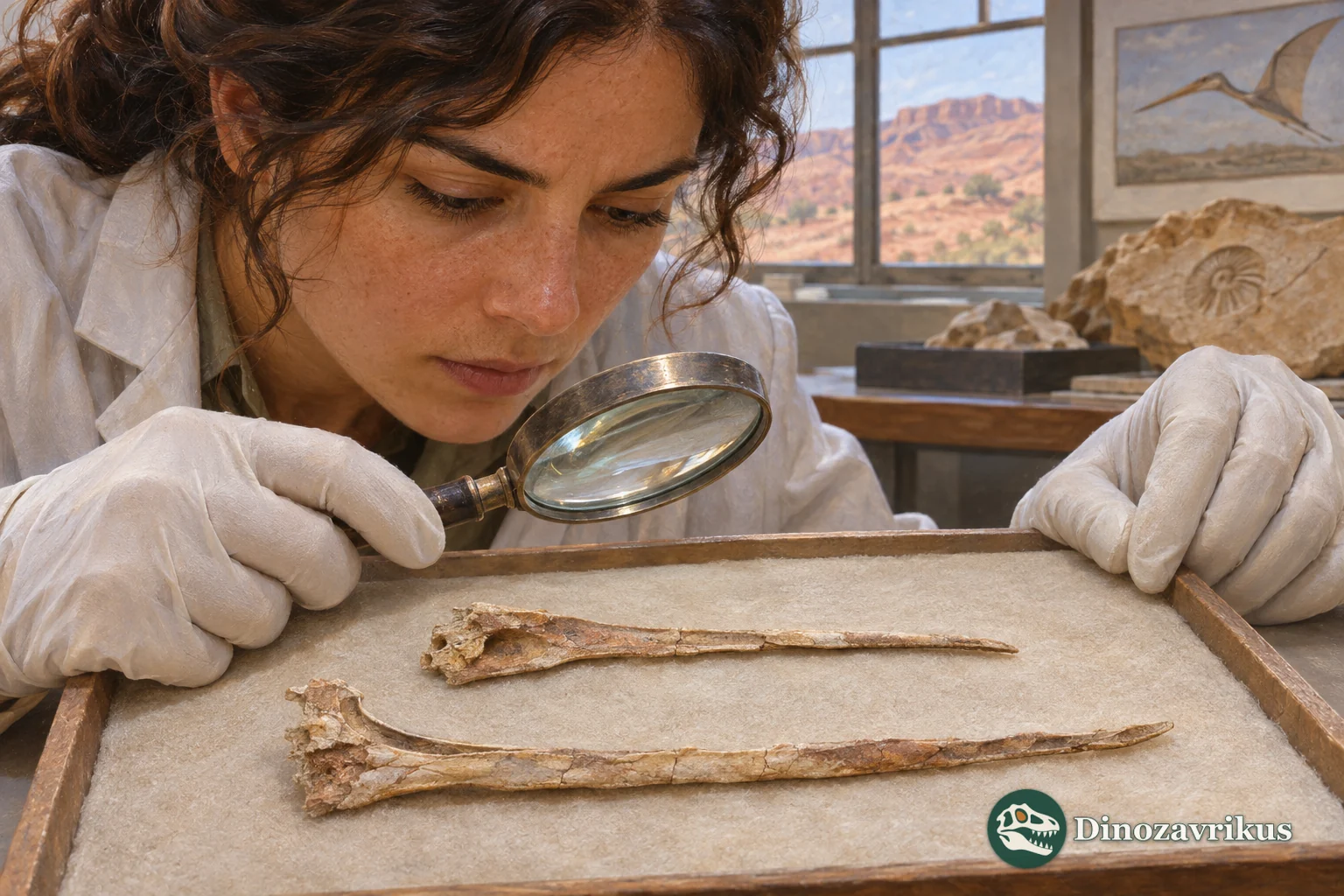
The type material came from Aferdou N'Chaft near Hassi El Begaa in Morocco's Errachidia Province. The species name refers to Hassi El Begaa. Holotype FSAC-KK 5075 is a 48 mm upper rostrum piece with its tip missing. Paratype FSAC-KK 5076 is 67 mm of lower jaw symphysis, recovered separately.
Both are attributed to the upper Ifezouane Formation of the Kem Kem Group, probably spanning the Albian to early Cenomanian interval. Neither is a complete skull. Their similar proportions support assignment to one species, but do not demonstrate one individual. Alanqa is another Moroccan pterosaur known from jaw material, with different diagnostic anatomy.
A thin beak with strong walls
The toothless jaw fragments are dorsoventrally flattened and taper at a very low angle, around three degrees or less. Their bony walls are relatively thick around a small central cavity. A ridge on the upper element corresponds to a groove on the lower one. The original team used computed tomography to inspect these internal features.
Small foramina occur in rows on the bone surfaces. They may have transmitted vessels or nerves, but cannot prove a sensory tip when the tips and soft tissues are missing. Measurements of preserved pieces should not be presented as a securely measured full beak length.
The probing idea and its limits
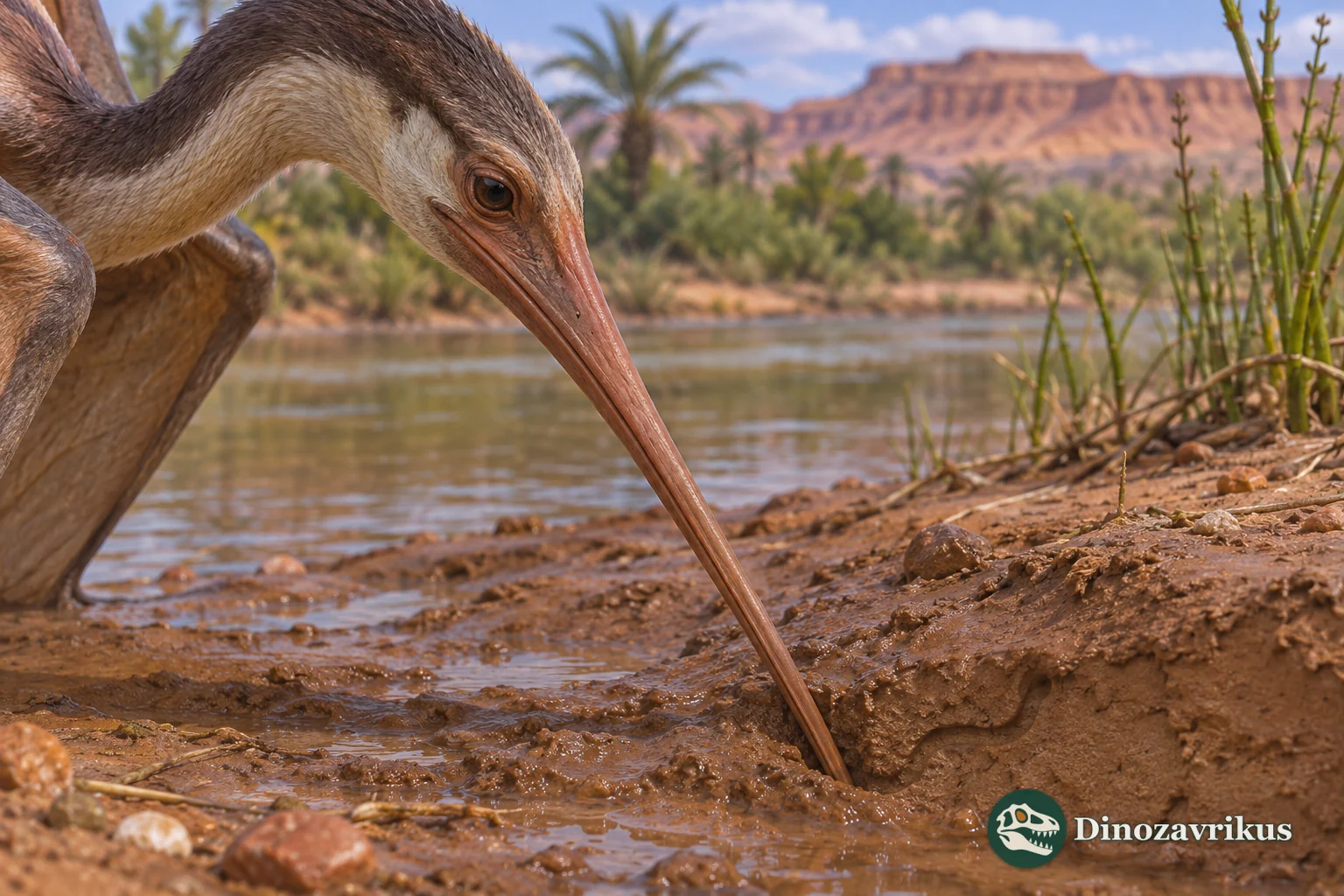
Roy Smith and colleagues compared the narrow jaws with beaks of living birds that probe soft ground for invertebrates. It is a functional hypothesis, not a trace of feeding. No stomach content, prey residue or feeding mark is associated with Leptostomia. Apatorhamphus illustrates the diversity of Moroccan jaw fossils; a shared region does not establish a shared diet.
No wing bone assigned to Leptostomia fixes its wingspan or mass. A possible azhdarchoid affinity was discussed in the original work, but a precise family remains difficult to support from two jaw fragments. A later review of Kem Kem pterosaurs stressed that the fragments cannot be assumed to come from one individual.
What the images can responsibly portray
An animal searching in mud illustrates the authors' feeding proposal. The full body, wing shape, colour, exact beak tip and behaviour shown in such art extend beyond the recovered fossils.
Frequently asked questions
How many Leptostomia fossils were described?
The 2020 description used an upper jaw fragment, FSAC-KK 5075, and a separate lower jaw fragment, FSAC-KK 5076.
Were the two jaws from one animal?
That is unknown. They were assigned to one species by similarity, but found separately.
Did it definitely probe mud for food?
No. Probing is a proposal based on jaw shape and comparisons with modern birds, without direct dietary remains.
How large was its wingspan?
No reliable value is known because the attributed material contains no wing bones.