

Lianghusuchus hengyangensis was a crocodilian from the Hengyang Basin of Hunan, China. Incomplete bones from both sides of the upper jaw preserve parts of the tooth row. They have been used to suggest a relationship with alligators, though its exact place among crocodilians remains unresolved.
Quick facts
| Species | Lianghusuchus hengyangensis |
|---|---|
| Group | Possible alligatoroid |
| Age | Early Palaeogene, age debated |
| Locality | Hengyang Basin, Hunan, China |
| Type material | Upper jaw fragments, JGMMV 502 |
| Historical age assignment | Eocene |
What can the fossils tell us?
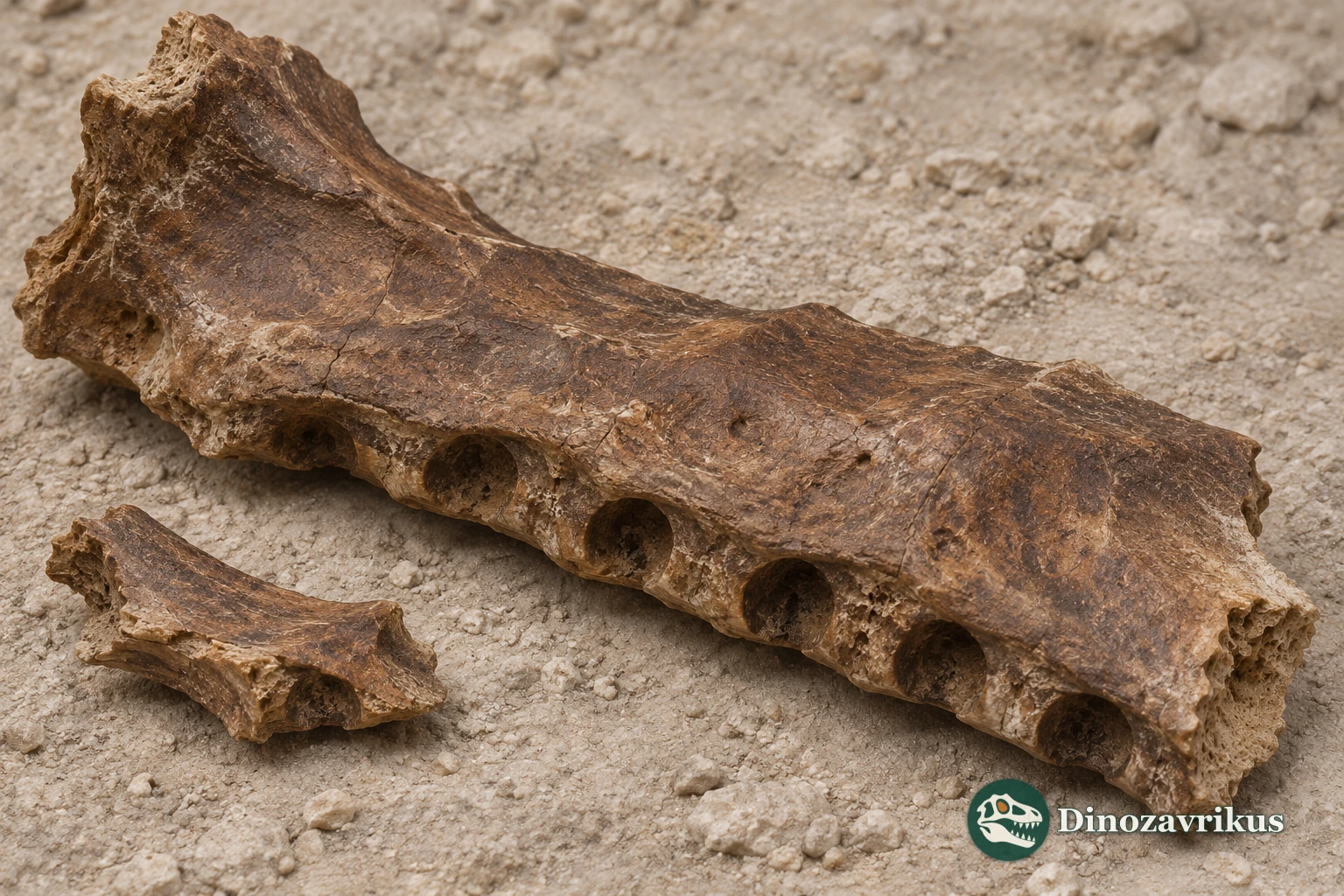
The type comprises a right maxilla and a fragment of the left. The bones preserve some of the tooth row but leave the full skull outline unknown.
Crocodilian studies often list the fossils as Eocene. An assignment to the lower fossiliferous level of the Lingcha succession would make them latest Palaeocene.
Maxillary anatomy supplies some characters for comparison. A more complete skull would be needed to place it confidently within the group.
Jaw bones from Hunan
Chung-Chien Young described Lianghusuchus in a paper on fossil crocodilians from China. The type, JGMMV 502, is listed as a right maxilla and a fragment of the left. A bone from the back of the skull, vertebrae and osteoderms have also been referred to it. They represent separate pieces of anatomy.
Why the age is debated
The fossils were long reported as Eocene. Magnetic polarity and carbon isotope records in the Hengyang Basin place the Palaeocene–Eocene boundary between lower and upper fossil-bearing levels in the Lingcha succession. One later account placed Lianghusuchus in the lower level, implying a latest Palaeocene age. Eocene remains the age cited in other published accounts.
A relationship suggested by the tooth row
Young originally assigned Lianghusuchus to the crocodile family. Christopher Brochu later noted that the maxillary tooth row was more suggestive of an alligatoroid. For another Palaeogene alligatoroid such as Diplocynodon, several regions of the skull and jaws can be compared. Preserved characters of Lianghusuchus give a narrower basis for identifying its closest relatives.
Frequently asked questions
Where was Lianghusuchus found?
The type material comes from the Hengyang Basin in Hunan Province, southern China.
Was it definitely Eocene?
Several descriptions list it as Eocene. If the find belongs to the lower fossil-bearing part of the Lingcha succession, it is latest Palaeocene instead.
What suggests a relationship with alligators?
The arrangement of the upper tooth row is consistent with alligatoroid affinities. The rest of the skull is too incomplete to establish its closest relatives.
How long was it?
No reliable length can be derived from the surviving material. The upper jaw is fragmentary and the vertebrae are known as separate bones.