

Liaodactylus primus lived in what is now northeastern China about 160 million years ago. A nearly complete skull around 133 mm long, articulated jaws and the first neck vertebrae preserve many slender teeth. Researchers interpret the teeth as an adaptation for straining small food from water. No meal was found with the fossil, and no wing bones can establish a wingspan.
Quick facts
| Scientific name | Liaodactylus primus, Zhou and colleagues, 2017 |
|---|---|
| Holotype | PMOL-AP00031, nearly complete skull and articulated jaws |
| Locality | Near Daxishan village, Jianchang County, Liaoning, China |
| Rock unit | Tiaojishan Formation, Upper Jurassic |
| Age | Oxfordian, about 160 million years ago |
| Skull | Approximately 133 mm long |
| Wingspan | Unknown; no wing bones assigned |
What can the fossils tell us?
PMOL-AP00031 preserves a nearly complete skull, articulated mandibles and the first neck vertebrae. The rest of the skeleton is unknown.
The close-set teeth underlie an interpretation of filtering small food from water; no actual prey is preserved.
The Daxishan locality belongs to the Late Jurassic Tiaojishan Formation, making this an early cranial record of ctenochasmatids.
The skull can be measured, but no Liaodactylus wing element is known. An exact wingspan or flight style is not established.
A skull from the Tiaojishan Formation
The specimen was collected roughly half a kilometre west of Daxishan village in western Liaoning. Chang-Fu Zhou and colleagues named it in 2017. The genus name refers to Liaoning; primus marks its early place in the history of its group. The holotype is held by the Palaeontological Museum of Liaoning as PMOL-AP00031.
The Oxfordian Tiaojishan rocks date to the Late Jurassic. In the original study Liaodactylus was the oldest identified ctenochasmatid, several million years older than European examples. Later Ctenochasma and Gnathosaurus provide useful comparisons without being proven descendants of the Chinese form.
Teeth and a feeding hypothesis
The long rostrum occupies nearly half the skull. Many slender teeth project outward, and the teeth decrease towards short pegs at the back of the row. Their position relative to the large skull opening helped diagnose the genus. The nearly complete skull, lower jaws and first neck vertebrae are the directly preserved evidence.
Fine, close-set teeth could have strained small organisms from water. That interpretation rests on form and comparison with other ctenochasmatids. No stomach contents or prey remains reveal whether small crustaceans, other plankton or several food types were eaten. The pose of a pterosaur searching at water's edge remains illustrative.
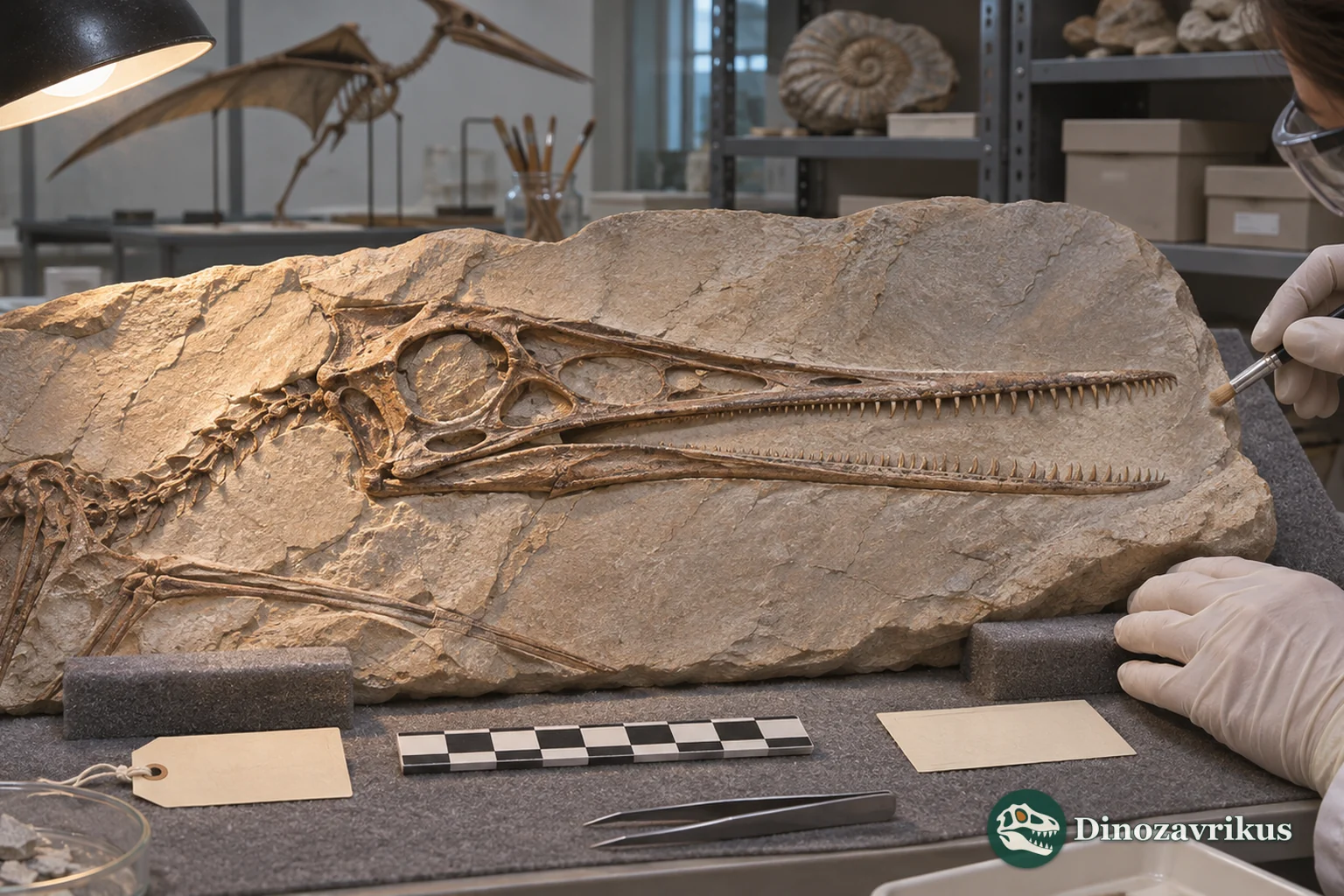
An early ctenochasmatid
A character analysis placed Liaodactylus within Ctenochasmatidae. This extended the documented history of that tooth-bearing group into the Oxfordian. A roughly contemporary Kryptodrakon is known from an incomplete skeleton without a skull and cannot establish the same feeding adaptation.
Neither body, wing membranes, feet nor tail are described for Liaodactylus. The skull length cannot directly determine its wingspan or mass. Colour, flight behaviour and soft tissues shown in artwork are reconstructions, not features of the holotype.
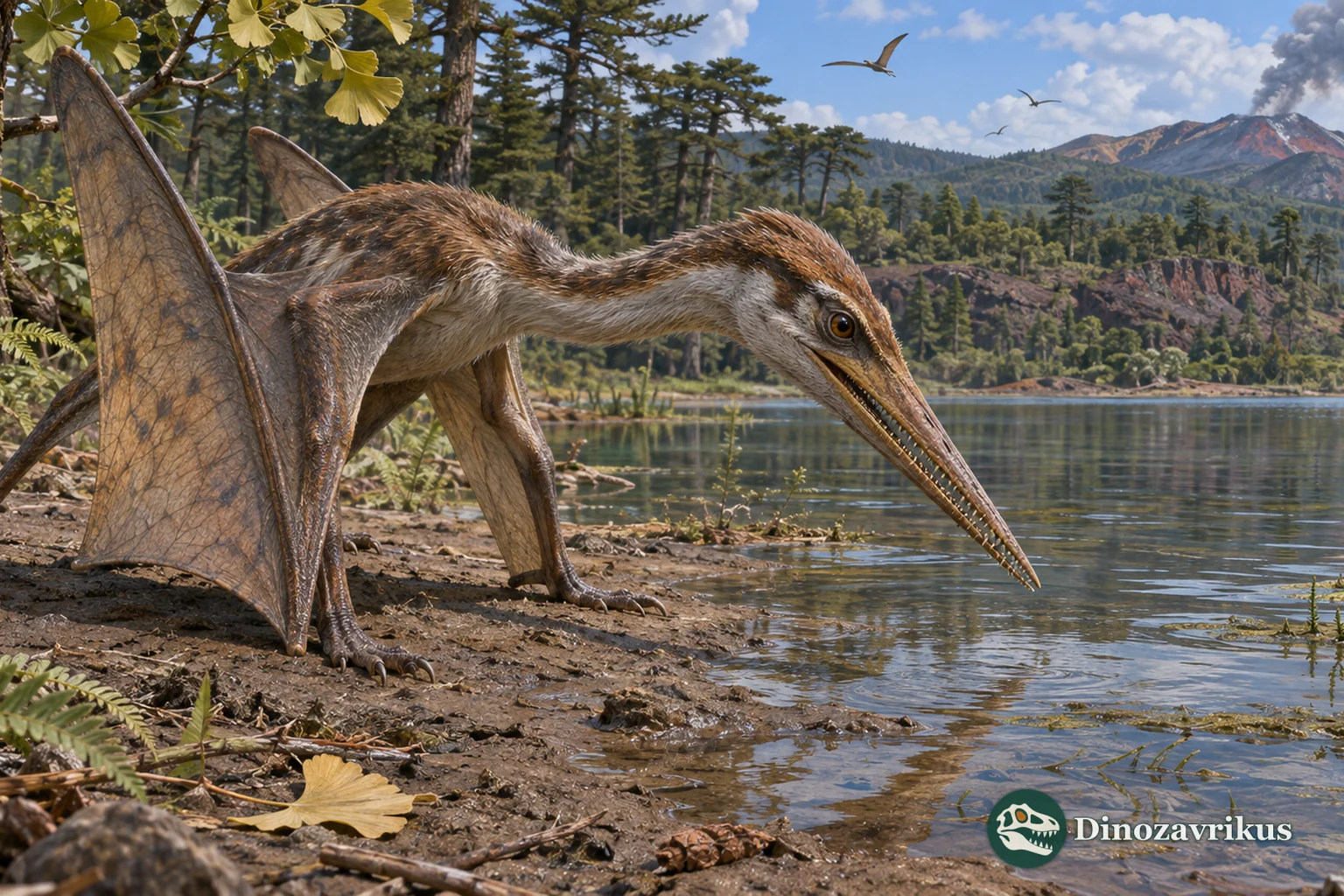
What a living scene adds
An illustration can combine the jaw evidence with general pterosaur anatomy and the Jurassic lake setting. The exact body outline and behaviour of this species remain untested by the known fossil.
Frequently asked questions
Where was Liaodactylus found?
Its holotype came from near Daxishan village in Liaoning, China, in the Tiaojishan Formation.
How old is the fossil?
The rocks are Oxfordian, Late Jurassic, approximately 160 million years old.
Did it definitely filter food?
Close-set teeth support filtering as an interpretation, but no direct meal or prey remains are known.
Is its wingspan known?
No. No wing bones are assigned to the species, so the wingspan cannot be measured directly.