

Listracanthus is a form genus based on distinctive fossil dermal denticles and spines assigned to cartilaginous fishes. Most specimens are isolated from the body, and the relationship between large spines and smaller denticles is still debated. The fossils document unusual skin structures; they do not yet provide a complete outline of the fish.
Quick facts
| Group | Cartilaginous fish; order-level placement uncertain |
|---|---|
| Type species | Listracanthus hystrix Newberry and Worthen, 1870 |
| Material | Isolated dermal denticles, spines and impressions |
| Key records | Illinois, the Donets Basin, European coal measures and Hunan, China |
| Age | Carboniferous and Late Permian records; separate reports extend into the Early Triassic |
| Body length | Unknown; isolated spine dimensions cannot be converted into total length |
| Ecology | Marine deposits; diet and locomotion are not established |
What can the fossils tell us?
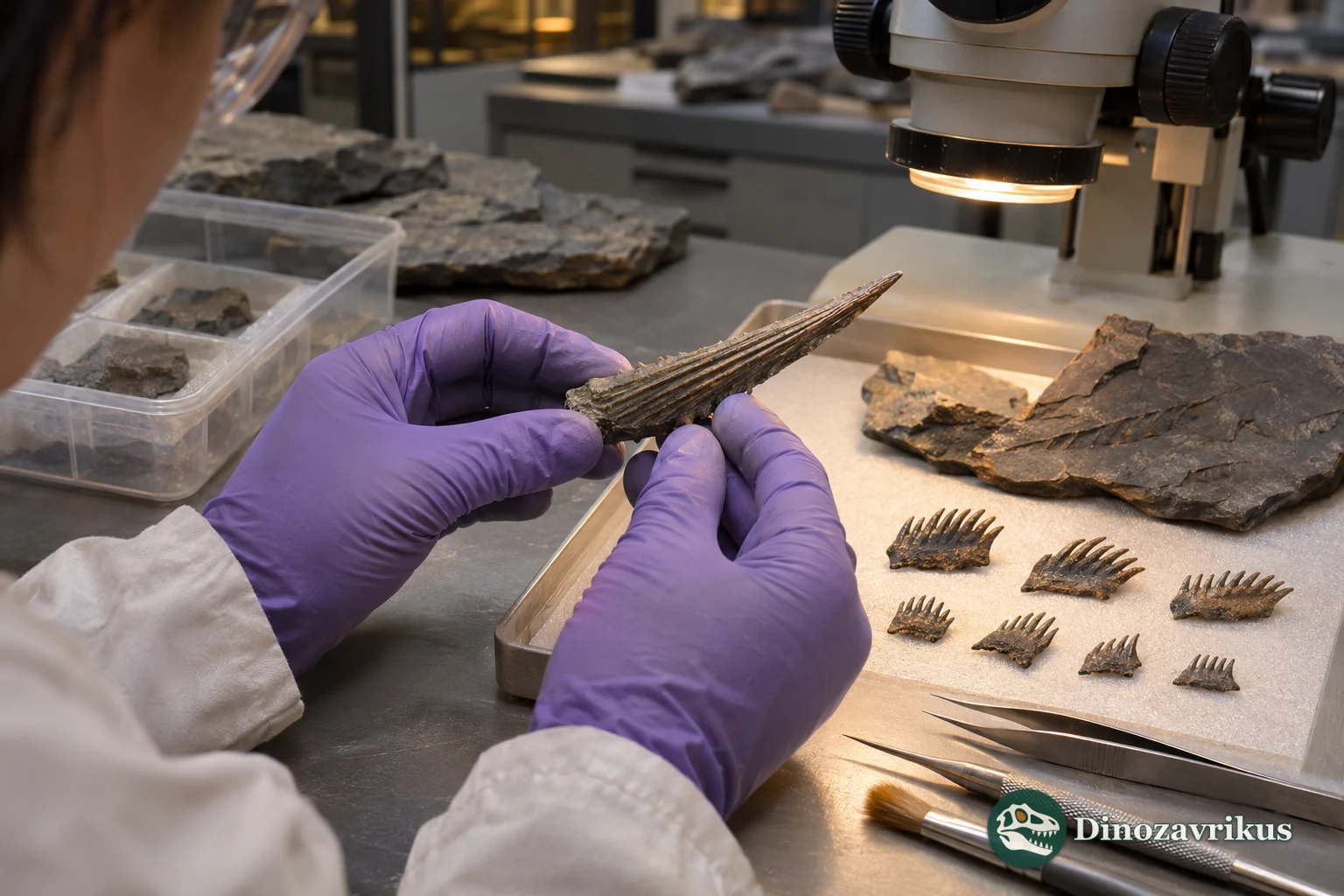
Newberry and Worthen described flattened, gently curved elements with longitudinal ridges and fine teeth along the margins. Their shape is direct evidence about the fossil surface structures, not their position on a complete body.
A Mospyne Formation sample includes an incomplete denticle about 6 mm high and a fragmentary spine estimated at 50 mm. The larger element may be an unusual denticle or may have occupied another body region.
The holotype IVPP V34643 and two paratypes support Listracanthus shaoyangensis from the late Wuchiapingian. Micro-XRF maps preservation chemistry; it does not reveal the fish's living colour.
A name for isolated structures
John Strong Newberry and Amos Henry Worthen established Listracanthus in 1870 for small, flattened and strongly striated spines from the Coal Measures of Illinois. The type species is L. hystrix, whose type locality is in Vermilion County, Illinois. The nineteenth-century description does not identify an individual finder, so the discovery cannot be assigned to a named collector.
Later work treats these fossils as dermal denticles, tooth-like structures in the skin of a cartilaginous fish. Because the genus is based on isolated parts, it is a form or organ taxon: its name identifies a recurring fossil morphology rather than a complete, articulated animal. The contrast with better-known remains of Hybodus shows how strongly the available fossil material can shape a reconstruction.
A small denticle and a 50-millimetre spine
Udovychenko and Dernov reported the first Donets Basin material from the Mospyne Formation of the Luhansk region. The sandstone bed lies about 55 metres below the G¹² limestone horizon and is dated to the late Bashkirian, Early Pennsylvanian. The sample contains one poorly preserved denticle and a fragment of a larger spine.
The denticle, IGSU-10/1, is incompletely about 6 mm high and 1.5 mm wide at the base; its basal body and tip are missing. Fine parallel ridges cover its flattened sides, and a fringe of narrow pointed denticles, up to 0.5 mm long, runs along the posterior edge. Specimen IGSU-10/2 is a weakly curved spine estimated at 50 mm long and 9 mm across the base. It has longitudinal ridges but lacks the small posterior needles seen on the smaller element.
The two forms occur at the same site, but that association does not prove how they were arranged in life. The large spine could be an aberrant denticle, or the two morphologies could come from different regions of the body. The authors leave both interpretations open because the fossils are not preserved with skin or skeleton.
A late Permian species from southern China
A 2026 study named Listracanthus shaoyangensis from the Shaoyang Fauna in Hunan Province. Biostratigraphic evidence places the Longtan Formation assemblage in the late Wuchiapingian, roughly five million years before the Permian–Triassic mass extinction. The holotype, IVPP V34643, and two paratypes are preserved as impressions rather than three-dimensional skeletons.
The species diagnosis relies especially on differences in the anterior fulcra, small projecting structures on the denticles. The team also used micro-X-ray fluorescence imaging to map elements across the fossil surfaces. Differences between specimen colours reflected distinct preservation modes. The chemical maps therefore help explain fossilization; they are not a record of the animal's original pigmentation.
Classification and a scattered time range
The group's position within cartilaginous fishes remains unsettled. Some researchers have discussed affinities with elasmobranchs, while others have considered holocephalan relationships. The 2026 paper classifies its material as Chondrichthyes incertae sedis, meaning that it is accepted as a cartilaginous fish but its more precise placement is unresolved.
A 2014 revision transferred the former species L. wardi and L. spinatus to the new genus Acanthorhachis, which has additional small spines on the lateral ridges. That study treated most previously named Palaeozoic species as junior synonyms of L. hystrix, while retaining L. pectenatus. Later papers have used somewhat different species lists, so old collection labels do not all represent settled diversity.
Published records include Carboniferous sites in North America and Europe, a late Permian species from China, and Early Triassic material from Canada. These separate occurrences do not mean that one species lived continuously through the whole interval. As with Acanthodes, taxonomic conclusions depend on which parts of the animal happen to fossilize, but the two fishes are not thereby shown to be close relatives.
What the fossils do not show
The known specimens document grooves, ridges, basal forms and marginal combs on skin elements. They do not establish fin placement, head proportions, tail shape or overall length. A five-centimetre spine cannot be used as a body-size estimate without a preserved anatomical position or a validated comparison.
Protective, stabilizing or other functions have been proposed for such structures, but none is demonstrated for Listracanthus. The available material does not establish particular prey, swimming style, growth or reproduction. The cover depicts an artistic view of a fossil element rather than an imagined complete fish.
Frequently asked questions
Has a complete Listracanthus skeleton been found?
No complete skeleton is known. The genus is represented chiefly by isolated dermal denticles, spines and impressions.
When did Listracanthus live?
Published records include Carboniferous and Late Permian material, as well as separate Early Triassic reports. They do not document a single species continuously across that entire interval.
Why are some large spines assigned to the same genus as small denticles?
They share features such as longitudinal ridges, but their relationship is uncertain. A large spine could be an unusual denticle or an element from another body region.
What did the fish look like?
Its body outline, total length, fins and colour are unknown. The fossils identify skin structures, not a complete animal.