

Longipteryx was an enantiornithine bird from Early Cretaceous Liaoning, China. Its jaws carried large, curved teeth concentrated near the tips. Two skeletons preserve swallowed seeds, direct evidence that the diet included plant material. Other fossils preserve traces of the feathers lining its wings.
Quick facts
| Group | Enantiornithines (Enantiornithes) |
|---|---|
| Age | Early Cretaceous (Aptian) |
| Region | East Asia (Liaoning Province, China) |
| Diet | Ate fruit-like structures from gymnosperms |
| Type species | Longipteryx chaoyangensis |
| Holotype | IVPP V12325, an incomplete articulated skeleton |
| Formation | Jiufotang Formation |
What can the fossils tell us?
Fossils preserve curved teeth at the front of the elongated jaws. Their form inspired different proposals about feeding.
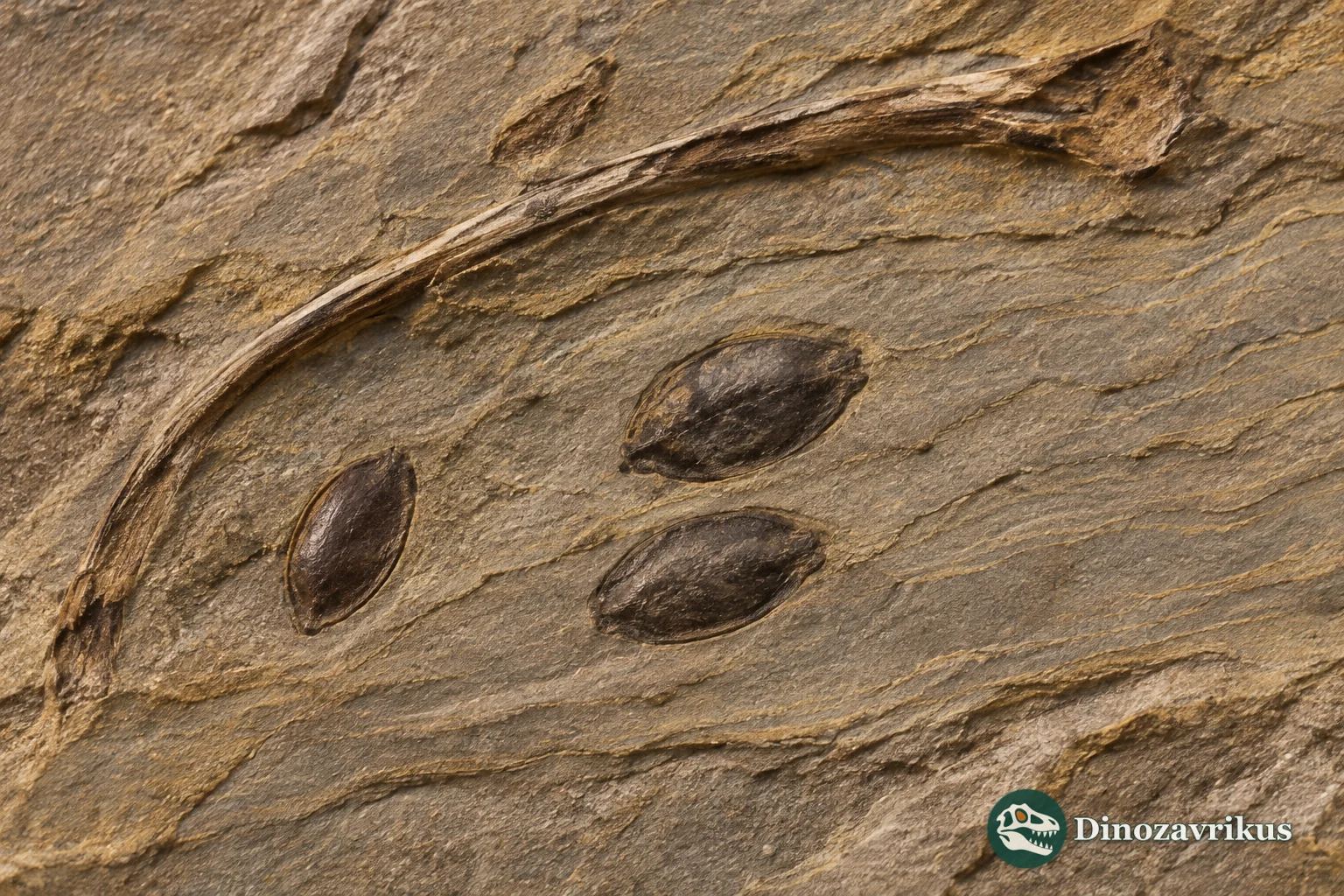
Two specimens preserve intact gymnosperm seeds in their abdominal cavities. The finds document part of the diet. They leave the frequency of those meals open.
Specimens from Jianchang preserve traces of flight feathers. Their arrangement helps constrain the shape of the wing.
A distinctive bird from the Jiufotang Formation
Fucheng Zhang, Zhonghe Zhou, Lianhai Hou and Gang Gu described Longipteryx chaoyangensis in 2001. Its type specimen, IVPP V12325, comes from western Liaoning. The bones preserve the proportions of the head and limbs, and its distinctive jaws help identify additional specimens.
Longipteryx had an elongated snout and relatively large, recurved teeth at the front. Its teeth had thick enamel. The arrangement prompted comparisons with fish-eating birds and proposals that it fed on insects with hard body coverings. Those ideas came from the shape of the bird's feeding apparatus.
What swallowed seeds reveal
Two fossils preserve intact gymnosperm seeds in their abdominal cavities. The seeds lack signs of crushing, and the specimens lack gastroliths associated with the seeds. In 2024, researchers argued that the birds swallowed the seeds with soft, fruit-like structures produced by gymnosperms.
These meals demonstrate that the diet included plant material, while leaving open what else Longipteryx ate. Other birds from the same formation have yielded different meals. Specimens referred to Yanornis preserve swallowed fish.
New evidence from feathers
In 2026, researchers described plumage in specimens STM 8-28 and STM 8-132 from Jianchang County. Traces of the flight feathers survive alongside other plumage. The arrangement of the arm bones and the lengths of the feathers informed a reconstruction of a wing between the broad and narrow shapes proposed for other early birds.
The reconstructed shape is compatible with several flight styles. The fossils give direct evidence of feathers and wing anatomy, while the bird's movements are inferred from comparison.
Frequently asked questions
Where did Longipteryx live?
Its fossils come from the Early Cretaceous Jiufotang Formation of northeastern China.
Where were its teeth?
The large, recurved teeth were concentrated toward the front of the elongated jaws.
What seeds were found in the fossils?
Two specimens preserve intact gymnosperm seeds. Researchers interpreted them as evidence that the bird swallowed fruit-like structures.
Are its flight feathers preserved?
Yes. Two specimens from Jianchang preserve traces of the flight feathers.